
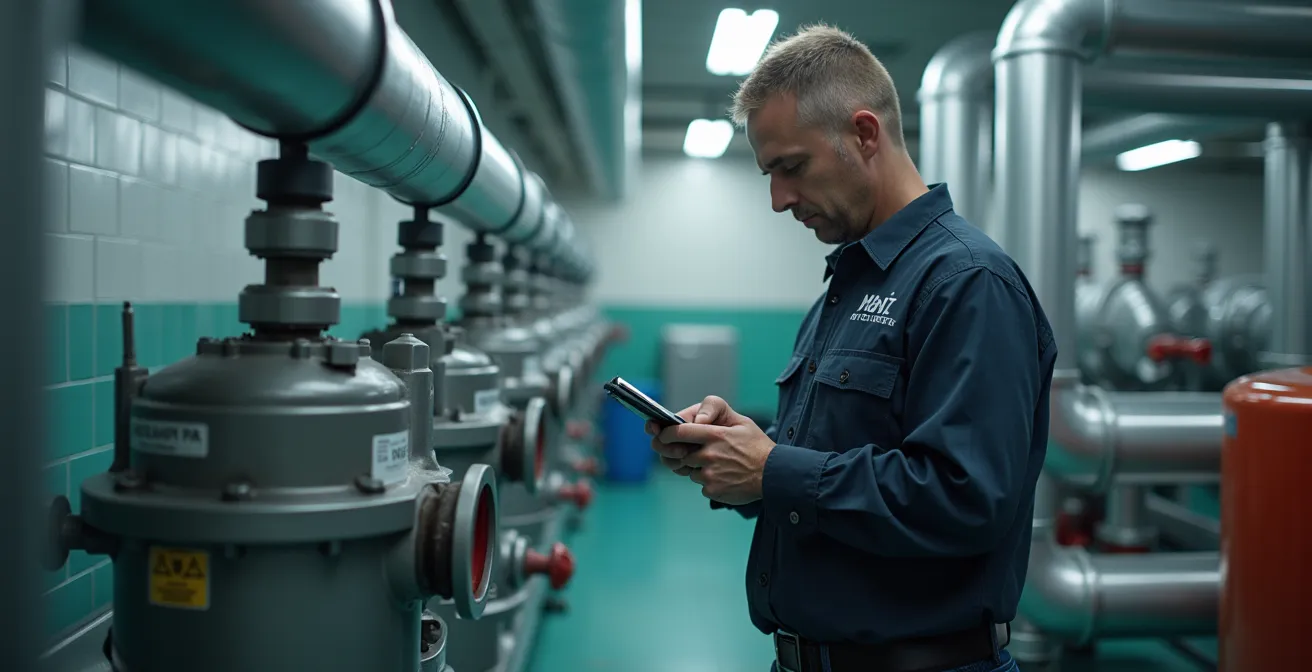
The annual backflow preventer test is a mandatory legal assessment of your commercial property’s financial liability, not just a plumbing inspection.
- Under Quebec law, failure to certify your device annually exposes your business to daily fines, insurance cancellation, and legal action in the event of a contamination incident.
- The type of device required (DCVA vs. RPZ) is determined by your tenants’ activities, which dictates the level of risk your building poses to the public water supply.
Recommendation: Treat the compliance notice as a critical risk management task. Immediately engage a CMMTQ-certified tester to assess your device and ensure your legal and financial protection.
Receiving an official notice from your municipality regarding the mandatory annual testing of your building’s backflow prevention device can be unsettling. For many commercial property or restaurant owners in Quebec, this document raises immediate questions about cost, operational disruption, and the consequences of non-compliance. The standard reaction is to view this as another administrative burden, a simple item on a long list of facility maintenance tasks. This perspective, however, overlooks the fundamental purpose of the regulation.
The requirement for annual testing, enforced by the Régie du bâtiment du Québec (RBQ) and local authorities, is not merely about ticking a box. It is a critical component of public health infrastructure, designed to prevent a catastrophic event: the contamination of the municipal potable water supply by your building’s internal systems. As a certified backflow device tester, my role is to ensure this protective barrier is functional. But more importantly, from a property owner’s perspective, this annual certification is your primary defense against significant legal and financial liability. It is documented proof that you have exercised due diligence in protecting the public.
This article will not simply repeat the regulations. Instead, it will deconstruct the regulatory and financial logic behind them. We will explore why different buildings require different devices, the true cost of a failed test or a missed deadline, and how to manage this compliance requirement not as an expense, but as an integral part of your property’s risk management strategy. By understanding the “why,” you can make informed, cost-effective decisions that protect your investment, your tenants, and the community.
To navigate these critical requirements, this guide breaks down the essential aspects of backflow preventer compliance in Quebec. The following sections detail everything a commercial property owner needs to know, from device selection to the severe costs of non-compliance.
Summary: A Commercial Owner’s Guide to Backflow Preventer Compliance in Quebec
- Dispositif à double clapet ou à zone de pression réduite : lequel votre bâtiment exige-t-il ?
- Que signifie un échec au test de pression de votre dispositif anti-refoulement ?
- L’amende pour défaut de certification annuelle : combien cela coûte-t-il vraiment ?
- Kit de réparation vs remplacement complet : quelle option est la plus rentable après 10 ans ?
- Pourquoi votre système de gicleurs a-t-il besoin de sa propre protection anti-refoulement ?
- Clapet normally ouvert ou fermé : lequel choisir pour votre résidence principale ?
- Numéro d’enregistrement canadien (NEC) : pourquoi est-ce illégal d’installer une cuve sans ce numéro ?
- Test des soupapes de sûreté : comment éviter l’explosion de votre chauffe-eau ?
Dispositif à double clapet ou à zone de pression réduite : lequel votre bâtiment exige-t-il ?
The first step in compliance is understanding the specific hardware your commercial property is required to have. The Quebec Construction Code, Chapter III, does not treat all buildings equally. The selection between a Double Check Valve Assembly (DCVA) and a Reduced Pressure Zone (RPZ) device is dictated by your building’s designated hazard level. This level is not arbitrary; it is a direct assessment of the potential for your operations to contaminate the public water supply.
A DCVA is typically sufficient for low-hazard facilities, such as a standard office building with only washrooms and kitchenettes. It provides a basic level of protection against back-pressure and back-siphonage. However, if your property houses tenants involved in activities deemed high-hazard, the requirement escalates to an RPZ. This superior device creates a physical air gap and a relief valve to discharge contaminated water, offering a fail-safe level of protection. The determination of hazard level is therefore the most critical factor in your compliance.
The following table, based on RBQ guidelines, illustrates which activities mandate the installation of a more robust RPZ device. If your building contains any of these facilities, a DCVA is non-compliant and will result in a failed inspection, regardless of its mechanical condition. A thorough assessment of tenant activities is a non-negotiable first step for any property manager.
| Building Type | Required Device | Hazard Level | Testing Frequency |
|---|---|---|---|
| Standard Office Building | DCVA (Double Check Valve Assembly) | Low Hazard | Annual |
| Building with Dental Clinic | RPZ (Reduced Pressure Zone) | High Hazard | Annual |
| Laboratory Facility | RPZ | High Hazard | Annual |
| Car Wash | RPZ | High Hazard | Annual |
| Restaurant | RPZ | High Hazard | Annual |
Ultimately, the device installed in your building is not a choice but a mandate based on risk. An incorrect device is an automatic compliance failure, making an upfront hazard assessment essential to avoid unnecessary repairs and potential fines.
Que signifie un échec au test de pression de votre dispositif anti-refoulement ?
A failed backflow preventer test is not a minor administrative issue; it is a critical safety alert indicating that the barrier protecting the municipal water supply is compromised. When a CMMTQ-certified tester conducts the annual inspection, they use specialized gauge equipment to verify that the device’s internal check valves and, in the case of an RPZ, the relief valve, are functioning to precise specifications. An email from your tester with “FAIL” in the subject line means your property is now an active risk.
In major Quebec municipalities like Montreal and Quebec City, the protocol following a failed test is immediate and strict. The certified tester is legally obligated to report the failure to the city’s water department. This triggers a formal compliance order, giving the building owner a very short window—typically from 48 hours to 10 days—to perform the necessary repairs and have the device re-certified. For high-hazard facilities, the municipality may issue a “do not use water” order, causing severe operational disruptions for tenants until the issue is resolved.

Failures are often caused by factors specific to Quebec’s environment. The primary culprits are often debris from municipal water main breaks, which can lodge in the valves and prevent a proper seal, or frost damage from inadequately winterized devices. A failed test report will specify which component malfunctioned, allowing a qualified plumber to diagnose whether a simple cleaning, a repair kit, or a full replacement is necessary. Ignoring this report is not an option; it is the starting point for immediate, mandated action.
A failed test result is effectively a ticking clock. It signifies that your legal protection is void until the device is proven to be fully operational, placing the full weight of liability on you, the property owner, for any incident that may occur.
L’amende pour défaut de certification annuelle : combien cela coûte-t-il vraiment ?
The direct financial penalty for failing to submit a passing annual test report is the most visible consequence, but it is often just the tip of the iceberg. Municipal by-laws across Quebec are designed to make non-compliance a financially untenable position for a commercial property owner. The fines are not a one-time slap on the wrist; they are structured to accumulate rapidly.
Depending on the municipality, these penalties can range from $250 to $10,000 per day of non-compliance. This means that a delay of even a few weeks can result in thousands of dollars in direct fines. However, the true cost of willful neglect is far greater, as it encompasses liability for any damages caused by a backflow event. This is where the financial risk escalates from manageable fines to potentially catastrophic losses.
Hypothetical Case Study: The True Cost of a Missed Test in Gatineau
Consider a commercial building in Gatineau that houses a restaurant. The owner ignores the annual backflow testing notice. A water main break in the street causes a momentary drop in pressure (a back-siphonage event), pulling cleaning chemicals and contaminated water from the restaurant’s floor drains back into the building’s plumbing and, subsequently, the local water supply. The building owner faces not just the maximum municipal fines, but also a lawsuit from the restaurant for business interruption and reputational damage, and a civil suit from the city for the cost of flushing the local water lines. Furthermore, their property insurer, upon discovering the willful non-compliance with a known safety regulation, denies the claim and cancels the policy. The total cost exceeds $250,000, all of which could have been prevented by a $300 annual test.
This scenario illustrates a critical point: the annual test fee is not an expense. It is a very low-cost insurance premium against immense liability. The fines are merely the first layer of financial consequence in a chain of events that can threaten the solvency of your business.
Therefore, viewing the annual test through the lens of risk management reveals that the cost of compliance is negligible compared to the well-defined and severe cost of failure.
Kit de réparation vs remplacement complet : quelle option est la plus rentable après 10 ans ?
When a backflow preventer fails its annual test, the building owner is faced with a critical asset management decision: should the device be repaired, or should it be replaced entirely? The immediate cost of a repair kit is always lower than a full replacement. However, a decision based solely on the initial outlay is often the most expensive one in the long run. A Total Cost of Ownership (TCO) analysis is the correct framework for this decision.
A device that is over 10 years old and has begun to fail is likely to continue requiring service. The internal rubber components and springs have a finite lifespan. While one repair might solve the immediate problem, another failure a year or two later is a strong possibility. These recurring repair costs, coupled with the potential for business downtime if specialized parts must be ordered from Quebec suppliers like Wolseley or Noble, can quickly exceed the cost of a new unit.
The following analysis compares the 15-year TCO of repairing an aging device versus installing a new one. It accounts for initial cost, annual testing, and projected repair expenditures over the period. This data demonstrates that replacing an older, unreliable unit can be the more financially prudent choice over the long term.
| Option | Initial Cost | Annual Testing | Repairs (10 years) | 15-Year Total |
|---|---|---|---|---|
| Keep Old Unit + Repairs | $0 | $300/year | $2,500 | $7,000 |
| New RPZ Installation | $1,500 | $300/year | $500 | $6,500 |
| New Lead-Free RPZ | $2,000 | $300/year | $200 | $6,700 |
Furthermore, installing a new, modern device, particularly a lead-free model, can be a strategic move. It ensures parts availability for future repairs and pre-emptively aligns the property with evolving standards like CSA B64.10 and potential future Quebec Construction Code requirements, protecting the asset’s value and compliance status for the next decade or more.
Pourquoi votre système de gicleurs a-t-il besoin de sa propre protection anti-refoulement ?
A common and dangerous oversight in commercial buildings is the assumption that the main backflow preventer protects all systems. This is incorrect. A building’s fire sprinkler system must have its own dedicated backflow prevention device, typically a DCVA, installed on its supply line. The reason for this is the hazardous nature of the water sitting inside the sprinkler pipes.
This water is not fresh. It is stagnant, often for years, creating an anaerobic environment perfect for microbial growth. As the Quebec Construction Code highlights, this is not a theoretical risk. In an official bulletin on plumbing requirements, the code is explicit about the danger.
Fire sprinkler systems contain stagnant, anaerobic water with microbiological induced corrosion (MIC) and antifreeze chemicals like glycol, creating a highly toxic mixture that must be isolated from potable water
– Quebec Construction Code, Chapter III, Plumbing Requirements for Fire Protection Systems
A pressure drop in the municipal main could easily siphon this toxic mixture back into the building’s potable water lines, creating a severe health hazard. Beyond the health risk, there is a significant financial one. Quebec commercial property insurers confirm that in the event of a sprinkler discharge, any subsequent water damage claims can be denied if the investigation reveals a non-compliant or un-tested backflow connection on the fire system. This transforms a covered peril into a massive, uninsured loss.

The annual test of the fire system’s backflow preventer is therefore just as crucial as the test on the main domestic supply. It is a separate legal requirement and a prerequisite for maintaining both public safety and your property’s insurance coverage.
This requirement underscores the principle of “zoning” protection. Each potential source of contamination, especially one as hazardous as a fire system, must be isolated at its source to ensure the absolute integrity of the building’s drinking water.
Clapet normally ouvert ou fermé : lequel choisir pour votre résidence principale ?
To fully appreciate the stringency of commercial backflow prevention regulations, it is instructive to contrast them with the requirements for residential properties. Homeowners in Quebec are primarily concerned with preventing sewer backup, not protecting the municipal water supply. The device mandated for this purpose is fundamentally different in design and function.
For residential buildings, the Quebec Construction Code and municipal regulations, such as those in Montreal, typically mandate the installation of a normally-closed backwater valve on the main drain. As confirmed by Montreal municipal drainage regulations, this is a passive device. It consists of a simple flap that is pushed open by the normal outflow of wastewater from the home. If pressure from the municipal sewer reverses during a flood event, the back-pressure forces the flap shut, preventing sewage from entering the basement.
The distinction between residential and commercial systems is critical and can be summarized as follows:
- Purpose: Residential valves prevent sewer backup into one home. Commercial devices prevent contamination of the entire public water supply.
- Operation: Residential valves are passive. Commercial devices (DCVAs and RPZs) are active, mechanical assemblies with springs and precisely calibrated valves.
- Testing: Residential valves do not require annual professional testing. Commercial devices require mandatory annual certification by a CMMTQ-certified professional.
- Reporting: There is no reporting for residential valves. Commercial test reports must be filed with the municipality and, in some cases, the RBQ.
This comparison makes it clear why the commercial regulations are so rigorous. A commercial building is not just a structure; it is an active node connected to a public utility, and with that connection comes a much higher standard of care and legal responsibility.
Numéro d’enregistrement canadien (NEC) : pourquoi est-ce illégal d’installer une cuve sans ce numéro ?
A building owner’s responsibility for safety and compliance extends beyond the backflow preventer at the water main. It encompasses all pressurized systems within the facility. A frequent point of failure is the installation of unapproved equipment, such as boilers or expansion tanks, that lack a Canadian Registration Number (CRN), or Numéro d’enregistrement canadien (NEC).
The CRN is a number issued by each province or territory to certify that a boiler, pressure vessel, or fitting has been designed and constructed to a specific, approved standard. Installing a vessel without a valid CRN for Quebec is illegal. It signifies the equipment has not been vetted for safety, making it a significant liability. The Régie du bâtiment du Québec draws a direct and powerful analogy:
The CRN is to pressure vessels what the CSA B64.10 certification is to backflow preventers. Both are non-negotiable legal proofs of safety required for installation in Quebec
– Régie du bâtiment du Québec, Mechanical Systems Safety Requirements
The true danger emerges when this violation is combined with a lapse in backflow prevention compliance. This creates what safety professionals call a dual-point failure risk.
Case Study: The Dual-Point Failure Risk
p>
An unapproved boiler (lacking a CRN) is connected to a building’s water supply to be filled. The boiler system contains treatment chemicals. If the building’s backflow preventer is also faulty or has not been tested, a drop in city water pressure can siphon those chemicals directly from the unapproved, potentially unsafe boiler into the drinking water. This scenario represents a catastrophic failure, violating multiple Quebec safety regulations simultaneously and creating massive liability for the owner, potentially leading to criminal charges if a public contamination event occurs.
Therefore, backflow preventer compliance cannot be viewed in isolation. It is one critical part of a larger ecosystem of mechanical safety, where every component, from the water heater to the main backflow device, must be certified, registered, and properly maintained to ensure safety and mitigate liability.
Key Takeaways
- Annual backflow testing is a legal mandate in Quebec for all commercial properties, with device type (DCVA vs. RPZ) determined by your building’s specific hazard level.
- Non-compliance leads to severe daily fines, potential insurance claim denials, and significant legal liability in case of a contamination event.
- A holistic approach to mechanical safety, including testing of fire sprinkler backflow devices and water heater relief valves, is the most cost-effective compliance strategy.
Test des soupapes de sûreté : comment éviter l’explosion de votre chauffe-eau ?
Your responsibility as a commercial building owner is to manage a complete system of mechanical safety, of which backflow prevention is just one part. Another equally critical—and often overlooked—component is the Temperature and Pressure (T&P) relief valve on your commercial water heater. A faulty T&P valve can lead to a catastrophic boiler explosion, posing a direct threat to life and property. Just like your backflow preventer, this safety device requires regular testing to ensure it functions correctly.
p>
Viewing these requirements as separate, individual tasks is inefficient and costly. The most effective and economical approach is to bundle these mandatory inspections. A certified technician qualified to test backflow preventers is often also equipped to test T&P valves and inspect other mechanical systems. Consolidating these services into a single annual service call significantly reduces costs compared to scheduling separate appointments.
Indeed, Quebec mechanical contractors report significant savings for property owners who bundle their compliance testing. The cost can be as low as $135 per device for bundled service, compared to over $300 for individual, separate calls. This strategy transforms compliance from a series of reactive, costly events into a single, proactive, and budgeted maintenance plan.
Action Plan: Your Annual Mechanical Safety Compliance Checklist
- Schedule annual certification for your main domestic backflow preventer to prevent public water contamination.
- Schedule simultaneous testing of the Temperature & Pressure (T&P) relief valves on all commercial water heaters to prevent explosions.
- Verify the Canadian Registration Number (CRN) is present and valid for all boilers and pressure vessels on the premises.
- Schedule the annual test for the dedicated backflow preventer on the fire sprinkler system to maintain insurance coverage.
- Bundle all required tests into a single service call with a qualified mechanical contractor to maximize cost savings.
- Maintain a documented log of all tests and certifications to provide to municipal inspectors and your insurance provider upon request.
To ensure the complete safety, compliance, and financial protection of your commercial property, the logical next step is to schedule a comprehensive, bundled inspection. Contact a CMMTQ-certified professional today to assess your backflow preventers, T&P valves, and other critical systems in a single, efficient visit.