
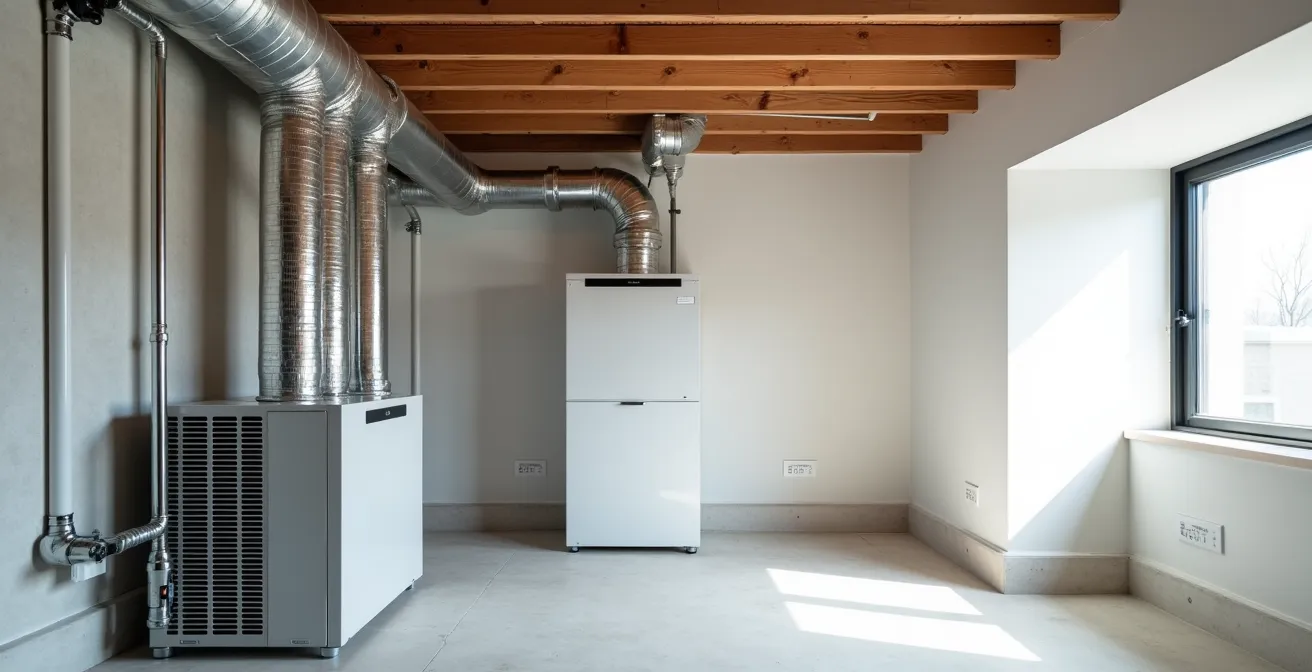
That persistent condensation on your new home’s windows isn’t a sign of faulty windows; it’s a symptom that your airtight home can’t breathe. Under Quebec’s Novoclimat standards, an HRV isn’t just an appliance—it’s the mandatory respiratory system of your house. It’s essential for expelling humidity and pollutants while supplying fresh, healthy air, directly preventing issues like mould growth, poor indoor air quality, and the dangerous buildup of radon.
If you’ve noticed persistent condensation on the windows of your new or recently renovated Quebec home, your first instinct might be to blame the windows. However, in a modern, high-performance house built to standards like Novoclimat, the reality is far more complex. These homes are designed to be incredibly airtight to maximize energy efficiency. While this is excellent for your heating bills, it creates an unintended consequence: the house can’t breathe on its own. Without a dedicated system for air exchange, your home effectively becomes a sealed box, trapping moisture, allergens, and chemical pollutants inside.
This is where the concept of the building as a living system becomes critical. Think of your airtight house not as an inanimate structure, but as a body that needs to respire. The Heat Recovery Ventilator (HRV) is not just another piece of mechanical equipment; it is the active, mechanical lungs of your home. Its job is to perform a balanced exchange: “exhaling” stale, moist, and polluted indoor air while “inhaling” an equal amount of fresh, clean outdoor air. This process is fundamental to maintaining the health of both the structure and its occupants.
This guide moves beyond the basic mechanics to explain why an HRV is the cornerstone of a healthy Novoclimat home. We will explore how it manages Quebec’s unique climate challenges, why its maintenance is non-negotiable for your family’s respiratory health, and how it plays a crucial role in preventing invisible dangers like negative air pressure and radon infiltration. Understanding your HRV is understanding the key to a healthy, comfortable, and truly efficient modern home.
To help you master this essential component of your home, this article breaks down the most critical aspects of owning and maintaining an HRV in Quebec. Follow this guide to ensure your home’s respiratory system is functioning at its best.
Summary: Understanding the HRV System in Your Novoclimat Home
- HRV or ERV: which to choose for the dry winter of Quebec?
- Air exchanger cleaning: why ignoring it clogs your lungs and your system?
- How to know if your house is in negative pressure and sucking in radon?
- Noisy ventilation ducts: solutions for peaceful sleep
- Bathroom timer: is it enough to evacuate the humidity from a 20-minute shower?
- Air leaks: why caulking your windows pays more than changing your furnace?
- Forced-air heating: how to avoid your furnace becoming a dust distributor?
- How to Conduct a Home Energy Audit to Find Where You Lose Heat?
HRV or ERV: which to choose for the dry winter of Quebec?
The choice between a Heat Recovery Ventilator (HRV) and an Energy Recovery Ventilator (ERV) is a critical decision for Quebec homeowners, directly impacting both comfort and health. While both devices exchange stale indoor air for fresh outdoor air, their core difference lies in how they handle moisture. An HRV primarily transfers heat, while an ERV transfers both heat and humidity. In the context of Quebec’s cold, dry winters, the choice becomes clear. An HRV is generally the superior option because it helps expel excess indoor humidity generated by cooking, showering, and breathing, preventing the window condensation that signals a moisture problem. It does not attempt to retain this moisture, which is exactly what’s needed in an airtight home prone to high humidity in winter.
Maintaining a balanced indoor humidity level is not just about comfort or preventing mould; it’s a matter of respiratory health. Overly dry air can irritate airways, while overly moist air promotes mould and dust mites. Critically, humidity also affects virus transmission. Scientific research shows that virus infectivity drops to 14.6-22.2% when relative humidity is above 43%, compared to being as high as 77% in drier air. An HRV, by design, helps manage and expel the high humidity that can accumulate in winter, which can then be balanced by a separate humidifier set to an ideal, healthy level of around 40%.
Under the Novoclimat program, the focus is on creating a complete, high-performance system. This means that not only must a certified HRV be used, but its installation must be carried out by a Novoclimat certified ventilation specialist. This ensures the unit is correctly sized and balanced for the home’s specific airtightness, guaranteeing it performs its respiratory function correctly without creating other issues. This professional oversight is mandatory and a key part of the Novoclimat certification.
Air exchanger cleaning: why ignoring it clogs your lungs and your system?
Thinking of your HRV as your home’s lungs makes its maintenance intuitive. Just as human lungs can become clogged by pollutants, an HRV’s performance and health benefits are completely nullified if its filters and core are not regularly cleaned. A dirty HRV doesn’t just stop working efficiently; it can become a source of contamination itself, recirculating the very dust, pollen, and particulates it was designed to remove. The accumulation of debris restricts airflow, forcing the motors to work harder, increasing energy consumption, and ultimately leading to premature system failure. More alarmingly, a clogged, damp filter becomes a breeding ground for mould and bacteria, which are then distributed throughout your home’s air supply.
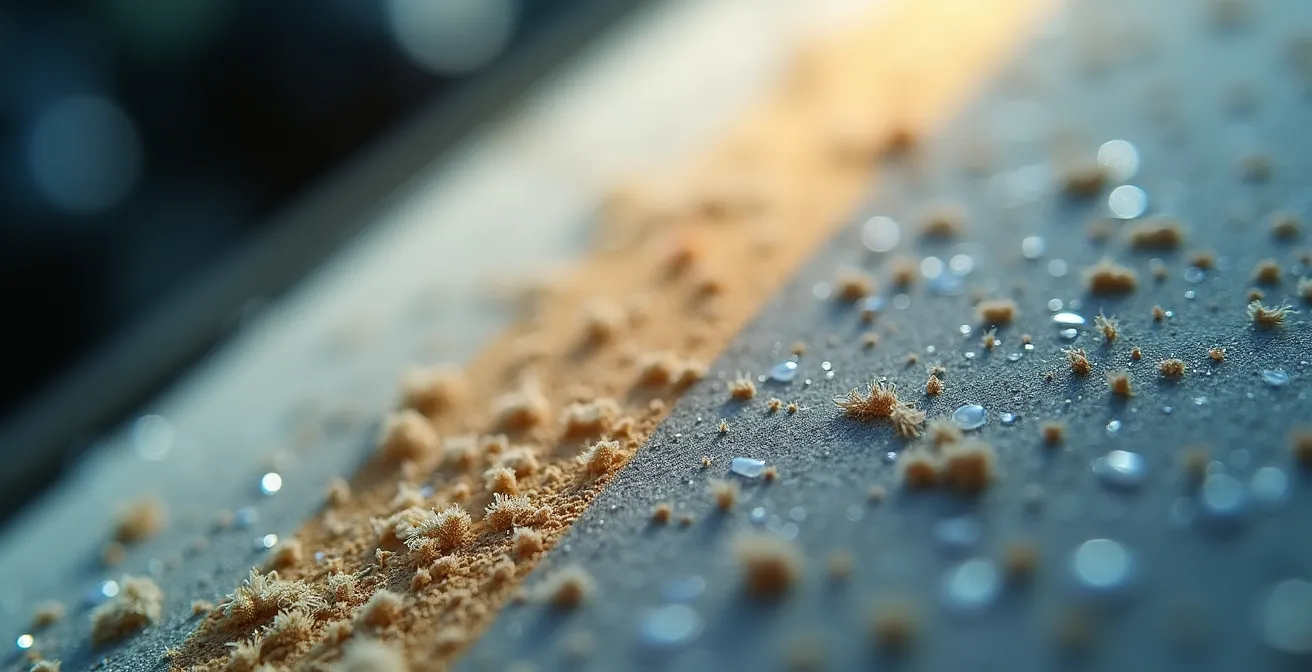
As the image clearly shows, the contrast between a clean and a dirty filter is stark. The accumulated debris is a visible testament to the pollutants that would otherwise be in the air you breathe. Ignoring this simple maintenance task is equivalent to forcing your home to breathe through a dirty mask. The consequence is poor indoor air quality, which can trigger allergies, asthma, and other respiratory issues. For a system whose entire purpose is to promote a healthy living environment, neglect is simply not an option. Regular cleaning ensures the free flow of fresh air and protects the long-term health of both your family and the ventilation system itself.
Your Seasonal HRV Maintenance Plan
- Spring: Clean pollen and outdoor debris from the intake vents and inspect the unit for any damage sustained during winter.
- Summer: Inspect the condensate drain to ensure it’s clear and not blocked, especially during humid periods.
- Fall: Clear all leaves, twigs, and debris from the exterior intake and exhaust hoods to ensure unobstructed airflow.
- Winter: During extreme cold snaps (below -25°C), visually check the HRV core for excessive ice buildup, which may indicate a balancing issue.
- Every 1-3 Months: Clean or replace the air filters. Follow the manufacturer’s specific instructions, as some are washable while others are disposable.
- Annually: Have the entire system serviced and re-balanced by an HRAI-certified contractor, ideally at the same time as your furnace maintenance.
How to know if your house is in negative pressure and sucking in radon?
In an airtight Novoclimat home, the balance of air pressure is a delicate and critical aspect of health and safety. Negative pressure occurs when more air is being exhausted from your home (by appliances like a range hood, a clothes dryer, or an unbalanced HRV) than is being supplied. When this happens, the house desperately tries to draw in “makeup” air from the path of least resistance. Unfortunately, this path is often through tiny cracks in the foundation, bringing with it soil gases, moisture, and the invisible, radioactive gas known as radon. Your home literally begins to suck in poison from the ground beneath it.
Radon is a naturally occurring radioactive gas that is the leading cause of lung cancer for non-smokers. It is colourless, odourless, and impossible to detect without testing. The danger is particularly acute in Quebec, where geology contributes to higher-than-average levels. According to surveys, 8% of Quebec homes exceed the 200 Bq/m³ Health Canada guideline, with some regions showing rates as high as 25%. A properly balanced HRV is your first line of defense, as it is designed to supply as much air as it exhausts, maintaining a neutral pressure. An unbalanced system or the overuse of exhaust-only appliances can create the very negative pressure that pulls radon in.
The Government of Quebec has issued clear advisories on this threat. As stated by health authorities:
In Canada, there is a guideline stating that the maximum acceptable radon concentration in a home is 200 Bq/m³. If the concentration in your home exceeds this limit, you should take corrective measures within one year.
– Gouvernement du Québec, Quebec Government Health Advisory on Residential Radon
The only way to know if your home has a radon problem is to test for it. Low-cost, long-term test kits are widely available. Understanding the risk levels associated with test results is crucial for taking appropriate action.
| Radon Level | Risk Category | Recommended Action | Timeline |
|---|---|---|---|
| Below 75 Bq/m³ | Green – Low Risk | Long-term monitoring recommended | Retest in 2-5 years |
| 75-200 Bq/m³ | Yellow – Moderate Risk | Consider mitigation measures | Within 2 years |
| 200-400 Bq/m³ | Orange – High Risk | Mitigation required | Within 1 year |
| Above 400 Bq/m³ | Red – Very High Risk | Immediate mitigation needed | Within 3 months |
Noisy ventilation ducts: solutions for peaceful sleep
A common complaint about ventilation systems is noise, which can range from a low hum to disruptive whistling or rattling. This noise is not an inherent flaw of HRV technology but almost always a symptom of a poorly designed or installed distribution system. In a high-performance Novoclimat home, where every detail is meant to enhance comfort, a noisy ventilation system is a clear sign that something is wrong. The Novoclimat program itself emphasizes quality installation precisely to avoid such issues. All certified installations require strict adherence to airflow requirements and must pass balancing tests performed by certified specialists, ensuring the “respiratory system” operates quietly and efficiently.
The primary causes of noise are often related to the ducts themselves. High air velocity, caused by undersized ducts, creates a whistling sound. Sharp, 90-degree bends generate turbulence and noise, as opposed to smooth, gradual turns. The use of flimsy, corrugated flex-duct instead of smooth rigid pipes creates significant friction and airflow noise. Finally, ducts that are not properly suspended can vibrate against the building structure, creating a rattling or humming sound that travels throughout the house. These are not product defects but installation errors.
Fortunately, many of these issues can be addressed. A qualified HVAC technician can identify the sources of noise and implement targeted solutions. These often include:
- Installing insulated, flexible duct connectors between the HRV unit and the rigid ductwork to absorb motor vibrations.
- Replacing sharp elbows with smooth-radius bends to reduce air turbulence.
- Ensuring all ductwork is properly sized for the required airflow and securely suspended with vibration-dampening hangers.
- Checking and re-balancing the entire system to ensure airflow is at the correct, specified rate, which is often the simplest fix.
Investing in professional installation from the start is the best prevention. A Novoclimat-certified installer is trained to design and build a duct system that is not only efficient but also acoustically engineered for peaceful living.
Bathroom timer: is it enough to evacuate the humidity from a 20-minute shower?
The steamy bathroom after a long, hot shower is the single biggest source of concentrated humidity in a home. In an airtight Novoclimat house, this moisture has nowhere to go and can quickly lead to condensation, paint peeling, and mould growth. Many modern bathrooms are equipped with a simple timer switch connected to either a dedicated exhaust fan or the home’s HRV system. The critical question is: is a standard 15- or 20-minute timer cycle enough to do the job? The answer is, very often, no.
A 20-minute shower can release a significant amount of water vapour into the air. While running the ventilation on high (or “boost” mode) during the shower is essential, the moisture doesn’t magically vanish the moment you turn off the water. It lingers in the air, on towels, and on surfaces. A short timer cycle that stops as soon as you leave the bathroom is insufficient to fully evacuate this residual humidity. The fan needs to continue running long after the shower is over to effectively dry out the room and its air.
The most effective strategy is to use the HRV’s boost mode for a prolonged period after each shower. According to ventilation best practices, using the HRV’s boost mode for 20-40 minutes post-shower is the recommended duration. This ensures that the humid air is fully exhausted and replaced with fresh, tempered air from outside. This not only protects the bathroom from moisture damage but also prevents that pocket of extreme humidity from spreading to other areas of the house. Upgrading from a basic mechanical timer to a more advanced digital one that allows for longer run times (30, 45, or 60 minutes) is a small, inexpensive investment that pays huge dividends in protecting the health of your home’s “respiratory system.”
Air leaks: why caulking your windows pays more than changing your furnace?
In the world of home energy efficiency, there’s a hierarchy of impact. While a high-efficiency furnace is a valuable component, its benefits are severely undermined if the house is leaky. It’s like trying to keep a bucket full of water that’s riddled with holes. The furnace will just run constantly to heat the air that is continuously escaping. This is the fundamental principle behind the Novoclimat program: build the envelope tight first. A certified Novoclimat home is up to four times more airtight than a typical home built in the 60s or 70s. This dramatic reduction in uncontrolled air leakage is the single most important factor in its energy performance.
This level of airtightness is not achieved by chance; it is engineered and verified. Every Novoclimat home must undergo a mandatory blower door test during construction. An independent inspector uses a powerful fan to depressurize the house, measuring precisely how much air leaks through the building envelope at a pressure of 50 Pascals. The result, expressed as Air Changes per Hour (ACH), must meet a stringent target (e.g., 1.5 ACH @ 50 Pa). This test identifies every unintended gap—around windows, electrical outlets, and structural joints—that must be sealed.
This is why sealing air leaks is so critical. It’s the foundation upon which all other mechanical systems, including the furnace and the HRV, are built. An HRV is sized and balanced based on the verified airtightness of the home. If that envelope is compromised by leaks, the entire “respiratory system” is thrown off balance. Caulking a window or sealing a drafty sill is not just a minor repair; it is an act of restoring the integrity of your home’s primary defense against energy loss. It ensures that the conditioned, fresh air supplied by your systems stays inside, and the unconditioned outside air stays out. This simple, low-cost measure directly enhances the performance of your expensive furnace and HRV, delivering a far greater return on investment.
Forced-air heating: how to avoid your furnace becoming a dust distributor?
A forced-air furnace is designed to distribute warm air throughout your home via a network of ducts. However, if not managed correctly, this same system can become a highly efficient distributor of dust, allergens, and other airborne particulates. When an HRV is integrated with a furnace—a common setup known as a simplified installation—the two systems must work in perfect harmony to ensure clean air delivery. If they are not properly configured and filtered, the furnace fan can inadvertently circulate contaminants pulled in from both inside and outside the home.
The solution lies in a dual-filtration strategy. Your HRV has its own filters to clean the incoming fresh air from outside. Your furnace has a separate filter to clean the air being recirculated from within the house. Both must be maintained. For superior air quality, the furnace filter should be upgraded to a high-efficiency model, such as one with a MERV 11 or MERV 13 rating. These filters are much more effective at capturing smaller particles like pollen, mould spores, and fine dust compared to standard, cheap fibreglass filters.
To achieve the best results, a few key steps are necessary:
- Install a MERV 11 or 13 filter in your furnace and change it according to the manufacturer’s schedule (typically every 3 months).
- Clean your HRV filters separately, also on a 1-3 month schedule.
- Ensure the furnace and HRV electrical systems are interlocked, so the furnace fan runs automatically when the HRV is operating, ensuring proper distribution of fresh air.
- Have the entire integrated system professionally balanced by an HRAI-certified technician to ensure airflow rates are correct and not creating pressure imbalances.
While a simplified installation is common, ventilation experts often recommend a “stand-alone fully ducted installation” for the HRV. This gives it a dedicated duct network, completely separate from the furnace, providing ultimate control over fresh air delivery without ever turning it into a dust distributor. This represents the gold standard for indoor air quality.
Key Takeaways
- An HRV is not an optional accessory in an airtight Novoclimat home; it is the essential “respiratory system” required for a healthy building.
- Proper installation, balancing, and regular maintenance by certified professionals are non-negotiable to prevent issues like noise, negative pressure, and system failure.
- A balanced HRV is your primary defense against the infiltration of dangerous soil gases like radon, a significant health risk in many parts of Quebec.
How to Conduct a Home Energy Audit to Find Where You Lose Heat?
You now understand that your Novoclimat home is a complex, integrated system. But how do you know if it’s performing at its peak? Just like a person gets a regular health check-up, your home can benefit from a professional diagnosis to identify hidden problems. A home energy audit is that check-up. It goes far beyond a simple visual inspection to provide a scientific assessment of your home’s performance, pinpointing exactly where you are losing heat, where air is leaking, and whether your ventilation system is properly balanced.
While some DIY methods exist, like using a tissue or an incense stick to spot drafts near windows, these methods are rudimentary. For a truly accurate diagnosis, a professional audit is required. Auditors use specialized equipment like a blower door to measure the home’s overall airtightness and a thermal imaging camera to visually identify areas of heat loss or missing insulation that are invisible to the naked eye. This provides a comprehensive health report for your building envelope and mechanical systems.
For Quebec homeowners, the most logical and beneficial path is to use the government-supported Rénoclimat program. This program provides access to a subsidized professional energy audit conducted by a certified advisor. The advisor will perform a complete assessment, including the blower door test and an inspection of your insulation, heating, and ventilation systems. They can identify issues like an unbalanced HRV, duct leakage, or poor insulation. Following the audit, you receive a detailed report with prioritized recommendations for improvements. Crucially, the Rénoclimat program may also provide financial assistance for making these upgrades, including the installation or replacement of an HRV, making it an invaluable resource for ensuring your home is as healthy and efficient as possible.
To ensure your home’s respiratory system is functioning optimally, the next logical step is a professional diagnosis. Investigate Quebec’s Rénoclimat program to have a certified advisor conduct a comprehensive energy audit and ensure your home provides the healthiest possible environment for your family.