A thermostatic mixing valve (TMV) isn’t just a safety gadget; it’s an active safety system legally required in Quebec for dual protection against severe scalding burns and Legionella bacteria.
- It actively shuts down water flow during a cold water supply failure to prevent scalding.
- Quebec law mandates a delicate balance: water stored at 60°C to kill bacteria, but delivered at a maximum of 49°C at the tap.
Recommendation: To ensure your home complies with the law and your family is protected, your TMV system must be installed and annually maintained by a CMMTQ-certified plumber.
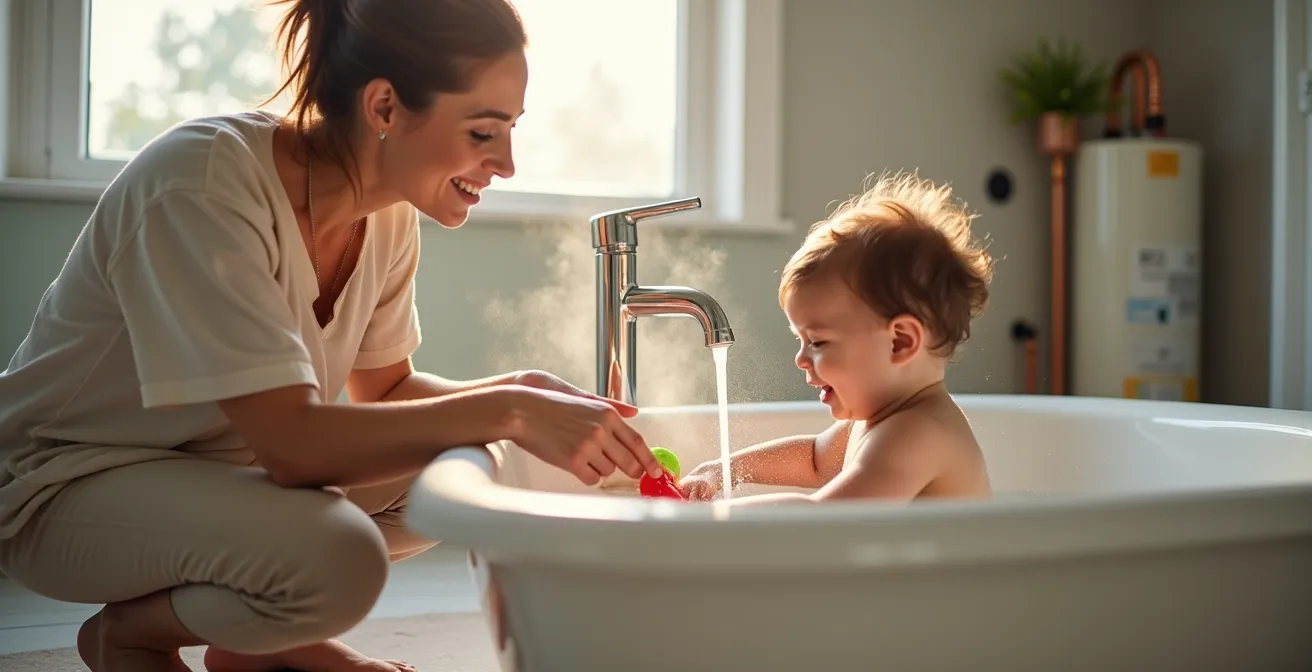
The image of a young child reaching for a running tap is a universal moment of parental anxiety. A simple turn of the handle can release water hot enough to cause a severe burn in seconds. Many well-intentioned parents believe the solution is to simply turn down the temperature on their water heater. However, this common-sense fix unknowingly opens the door to a hidden danger: Legionella, a harmful bacteria that thrives in lukewarm water. This creates a dangerous paradox where protecting against one threat exposes your family to another.
The conversation around home water safety often touches on various elements, from installing lead-free faucets to managing water pressure. While these are important, they don’t address the core conflict between scalding heat and bacterial growth. So how do you solve this puzzle? What if the key isn’t choosing one safety measure over the other, but implementing an engineered system designed to manage both risks simultaneously?
This is precisely the role of the thermostatic mixing valve (TMV). Far from being a simple accessory, it is a smart, mechanical guardian mandated by law in Quebec. It stands as the critical component of a responsible domestic hot water system. This article will deconstruct how this essential device works as an active safety system, explore the specific legal requirements you must follow in Quebec, and guide you through choosing, installing, and maintaining the right valve to ensure your family’s absolute safety.
To navigate this crucial topic, this guide breaks down every critical aspect of thermostatic mixing valves, from their fundamental safety mechanisms to the specific regulations and advanced applications within your home’s plumbing ecosystem. The following summary outlines the key areas we will explore to provide you with a complete understanding.
Summary: A Complete Guide to Thermostatic Mixing Valve Safety in Quebec
- How does a thermostatic mixing valve react if the cold water is cut off?
- Water heater at 60°C and tap at 49°C: the perfect equation against Legionellosis
- Central valve or under the tap: which strategy for an adapted bathroom?
- Why is your shower getting cold despite the thermostatic mixer?
- What certifications should you look for to ensure the valve’s reliability?
- 3-way or 4-way valves: how to protect the boiler from cold water return?
- Lead-Free: how to recognize the official marking on a faucet?
- Recirculation loop: gravity (thermosiphon) or forced pump for your renovation?
How does a thermostatic mixing valve react if the cold water is cut off?
A true thermostatic mixing valve is not a passive plumbing part; it is an active safety system with a crucial built-in intelligence. Its primary function is to blend hot and cold water to a safe, pre-set temperature, but its most critical feature is its ability to react instantly to a system failure. If the cold water supply is suddenly interrupted—due to a municipal water main break or a frozen pipe, for instance—the valve’s internal thermal actuator senses the immediate temperature spike. This triggers a fail-safe mechanism that is engineered to protect users from pure, scalding hot water.
This is not a slow or partial adjustment. The valve is designed to shut down the hot water flow almost completely within milliseconds, reducing the output to a mere trickle or stopping it entirely. This automatic and mechanical response eliminates the risk of a devastating burn, providing a level of protection that a standard faucet simply cannot offer. It is this active, self-regulating behaviour that distinguishes a TMV as an essential piece of safety equipment, especially in homes with children, seniors, or individuals with mobility or sensory challenges.
The sequence of this safety shut-off is a testament to its precise engineering:
- The TMV’s thermal actuator instantly senses the loss of cold water pressure and the resulting temperature surge.
- An internal bypass or shuttle mechanism activates in a fraction of a second.
- The valve’s piston moves to block the hot water inlet port.
- The mixed water flow is reduced to a non-scalding trickle (typically below 0.5 GPM) or stops entirely.
- The system remains in this safe mode, preventing any significant hot water delivery until cold water pressure is safely restored.
Water heater at 60°C and tap at 49°C: the perfect equation against Legionellosis
The greatest challenge in managing a home’s hot water is the “dual protection mandate”: the water must be hot enough to kill bacteria in the tank but cool enough not to cause burns at the tap. The bacterium Legionella pneumophila, which causes a severe form of pneumonia, thrives in water temperatures between 25°C and 45°C. To effectively prevent its growth, public health authorities and plumbing codes universally recommend that water heaters be set to maintain a minimum temperature of 60°C (140°F). At this temperature, however, water can cause a third-degree burn to a child in less than a second.
This is where the thermostatic mixing valve provides the perfect solution, acting as a bridge between these two conflicting safety requirements. It allows you to keep your water heater at the bacterially-safe 60°C while ensuring the water delivered to your showers, bathtubs, and sinks is at a safe temperature. In fact, the Quebec Construction Code strictly requires a maximum temperature of 49°C (120°F) at the tap for residential buildings, a rule designed specifically to prevent scalding. A TMV is the only reliable method to enforce this legal limit while maintaining a healthy water tank.
This balanced approach is a cornerstone of public health initiatives. For example, a Toronto Public Health campaign educated families that while a 60°C heater setting is vital, TMVs are indispensable for delivering safe 49°C water, highlighting the severe burn risk at temperatures just a few degrees higher.

As this image illustrates, the TMV creates an invisible but critical safety barrier. It reconciles the high temperature needed for microbiological safety in the tank with the gentle warmth required for human safety at the point of use, making it an irreplaceable component of a modern, safe plumbing system.
Central valve or under the tap: which strategy for an adapted bathroom?
Once you’ve decided to install a thermostatic mixing valve, the next critical decision is its location. There are two primary strategies: installing a single, central (or “master”) TMV at the water heater, or installing smaller “point-of-use” TMVs at individual fixtures like a shower or sink. The best choice depends heavily on your home’s age, plumbing layout, and specific safety goals, especially in the context of Quebec’s diverse housing stock.
A central TMV is installed directly on the hot water outlet of your water heater. It tempers all the hot water distributed throughout the house to the safe 49°C limit. This is an excellent solution for new constructions, like those found in Brossard or Laval, as it provides whole-home protection from a single, easily maintained device. A point-of-use TMV, on the other hand, is a smaller valve installed directly under a sink or behind the wall for a shower. This approach is ideal for retrofitting older homes, such as the plexes in Montreal’s Plateau, where modifying the main plumbing line is difficult. It allows for targeted protection where it’s needed most.
The critical role of TMVs is especially pronounced in environments caring for vulnerable individuals. As experts from Darspec, a Quebec-based engineering firm, note, they are essential in specialized settings:
In Long-Term Care Hospital Centers (CHSLD), specialized thermostatic mixing valves are mainly used for emergency showers. They adjust the flow rate and temperature immediately and keep them stable for the desired duration.
– Darspec Engineering, The right mixing valve in the right place
This application in CHSLDs underscores their reliability and importance in protecting those who cannot react quickly to temperature changes. For a clearer comparison of these installation strategies in a Quebec context, an analysis of different home types provides valuable insights.
| Installation Type | Best For | Cost Range | Pros | Cons |
|---|---|---|---|---|
| Central TMV at water heater | New constructions in Brossard/Laval suburbs | $500-800 installed | Whole-home protection, single maintenance point | Higher initial cost, requires professional installation |
| Point-of-use TMV under tap | Old Montreal plexes, Plateau renovations | $150-300 per fixture | Targeted protection, easier retrofit | Multiple units needed, individual maintenance |
| Combination approach | Downtown condos (Griffintown) | Varies by scope | Maximum flexibility and safety | Highest total investment |
Why is your shower getting cold despite the thermostatic mixer?
It’s a frustrating scenario: you’ve invested in a thermostatic mixer for your shower, but you still experience unwelcome blasts of cold water or a gradual loss of heat. Before blaming the valve itself, it’s important to understand the potential causes, many of which are related to maintenance or the surrounding plumbing system. First, ensure you have a true thermostatic mixing valve (a safety device) and not just a thermostatic shower faucet (a comfort device), as the latter may have less robust internal components and lack the critical fail-safe shutoff feature.
One of the most common culprits, especially in Quebec municipalities with hard water, is limescale buildup. Mineral deposits can accumulate inside the valve’s delicate thermal element and moving parts, impairing its ability to react smoothly to pressure and temperature changes. Similarly, the small inlet strainers or filters on the hot and cold water ports can become clogged with sediment and debris from the pipes, restricting flow and causing an imbalance. An imbalanced water pressure between your hot and cold supply lines is another frequent cause of temperature fluctuations.
Proper and regular maintenance is the key to ensuring your TMV operates reliably for years. If you’re facing persistent issues, it’s a sign that your system is due for a professional check-up. To diagnose the problem, a systematic approach is best.
Your Troubleshooting Checklist for TMV Issues
- Verify Valve Type: First, confirm you have a true safety TMV, not just a comfort-oriented thermostatic faucet. Check the product documentation or ask your plumber.
- Inspect for Limescale: Check visible parts of fixtures for white, crusty buildup, which indicates hard water. The internal parts of the valve are likely affected as well.
- Clean Inlet Strainers: Have a plumber shut off the water and inspect the small filter screens at the hot and cold inlets of the valve for any clogging from sediment.
- Check Water Pressure: A plumber can test the dynamic water pressure of both hot and cold lines supplying the valve to ensure they are balanced. An imbalance can “overpower” the valve.
- Schedule Professional Maintenance: If problems persist, it’s time for professional service. In fact, maintenance experts recommend yearly TMV inspection, with frequency adjusted based on your local water’s mineral content. Always use a CMMTQ-certified plumber.
What certifications should you look for to ensure the valve’s reliability?
In the world of plumbing safety, certifications are not just recommendations; they are your guarantee that a device has been rigorously tested to perform as promised, especially in a fail-safe scenario. When choosing a thermostatic mixing valve in Canada, and particularly in Quebec, relying on brand reputation is not enough. You must verify that the product meets specific, legally mandated standards. The most important mark to look for is from the CSA Group (Canadian Standards Association). This certification is non-negotiable.
Any plumbing fitting sold and installed in Quebec must comply with this standard. Specifically, the CSA B125.3 standard is legally required for plumbing fittings, and it covers performance requirements for devices like TMVs, ensuring they meet strict safety and reliability criteria. This marking on the valve’s body or packaging confirms it has been tested for temperature control accuracy, flow rate, and, most importantly, its ability to shut down correctly during a cold water failure. Without this mark, there is no assurance the valve will protect your family.
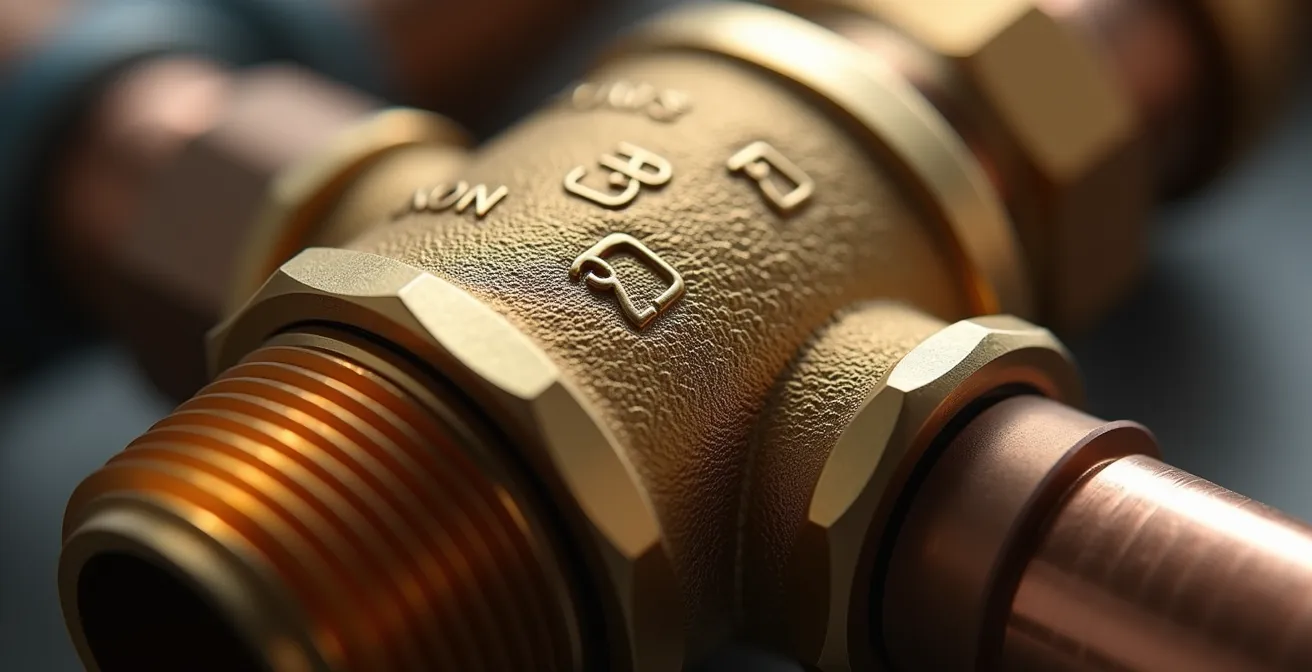
Beyond the primary CSA mark, other certifications provide additional layers of assurance about the valve’s performance and material safety. When inspecting a valve or its packaging, look for the following stamps of approval:
- CSA Logo: The primary mark indicating compliance with Canadian standards. It should be physically present on the valve body.
- ASSE 1017, 1070, or 1016: These are standards from the American Society of Sanitary Engineering, often cross-referenced for specific applications (e.g., ASSE 1017 for master mixers, ASSE 1016 for shower valves).
- NSF/ANSI/CAN 61: This critical certification ensures the materials used in the valve are safe for contact with drinking water and comply with “lead-free” requirements.
Always ask your CMMTQ-certified plumber to provide the certification documentation for any valve they install. This paperwork is your proof of compliance and is essential for home insurance and warranty purposes.
3-way or 4-way valves: how to protect the boiler from cold water return?
While most families encounter TMVs for protecting against scalding at the tap, these versatile valves play an equally critical role within the broader “hydronic ecosystem” of a home, especially in properties with boiler-based heating systems. In this context, they are used not only for user safety but also to protect the expensive boiler equipment itself from damage. The primary threat to a modern, high-efficiency boiler is thermal shock. This occurs when a large volume of cold water returns to the hot boiler from the heating loop (e.g., from radiant floors or radiators), causing rapid temperature changes that can stress and crack the boiler’s heat exchanger.
Specialized 3-way or 4-way thermostatic mixing valves are installed within the heating loop to prevent this. Instead of mixing hot and cold potable water, they mix the hot water leaving the boiler with the cooler water returning from the system. By doing so, they ensure the water re-entering the boiler is always above a certain minimum temperature (e.g., 55°C or 130°F), preventing thermal shock and prolonging the life of the appliance. This demonstrates the TMV’s role as an integral system component, not just an end-point accessory.
Case Study: Protecting a Canadian Hydronic System
A Canadian property owner with a hydronic floor heating system, running at a high output of 71°C (160°F) on the coldest days, needed to protect their boiler. By installing a Caleffi 521 Series mixing valve, they created a bypass loop that blends hot supply water with cooler return water. According to the technical analysis, the pump was strategically placed to pull water *away* from the mixing port, not push into it, which is crucial for maintaining balanced pressures. This configuration successfully prevents thermal shock to the boiler while the valve simultaneously delivers a consistent, safe temperature to the radiant floor tubing, handling flow rates from 1.3 to 10 GPM.
This application shows the advanced capability of TMVs. They are essential for maintaining the health and efficiency of complex heating systems, ensuring both equipment longevity and consistent, comfortable heat delivery throughout the home. This is a perfect example of how plumbing components work together in a finely tuned system.
Lead-Free: how to recognize the official marking on a faucet?
The conversation about water safety rightly extends beyond temperature to the very materials the water touches. Ensuring your plumbing fixtures are “lead-free” is a critical health consideration, and like temperature, this is governed by strict regulations in Canada. Since 2014, all new plumbing fittings and fixtures intended to convey drinking water must comply with a stringent lead-free standard. This is not just a guideline; it is the law.
The key certification to look for is NSF/ANSI/CAN 61. This standard ensures that the amount of lead that can leach from the brass or other metallic components into the water is negligible. While older brass fittings could contain up to 8% lead, modern certified lead-free fittings must contain no more than 0.25% weighted average. When purchasing a thermostatic mixing valve, faucet, or any other plumbing part, verifying this certification is just as important as checking for the CSA safety mark.
Manufacturers make it easy to identify compliant products. You can verify a product’s lead-free status by following a simple checklist. According to industry leaders like Cash Acme Canada, all new plumbing fittings must meet this standard, and homeowners should know how to verify it.
- Look for the ‘LF’ Stamp: Many compliant valves and fittings will have “LF” stamped directly into the brass body to indicate they are lead-free.
- Check for NSF/ANSI/CAN 61: This certification mark should be clearly printed on the product’s packaging or in its technical documentation.
- Confirm CSA B125.3 Compliance: This broader plumbing fitting standard now incorporates the lead-free requirements, so its presence is another layer of confirmation.
- Request Documentation: Your CMMTQ-certified plumber should be able to provide written confirmation and documentation for all installed parts. Keep this for your records.
By consciously selecting certified lead-free products, you are completing the circle of water safety in your home, ensuring the water is not only at a safe temperature but is also free from harmful contaminants.
Key Takeaways
- A TMV provides dual protection by allowing your water heater to stay at a bacteria-killing 60°C while delivering burn-safe 49°C water to your taps.
- In Quebec, TMVs are not optional. The law requires a maximum tap temperature of 49°C and all plumbing fittings must have CSA certification.
- For guaranteed safety and legal compliance, installation and annual maintenance must be performed by a CMMTQ-certified plumbing professional.
Recirculation loop: gravity (thermosiphon) or forced pump for your renovation?
One of the common annoyances in larger homes is the long wait for hot water to reach a distant bathroom. This wait is not only inconvenient but also wastes a significant amount of water. Furthermore, it creates a safety risk, as it gives unsupervised children time to turn the faucet to full hot while waiting for the water to warm up. A hot water recirculation loop is the elegant engineering solution to this problem, and it works best when paired with thermostatic mixing valves for total safety.
A recirculation system creates a continuous loop of pipe from the water heater to the furthest fixture and back again, keeping hot water constantly circulating throughout the house. This provides instant hot water at every tap. There are two main types: a gravity system (thermosiphon), which uses the natural principle of hot water rising to create slow circulation, and a forced-pump system, which uses a small, efficient pump for more powerful and consistent circulation. Forced systems are generally preferred in modern renovations for their reliability.
However, a recirculation loop that circulates 60°C (140°F) water for bacterial control would create a scalding risk at every tap. This is why a hybrid system, combining a recirculation loop with point-of-use TMVs, represents the pinnacle of safety and convenience.
Case Study: A Safe and Efficient Montreal Renovation
A renovation project in a Montreal home implemented a forced-pump recirculation loop designed to maintain a bacteria-killing 60°C (140°F) throughout the piping. To ensure safety, a point-of-use thermostatic mixing valve was installed at each bathroom fixture, reliably tempering the water down to a safe and comfortable 49°C (120°F). This configuration completely eliminated the 30-second wait for hot water, preventing the risk of unsupervised faucet adjustment by children. The system not only provided instant hot water and total safety but also resulted in estimated water savings of approximately 11,000 litres (3,000 gallons) per year for the family of four.
This comprehensive approach shows how different plumbing technologies can be integrated to create a system that is safe, efficient, and comfortable, addressing multiple problems with a single, well-designed solution.
To ensure your home’s water system is not only safe but fully compliant with Quebec regulations, the next logical step is to have it assessed by a CMMTQ-certified plumbing professional. They can verify your current setup and recommend the right thermostatic mixing valve solution for your family’s specific needs and your home’s unique layout.