
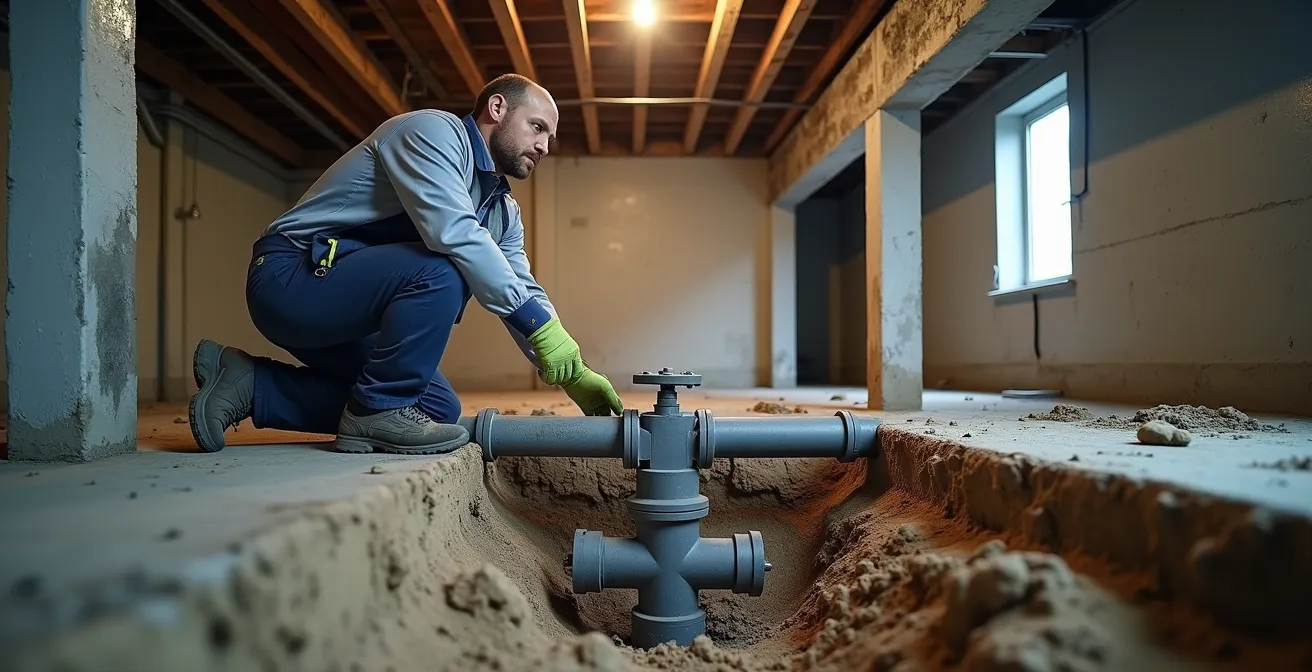
A backwater valve is mandatory in many Quebec regions not just for compliance, but as an act of sanitary and financial survival against increasingly overwhelmed municipal sewer systems.
- A poorly installed or neglected valve offers a dangerous false sense of security, leading to catastrophic damage.
- Warning signs are often subtle, and misinterpreting them can be a multi-thousand-dollar mistake.
Recommendation: Move beyond simple compliance and adopt a proactive inspection and maintenance strategy to ensure your protection is real, not just theoretical.
For a Quebec homeowner, especially in dense urban areas or flood-prone zones, the faint gurgle from a basement drain during a heavy rainstorm is a sound of pure dread. It’s the first whisper of a potential catastrophe: a sewer backup. This isn’t just about water damage; it’s a sanitary crisis where raw sewage from the city’s main line can invade your home, causing irreversible damage and posing serious health risks. Faced with this threat, many rely on a simple piece of plumbing: the backwater valve. The common advice is to “get one installed” and “check if your city requires it.”
But this surface-level understanding is dangerously incomplete. The real issue isn’t just about having a valve; it’s about preventing the “catastrophic inversion” where the very system designed to protect you fails. What if the true danger lies in the silent failures and critical mistakes that render this mandatory device useless? The key to genuine protection isn’t simply installing a valve, but mastering its lifecycle, from understanding its subtle language of failure to navigating the specifics of Quebec’s insurance and subsidy landscape. This is about moving from passive compliance to active sanitary survival.
This guide exposes the critical failure points often overlooked by homeowners. We will dissect the warning signs that your system is under duress, clarify the crucial choice between valve types for our climate, and reveal the single biggest installation error that creates a devastating false sense of security. Ultimately, you will learn to see your backwater valve not as a passive fixture, but as an active defense system requiring vigilance.
Summary: Why Is a Backwater Valve Mandatory in Some Quebec Municipalities?
- Clapet antiretour : comment savoir s’il fonctionne encore après 5 ans ?
- Quels bruits dans vos toilettes annoncent un refoulement d’égout imminent ?
- Clapet normalement ouvert ou fermé : lequel choisir pour votre résidence principale ?
- L’erreur de positionnement du clapet qui rend votre protection inutile
- Comment obtenir la subvention municipale pour l’installation de votre clapet ?
- Pompe de puisard (Sump Pump) : le test de la chaudière d’eau est-il suffisant ?
- Appeler le plombier ou l’assureur en premier : l’ordre qui change tout
- Franchise à 1000 $ ou 5000 $ : quand vaut-il la peine de réclamer pour un tuyau brisé ?
Clapet antiretour : comment savoir s’il fonctionne encore après 5 ans ?
The promise of a backwater valve is long-term security, but this security has an expiration date determined by maintenance, not just time. While the device itself may be built to last, its effectiveness plummets without regular attention. Homeowners often fall into a state of “false security,” assuming the valve they had installed years ago is still functional. The reality is that debris, sediment, and simple wear and tear can render it useless long before its structural lifespan is over. For this reason, you cannot simply install it and forget it.
The industry standard for a properly cared-for device offers a clear benchmark. According to insurance industry recommendations, backwater valves can last up to 10 years but this is entirely conditional on proper annual maintenance. After the five-year mark, this yearly inspection becomes non-negotiable. It’s the only way to confirm that the internal components are free to move and that the seal remains intact. A valve that is stuck open due to debris is no valve at all.
A proactive inspection is the only true method to verify function. This isn’t a complex task, but it requires diligence. You must physically access the valve, open its clear cover, and check the mechanism. Is the flap stuck? Is the O-ring seal cracked or brittle? Are the floats, designed to lift the flap during a backup, still buoyant and unobstructed? Answering these questions is fundamental to ensuring your home’s sanitary survival.
Your 5-Step Annual Valve Inspection Plan
- Visual Access: Remove the clear cover and check for any buildup of debris, grease, or solids around the flap mechanism.
- Seal Integrity: Carefully inspect the O-ring or gasket around the lid for signs of drying, cracking, or deterioration, which would compromise the seal.
- Buoyancy Test: Verify that both floaters on each side of the flap are clean and can move freely; they are essential for closing the valve during a backup.
- Component Cleaning: Wearing gloves, use a long-handled brush to gently clean around and under the flap to ensure it can seat perfectly in the closed position.
- Documentation: Take clear photos of the clean, inspected valve with a timestamp and keep them as proof of maintenance for your insurance provider.
Quels bruits dans vos toilettes annoncent un refoulement d’égout imminent ?
Your plumbing system speaks a language, and learning to interpret its warnings is a critical skill for preventing a catastrophic inversion. The most common signs of systemic pressure on the municipal sewer line manifest as audible changes in your home’s lowest drains, typically in the basement. When the city’s system begins to fill during a heavy downpour or Quebec’s rapid spring thaw, it pushes air back up the pipes. This trapped air escapes through your drains, creating a distinct gurgling sound in toilets, floor drains, or showers.
This gurgling is not a minor annoyance; it’s an alarm. It signifies that the sewer main is nearing its capacity and the water level is rising. As noted by plumbing experts in Quebec, these gurgling sounds are a direct indicator of peak stress on municipal sewer systems during “le dégel” and summer thunderstorms. Ignoring this sound is like ignoring a smoke alarm. It’s the final warning before the system fails and wastewater is forced into your home. The presence of these sounds confirms that your backwater valve will soon be called into action.
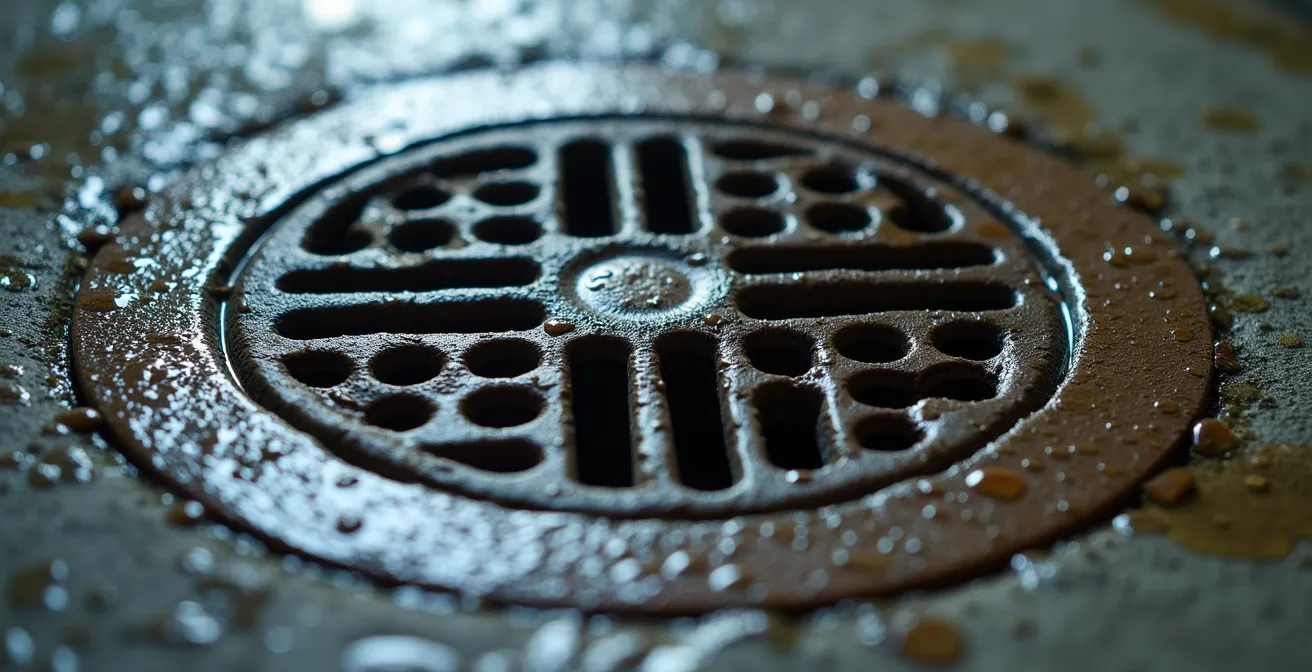
To identify these subtle warnings, you need to be attentive during severe weather events. The image below shows a typical basement floor drain, the frontline in a sewer backup event. Any unusual noises or visible water level changes here demand immediate attention.
Counter-intuitively, a sudden and complete silence from your drains during a heavy rainstorm can be an even more ominous sign. While gurgling indicates the system is struggling, absolute silence can mean a complete blockage has already formed downstream. This could be in your home’s main drain or just outside, effectively plugging the line. In this scenario, pressure is building silently, and the first sign of a problem could be sewage seeping from the drain’s edges. This lack of noise provides a profound sense of false security right before a disaster.
Clapet normalement ouvert ou fermé : lequel choisir pour votre résidence principale ?
Choosing a backwater valve isn’t a one-size-fits-all decision. The two primary designs available—”normally open” and “normally closed”—have significant functional differences that directly impact their suitability for a residential property in Quebec. This choice is a crucial “failure point” if made incorrectly. The default recommendation from many plumbers for a single-family home is the normally open valve. This design allows sewage and, critically, sewer gases to flow freely out of the house under normal conditions. The flap only closes when backpressure from the municipal sewer forces it shut, preventing a backup.
The primary advantage of a normally open valve is its ability to allow the home’s plumbing system to “breathe.” It ensures proper venting of sewer gases, which is a fundamental aspect of the plumbing code. In contrast, a normally closed valve remains sealed at all times, opening only when wastewater from the house pushes its way out. While this provides a constant barrier, it can interfere with air circulation in the pipes and is more often recommended for specific situations like multi-unit dwellings where one unit’s plumbing could affect another’s. The context of municipal requirements is also key. As Square One Insurance notes, the mandate is not universal, which makes choosing the right device even more critical.
Backwater valves are required by some municipalities and recommended by others
– Square One Insurance, Backwater Valve Guide 2025
For Quebec homeowners, climate is a deciding factor. The severe freeze-thaw cycles of a Canadian winter can pose a risk to normally closed valves. If moisture gets trapped in the mechanism, it could freeze the valve shut, preventing your own wastewater from exiting the house. A normally open valve is generally less susceptible to this specific issue. The following table, based on an analysis from CAA-Quebec’s guide on wastewater management, breaks down the key differences to help you make an informed choice for your principal residence.
| Feature | Normally Open Valve | Normally Closed Valve |
|---|---|---|
| Default Position | Open – allows flow | Closed – blocks flow |
| Sewer Gas Venting | Allows proper venting | May restrict venting |
| Power Outage Impact | Continues to protect | Remains protective but limits use |
| Best For | Single-family bungalows | Multi-unit ground floors |
| Quebec Climate Suitability | Better for freeze-thaw cycles | May freeze in closed position |
L’erreur de positionnement du clapet qui rend votre protection inutile
Of all the potential failure points in a home’s defense against sewer backup, none is more absolute or creates a greater sense of false security than improper valve placement. A backwater valve is not just a device; it’s a strategic checkpoint. Its sole purpose is to isolate your entire home from the municipal sewer line. If it is installed in the wrong location on your main drain, it will fail to protect some or all of your basement fixtures, rendering your investment and effort completely useless.
The cardinal rule of installation is that the valve must be placed on the main building drain before any other pipe connections. It must be the very last thing on the line before the pipe exits your foundation. If a plumber installs the valve *after* the connection for a basement bathroom, a laundry sink, or even the weeping tile drain, those fixtures are left completely unprotected. During a backup, sewage will bypass the valve and flood your basement through these unprotected drains. This error is catastrophic, and improper valve placement after basement fixtures leaves them unprotected in 100% of cases, as confirmed by Quebec plumbing experts.
This isn’t just a functional error; it’s a compliance and liability nightmare. Plumbing firms licensed by the Régie du bâtiment du Québec (RBQ), like Abe Cohen Plumbing, stress this point. Their experience shows that incorrect installations not only void any chance of receiving a municipal subsidy but also create significant liability issues under the RBQ code. They report numerous cases where homeowners thought they were protected, only to discover during a flood that the valve’s position made it worthless. A common, devastating mistake is installing the valve on the main sanitary line but before the connection from the foundation’s weeping tile, allowing groundwater and sewer water to mix and flood the foundation from below.
Ensuring the installer is a licensed CMMTQ (Corporation des maîtres mécaniciens en tuyauterie du Québec) plumber who understands the RBQ code is non-negotiable. Before any work begins, you must have the plumber physically show you the proposed location and confirm it is the furthest point downstream on your main drain, protecting every single fixture in your home. Getting this wrong means you haven’t just wasted money; you’ve actively installed a system of false hope.
Comment obtenir la subvention municipale pour l’installation de votre clapet ?
Recognizing the systemic pressure on aging sewer infrastructure, many Quebec municipalities have implemented subsidy programs to encourage homeowners to install backwater valves. This financial incentive is a crucial part of making this protection accessible, but navigating the bureaucratic process requires precision. These programs are not automatic; they are reimbursements that depend on strict adherence to a specific set of rules. Missing a single step can result in the denial of your claim, leaving you to bear the full cost.
The available amounts and program names vary by city. For instance, recent municipal data shows a $560 subsidy is available through Montreal’s RénoPlex program, while cities like Laval and Longueuil have their own similar initiatives. The core requirements, however, are largely standardized across the province and focus on proving the work was done correctly by a certified professional. This is the municipality’s way of ensuring their investment results in a functional, code-compliant installation that genuinely reduces the load on emergency services and infrastructure during storms.
The entire process is built on documentation. From proof of ownership to pre- and post-installation photos, every piece of paper acts as a link in the chain of approval. The single most important document is the compliant invoice from your plumber. It must clearly show their company name, address, and, most importantly, their RBQ license number and CMMTQ certification. Without this, your application is almost certain to be rejected.

To successfully claim your subsidy, you must act like a project manager. The following steps, based on requirements from several major Quebec municipal programs, form a reliable roadmap. Be aware of deadlines, as most municipalities require submission within a specific window (often 90 days) after the work is completed.
- Obtain proof of ownership for your property (municipal tax bill or similar).
- Hire a licensed plumber who is a member of the CMMTQ and holds a valid RBQ license.
- Take clear “before” photos of the main drain area where the valve will be installed.
- Keep the detailed, compliant invoice from your plumber after the work is paid for.
- Take clear “after” photos showing the installed valve and the finished area.
- Download and complete the specific subsidy application form for your municipality (e.g., Montreal, Laval, Longueuil).
- Submit the complete package of documents before the municipal deadline.
Pompe de puisard (Sump Pump) : le test de la chaudière d’eau est-il suffisant ?
For homeowners with a sump pump, the annual “bucket test”—pouring a bucket or two of water into the pit to see if the pump activates—is a common ritual. While this test confirms the float switch and motor are working, it is dangerously insufficient for simulating the conditions of a real Quebec “dégel” (spring thaw). During the spring melt, the threat isn’t a single burst of water, but rather the relentless, sustained pressure from a high water table. A simple bucket test doesn’t check if the pump can handle a continuous flow for hours or even days, nor does it verify that the discharge line is clear and not frozen.
Quebec’s soil composition, often heavy with clay, exacerbates this issue. Clay soil absorbs water slowly, meaning that during a thaw or heavy rain, water accumulates around your foundation, putting immense and constant hydrostatic pressure on your weeping tile and sump pit. Expert reports from Quebec plumbers highlight that a simple bucket test fails to replicate this sustained flow scenario. The real test is a sustained flow test, using a garden hose to run water into the pit for at least 15-20 minutes to see how the pump cycles and if it can keep up with the volume. This is especially important as research reveals that 26% of Canadian homeowners have already experienced some form of water-related damage, much of it preventable.
Furthermore, it’s a critical error to view a sump pump and a backwater valve as interchangeable solutions. They fight two completely different battles. The sump pump fights groundwater from below, pushing water that seeps into your weeping tile away from your foundation. The backwater valve fights sewer water from the street, preventing the municipal system from forcing its way into your home. In many Quebec regions, having only one of these systems is an incomplete defense. During a major storm, the sewer system can back up (requiring the backwater valve) at the exact same time the water table is rising (requiring the sump pump). One cannot do the job of the other; they are two essential components of a single, robust system for total sanitary survival.
Appeler le plombier ou l’assureur en premier : l’ordre qui change tout
In the panic and chaos of a basement flood, your first instinct might be to call your insurance company. This is a critical, and potentially very costly, mistake. Under the terms of virtually all Quebec home insurance policies, the homeowner has a legal “duty to mitigate.” This means you are obligated to take immediate, reasonable steps to stop the source of the water and prevent further damage. Waiting for an adjuster to call you back while water continues to pour into your home is a direct violation of this duty and can be grounds for your insurer to reduce your claim or deny it entirely.
Therefore, the absolute first call you must make is to a 24/7 emergency plumber. Their immediate intervention is not just about fixing the problem; it’s about legally fulfilling your contractual obligation to your insurer. The plumber’s first priority will be to stop the flow of water, whether it’s from a burst pipe, a failed water heater, or a sewer backup. This action is the single most important thing you can do to protect your insurance claim.
Once the plumber is on the way, you can move to the second phase: documentation. Before any cleanup starts, you must create a comprehensive photographic and video record of the damage. Use your smartphone to take wide-angle shots of the entire affected area and close-ups of damaged items. This evidence is invaluable. The third step, and only after the first two are complete, is to contact your insurance provider. You will be in a much stronger position, able to say “I have a flood, the source has been stopped by a professional, and I have documented the initial damage.”
Following a strict protocol is essential for a successful insurance claim in Quebec. The order of operations is not a suggestion; it is a requirement for financial recovery. The following emergency protocol, based on guidance from authorities like CAA-Quebec on water damage claims, should be your immediate action plan.
- Call a 24/7 emergency plumber immediately to stop the water source and mitigate damage.
- Take extensive photos and videos of all damage *before* moving or cleaning anything.
- Document the exact time the damage was discovered and identify the source if possible.
- Do not discard any damaged items until they have been documented and you are told to do so by your insurer.
- Contact your insurance provider with your initial report and documentation.
- Keep all invoices and work orders from the plumber as proof of your mitigation efforts.
Key Takeaways
- A backwater valve’s functionality depends entirely on annual maintenance, not its installation date. A neglected valve is a useless valve.
- Gurgling sounds are a final warning of systemic pressure; however, sudden silence during a storm can signal a more immediate and severe blockage.
- Incorrect valve placement (i.e., not at the furthest downstream point) is a catastrophic error that offers zero protection and a complete false sense of security.
- Sump pumps and backwater valves are not interchangeable; they are two parts of a single defense system against two different threats (groundwater vs. sewer water).
Franchise à 1000 $ ou 5000 $ : quand vaut-il la peine de réclamer pour un tuyau brisé ?
Deciding whether to file an insurance claim for water damage is a calculated financial risk. Many homeowners, seeing a deductible of $1,000, might hesitate to claim for what appears to be minor damage, fearing a premium increase. Conversely, assuming any significant damage is worth a claim can also be a miscalculation. The decision hinges on two things: a realistic understanding of the true cost of water damage remediation and a clear knowledge of what your specific policy endorsements cover. The average cost is often far higher than people imagine.
The numbers are sobering. When you factor in not just the initial plumbing repair, but also water extraction, drying and dehumidification, removal of damaged drywall and flooring, antimicrobial treatment to prevent mold, and final restoration, costs escalate rapidly. According to data from industry publications, the average cost for water damage claims can reach $43,000. This staggering figure puts a $1,000 or even a $5,000 deductible into sharp perspective. A claim that seems small at first can easily cross the five-figure threshold once professional remediation begins.
However, the most critical factor is coverage. A standard Quebec home insurance policy does not cover all types of water damage. As the table below, based on information from Quebec’s Autorité des marchés financiers (AMF), illustrates, damage from sewer backup or groundwater infiltration is almost always excluded from a basic policy. It requires a specific, additional endorsement on your policy. Filing a claim for a sewer backup when you don’t have this endorsement is not only futile but also puts an unnecessary claim on your record. It is absolutely essential to read your policy *before* an incident to confirm you have the necessary endorsements for sewer backup and groundwater infiltration.
Here is a breakdown of typical coverage scenarios from l’Autorité des marchés financiers du Québec.
| Damage Type | Basic Policy Coverage | Additional Coverage Required |
|---|---|---|
| Internal plumbing leak | Covered | No |
| Dishwasher/water heater failure | Covered | No |
| Sewer backup | Not covered | Yes – Special endorsement |
| Ground water infiltration | Not covered | Yes – Special endorsement |
| Roof water damage | Not covered | Yes – Additional protection |
To ensure your home is truly defended against a catastrophic sewer backup, the next logical step is to have your system professionally inspected. Contact a CMMTQ-certified plumber to assess your current setup, or to plan a new, code-compliant installation that guarantees your family’s sanitary survival.