
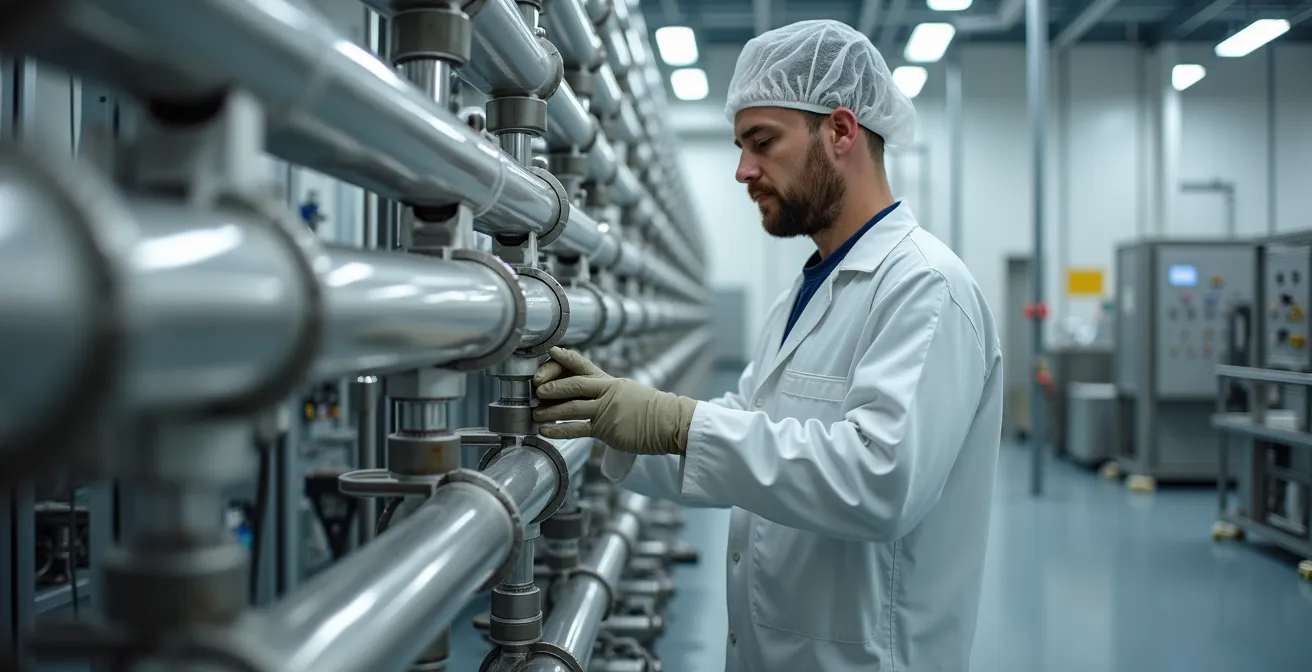
The critical decision for industrial piping isn’t merely stainless steel versus copper; it’s about mastering the physics of failure to prevent catastrophic downtime and ensure regulatory compliance in Quebec’s demanding environments.
- The correct material grade (e.g., 316L for chlorides) and process (e.g., orbital welding for purity) are non-negotiable for mitigating specific chemical and biological risks.
- A comprehensive lifecycle cost analysis consistently demonstrates stainless steel’s long-term economic superiority over plastics and copper, negating the higher initial investment through durability and lower maintenance.
Recommendation: Base your piping specifications not just on material type, but on a complete risk assessment of all potential failure modes: chemical (passivation), mechanical (supportage and vibration), and thermal (steam shock).
As a project manager in the pharmaceutical or chemical sector, you are the ultimate guardian of process integrity. The piping network is the circulatory system of your facility, and any failure—a pinhole leak, a contaminated batch, a catastrophic rupture—falls on your shoulders. The debate between stainless steel and copper is a familiar one, often simplified to a trade-off between copper’s initial cost and steel’s perceived durability. This view is dangerously incomplete. The conversation shouldn’t be about which material is “better,” but which system provides quantifiable resistance to the specific failure modes present in your facility.
Common wisdom focuses on basic corrosion resistance, but this overlooks the complex interplay of factors that lead to failure. We see catastrophic breakdowns not because a material was inherently bad, but because its specific limitations were not understood. This includes vulnerability to chloride ions, fatigue from mechanical vibration, degradation from thermal shock during steam cleaning, or contamination from improper welding techniques. The true cost of a piping system isn’t on the initial purchase order; it’s calculated in lost production, product recalls, and the frantic late-night calls to your maintenance teams.
This article will reframe the decision-making process. We will move beyond the superficial comparison and delve into the physics of failure. Our angle is that choosing stainless steel is only the first step. True reliability comes from understanding the *mechanisms* of degradation and specifying not just the material, but the processes and design principles that guarantee its performance. We will explore why the right grade of stainless steel is critical, how welding techniques impact purity, and how a proper lifecycle cost analysis reveals the true economic champion.
This comprehensive analysis will provide you with the technical arguments and data needed to justify the right investment. We’ll examine specific failure scenarios and their engineered solutions, giving you a clear roadmap to building a truly resilient and compliant piping infrastructure for your critical operations in Quebec.
Summary: A Deep Dive into Industrial Piping Choices
- Inox 304 vs 316L : lequel résiste aux produits chlorés de votre usine ?
- Soudure orbitale : pourquoi est-elle obligatoire pour les réseaux pharmaceutiques ?
- L’erreur de supportage qui fissure vos tuyaux en inox par vibration
- Passivation des tuyaux : pourquoi cette étape est cruciale après l’installation ?
- Coût cycle de vie : comment l’inox devient moins cher que le plastique après 10 ans ?
- Classe 150 vs Classe 300 : comment lire les brides pour éviter l’explosion ?
- Pourquoi l’eau bouillante détruit-elle les drains standards en PVC en quelques mois ?
- Béton polymère ou inox : quel matériau résiste aux chocs thermiques du nettoyage vapeur ?
Inox 304 vs 316L : lequel résiste aux produits chlorés de votre usine ?
The choice between stainless steel grades 304 and 316L is not a matter of preference; it is a calculated decision based on chemical exposure. While both are austenitic stainless steels, their performance diverges dramatically in the presence of chlorides (salts, bleach, certain acids). The primary difference is the addition of molybdenum (around 2-3%) in 316L, an element absent in 304. This addition fundamentally changes the material’s ability to resist pitting and crevice corrosion initiated by chloride ions.
In a typical industrial environment, grade 304 offers adequate corrosion resistance. However, in pharmaceutical or chemical plants where sanitation cycles often use chlorinated cleaners, or where the process media itself is chloride-rich, 304 becomes a significant liability. Chloride ions attack the passive chromium oxide layer that protects the steel, leading to localized, insidious pitting that can perforate a pipe wall from the inside out. Research from the AMPP Corrosion journal shows that 316L exhibits a corrosion rate of only 0.647 MPY in aggressive chloride solutions, demonstrating its superior defense mechanism.
The impact of temperature is also a critical factor. A detailed study on 316L’s behavior in concentrated ammonium chloride highlights these thresholds: at 60°C, no pitting was observed. At 80°C, evidence of pitting began to appear, and by 95°C, corrosion was severe. This demonstrates that even the robust 316L has its limits, making material selection a function of both chemical concentration and operating temperature. For a project manager, specifying 304 in a chlorinated environment is not a cost-saving measure; it is pre-programming a future failure.
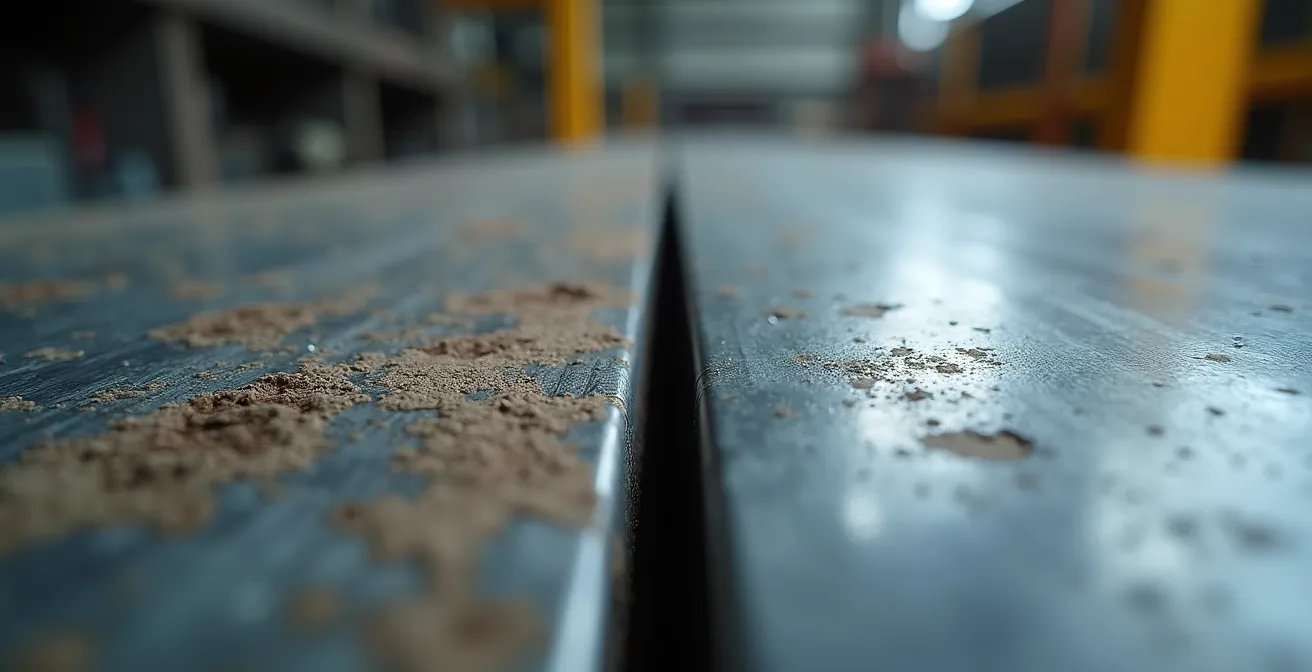
The visual difference after exposure, as seen above, is stark. The 304 surface becomes a landscape of micro-pits, each a potential point of failure. In contrast, the 316L, thanks to its molybdenum content, maintains its passive layer and structural integrity. This isn’t just an aesthetic issue; it’s a direct threat to product purity and system reliability.
Soudure orbitale : pourquoi est-elle obligatoire pour les réseaux pharmaceutiques ?
In high-purity applications, particularly in the pharmaceutical industry, the integrity of the piping system is defined by its weakest points: the welds. A manual weld, no matter how skilled the welder, introduces variability. It can create microscopic crevices, pits, or an uneven internal bead—all ideal breeding grounds for biofilm and bacterial contamination. This is where orbital welding becomes a non-negotiable requirement for GMP (Good Manufacturing Practices) compliance. Orbital welding is an automated, computer-controlled process that produces exceptionally smooth, consistent, and fully penetrated welds, time after time.
The core benefit is reproducibility. An orbital welding system executes a pre-defined and validated program, eliminating the human element that leads to inconsistencies. The result is a full-penetration weld with a clean, smooth internal surface that is free of cracks and crevices. This is critical for systems that undergo regular Clean-In-Place (CIP) and Steam-In-Place (SIP) cycles, as it ensures there are no areas where contaminants can be shielded from the cleaning and sterilization agents. The absence of these imperfections drastically reduces the risk of biofilm formation, which is a primary source of batch contamination and a major compliance failure.
For any pharmaceutical project in Canada, adherence to Health Canada’s guidelines is paramount. The validation of welding procedures is a key component of an Installation Qualification (IQ) and Operational Qualification (OQ) protocol. Traceability is another crucial aspect; every weld is documented, mapped, and inspected, creating a comprehensive record essential for audits and quality assurance.
Your GMP Validation Checklist for Orbital Welding in Canada
- Develop detailed Welding Procedure Specifications (WPS) outlining materials, techniques, and parameters for each type of joint.
- Conduct Installation Qualification (IQ) to verify that the orbital welding equipment is installed correctly and capable of operating within established limits.
- Perform Operational Qualification (OQ) by executing test welds to demonstrate that the procedure consistently produces welds meeting quality standards (e.g., smoothness, penetration).
- Create comprehensive weld maps documenting the location, welder ID, date, type, and inspection results for every single weld in the system for full traceability.
- Validate all procedures and documentation according to Health Canada’s GUI-0029 requirements before the system is put into service.
L’erreur de supportage qui fissure vos tuyaux en inox par vibration
The superior strength of stainless steel is often cited as a key advantage, but this property is frequently misunderstood. It isn’t just about burst pressure; it’s about resistance to mechanical fatigue, particularly from vibration. A common and costly error in industrial piping installation is improper supportage—using support spacing designed for weaker materials like copper or simply failing to account for vibration from pumps, motors, and fluid dynamics. This oversight can lead to vibration-induced stress cracking, even in robust stainless steel systems.
The physical properties tell the story. Type 316L stainless steel possesses a tensile strength of 570-620 MPa, roughly three times that of standard Type B copper. This immense strength means stainless steel can handle higher pressures and wider support spans without sagging. However, when a long, unsupported span is subjected to constant, low-amplitude vibration, the pipe material can work-harden at points of flexion and eventually develop micro-fractures. These cracks propagate over time, leading to leaks that are difficult to detect and often occur at the worst possible moments.
Proper engineering requires a support strategy designed specifically for stainless steel and the system’s operating conditions. This means analyzing sources of vibration and ensuring supports are placed at intervals that prevent resonant frequencies from building up along the pipe’s length. The material’s lower thermal expansion compared to copper also plays a role, reducing stress during temperature cycles but not eliminating the need for careful design.
| Property | 316L Stainless Steel | Copper Type B |
|---|---|---|
| Tensile Strength | 570-620 MPa | 190-210 MPa |
| Strength Ratio | 3x stronger | Baseline |
| Thermal Expansion | 9% less susceptible | More susceptible |
| Support Spacing Required | Wider intervals possible | Closer support needed |
Ignoring these principles by applying a “one-size-fits-all” approach to pipe support is a recipe for premature failure. The investment in stainless steel is undermined if the mechanical design doesn’t leverage its inherent strength and mitigate its specific failure modes like vibrational fatigue.
Passivation des tuyaux : pourquoi cette étape est cruciale après l’installation ?
One of the most critical yet frequently overlooked steps in a stainless steel piping installation is passivation. Many assume that stainless steel is inherently “stainless” from the moment it’s installed. This is a dangerous misconception. The corrosion resistance of stainless steel relies on a microscopic, passive layer of chromium oxide on its surface. This layer can be damaged or contaminated during fabrication, cutting, and especially welding. Passivation is a post-installation chemical treatment designed to remove contaminants and restore this protective layer to its full potential.
During installation, tiny particles of free iron from tools, grinding dust, or handling equipment can become embedded in the steel’s surface. These particles are the primary culprits. When exposed to moisture, they become initiation sites for rust, which can then compromise the underlying stainless steel. The welding process also disrupts the chromium oxide layer in the heat-affected zone, leaving it vulnerable. Passivation uses a mild oxidant, typically a nitric or citric acid solution, to dissolve this surface iron contamination and chemically assist in the rapid reformation of a thick, uniform, and highly corrosion-resistant chromium oxide layer.
Without proper passivation, you are essentially leaving the doors open for corrosion to begin. A recent 2024 study on 316L components highlighted the dramatic effect of this process. In saltwater tests, the corroded area of untreated samples was twice as large as that on properly passivated samples, providing clear, quantifiable proof of passivation’s role in restoring the material’s intended corrosion resistance.
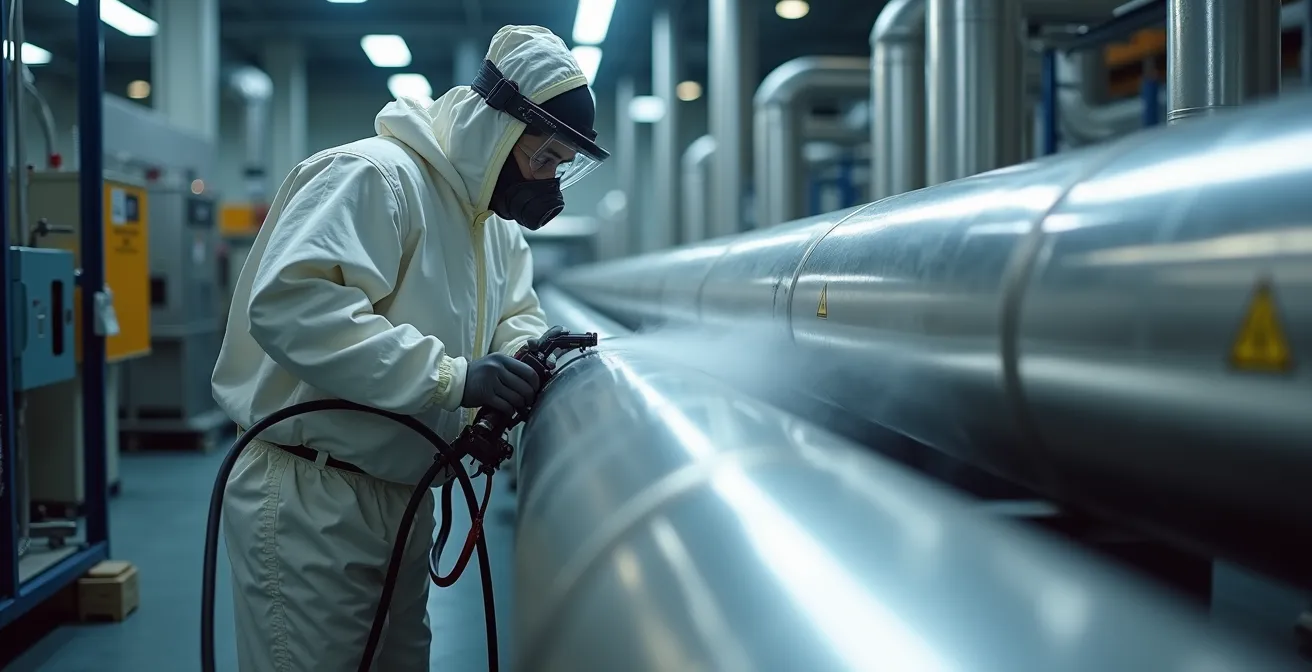
This is not a “nice-to-have” step; for any high-purity or critical application, it is an essential part of the quality assurance protocol. Skipping passivation to save time or a small amount of cost is a classic example of short-term thinking that jeopardizes the long-term integrity and multi-million dollar investment in a stainless steel piping system.
Coût cycle de vie : comment l’inox devient moins cher que le plastique après 10 ans ?
Project managers are often pressured to select lower-cost materials like high-end plastics (PVDF, a.k.a. Kynar) based on the initial purchase price. This approach is fundamentally flawed as it ignores the Total Cost of Ownership (TCO), or lifecycle cost. While stainless steel may have a higher upfront material cost, its exceptional durability, minimal maintenance requirements, and longevity make it the far more economical choice over a 10- or 20-year operational lifespan. The key is shifting the financial perspective from a capital expenditure (CapEx) to a long-term operational expenditure (OpEx) mindset.
High-end plastics are susceptible to degradation from chemical exposure, UV light, and mechanical stress, especially at connection points. This leads to a cycle of frequent repairs, component replacements, and associated downtime. Each replacement event incurs costs for new materials, specialized labor (plastic welding is a distinct skill), and, most significantly, lost production. A stainless steel system, when properly installed, is essentially a “fit and forget” solution. Its maintenance is minimal, typically limited to routine inspections rather than active repairs.
Furthermore, the end-of-life value proposition is completely different. Stainless steel is 100% recyclable and retains significant salvage value. A decommissioned stainless steel system can be sold as scrap metal, recouping a portion of the initial investment. In contrast, used industrial plastic often has a negative value, requiring payment for proper disposal as industrial waste. Insurance premiums can also be impacted, as the lower fire risk and higher mechanical integrity of steel are viewed more favorably by underwriters.
This comparative analysis from Allmach Australia demonstrates the lifecycle cost divergence clearly when comparing stainless steel to another common alternative, copper, but the principles are even more stark when applied to plastics.
| Cost Factor | 316L Stainless Steel | High-End Plastic (PVDF) |
|---|---|---|
| Initial Cost (15mm) | 10% higher | Baseline |
| Replacement Frequency | None in 20 years | 2-3 replacements |
| Maintenance Cost | Minimal | Regular repairs needed |
| Salvage Value | 100% recyclable | Disposal cost required |
| Insurance Premium Impact | Lower premiums | Higher risk assessment |
When all these factors are calculated, the initially more expensive stainless steel system reveals itself to be the shrewder long-term financial investment. The break-even point is often reached well before the 10-year mark, after which the steel system generates continuous savings for the remainder of its service life.
Classe 150 vs Classe 300 : comment lire les brides pour éviter l’explosion ?
Flanges are the critical connection points in a piping system, and a mismatch in their pressure rating is one of the most direct paths to catastrophic failure. Specifying the correct flange class is not an arbitrary choice; it is a fundamental safety requirement dictated by the system’s maximum operating pressure and temperature. The most common ASME B16.5 classes you will encounter are Class 150 and Class 300. A Class 300 flange is designed to handle significantly higher pressures than a Class 150 flange of the same nominal pipe size, but the difference is not linear and depends heavily on temperature.
For example, a 4-inch 316L stainless steel Class 150 weld neck flange might be rated for about 275 PSIG at ambient temperature, while a Class 300 flange of the same size and material is rated for roughly 720 PSIG. However, at 500°F (260°C), those ratings drop to around 180 PSIG and 580 PSIG, respectively. Using a Class 150 flange in a system that could experience pressure surges or operate at temperatures that push it beyond its P-T rating curve is courting disaster. The failure of a flange under pressure is not a gentle leak; it is an explosive event that releases high-energy process fluids, posing an extreme risk to personnel and equipment.
Verification is therefore a critical step during installation and inspection. Every flange must be clearly marked with its material grade, size, schedule, heat number (for traceability), and, most importantly, its pressure class (e.g., ‘150’ or ‘300’). Relying on paperwork alone is insufficient; physical verification on the shop floor and in the field is mandatory. In Quebec, this level of diligence is essential for compliance with regulations enforced by bodies like the Régie du bâtiment du Québec (RBQ) and for meeting GMP standards in regulated industries.
Your Flange Verification Checklist for Quebec RBQ & GMP Compliance
- Verify the material grade marking (e.g., 316L, F316) is stamped on the flange body and matches the project specifications.
- Confirm the pressure class designation (e.g., 150, 300, 600) is clearly and permanently marked on the flange’s edge.
- Check for a heat number, which allows full material traceability back to the foundry, a requirement for many RBQ and GMP applications.
- Cross-reference the flange’s pressure-temperature (P-T) rating with the official ASME B16.5 charts against your system’s maximum operating conditions.
- Document all findings, including photographs and heat numbers, in the equipment qualification records as objective evidence of compliance.
Pourquoi l’eau bouillante détruit-elle les drains standards en PVC en quelques mois ?
In many facilities, standard PVC is the default choice for drainage systems due to its low cost and ease of installation. However, this choice becomes a critical failure point in any area where hot water or steam discharge is possible, such as from autoclaves, wash-down stations, or certain processing equipment. PVC has a very low heat deflection temperature; standard Schedule 40 PVC begins to soften and deform at temperatures around 140°F (60°C). When subjected to boiling water (212°F / 100°C), the material doesn’t just soften—it loses its structural integrity entirely.
The failure mechanism is twofold. First, the immediate thermal shock causes the material to expand rapidly, putting immense stress on joints and fittings. Over repeated cycles, this leads to cracking and joint failure. Second, the sustained high temperature causes the pipe to sag, warp, and lose its shape, creating low spots where water can pool and further exacerbate thermal stresses. Within months of regular hot effluent discharge, a PVC drainage system can become a leaking, deformed mess, leading to water damage, safety hazards, and a contaminated environment under the production floor.
This is where the thermal stability of stainless steel becomes paramount. It maintains its structural integrity well beyond the temperature of boiling water or low-pressure steam. While temperature can accelerate certain types of corrosion in steel, as seen in studies where the stress corrosion cracking sensitivity of 316L increases at 65°C in high-chloride environments, this is a known and manageable factor. The material itself does not deform or lose its fundamental strength. This predictable performance under thermal load is why stainless steel is the only viable long-term solution for any drainage line that will handle hot liquids, ensuring the system remains intact and leak-free for decades, not months.
Key takeaways
- Material specification is paramount: 316L stainless steel’s molybdenum content is essential for resisting chloride-induced corrosion where 304 will fail.
- Process determines purity: Automated orbital welding is a GMP necessity in pharmaceutical applications to eliminate crevices that harbor bacteria, unlike manual welds.
- Lifecycle cost beats upfront price: Stainless steel’s durability, low maintenance, and recyclability make it more economical than plastics or copper over the long term, despite a higher initial investment.
Béton polymère ou inox : quel matériau résiste aux chocs thermiques du nettoyage vapeur ?
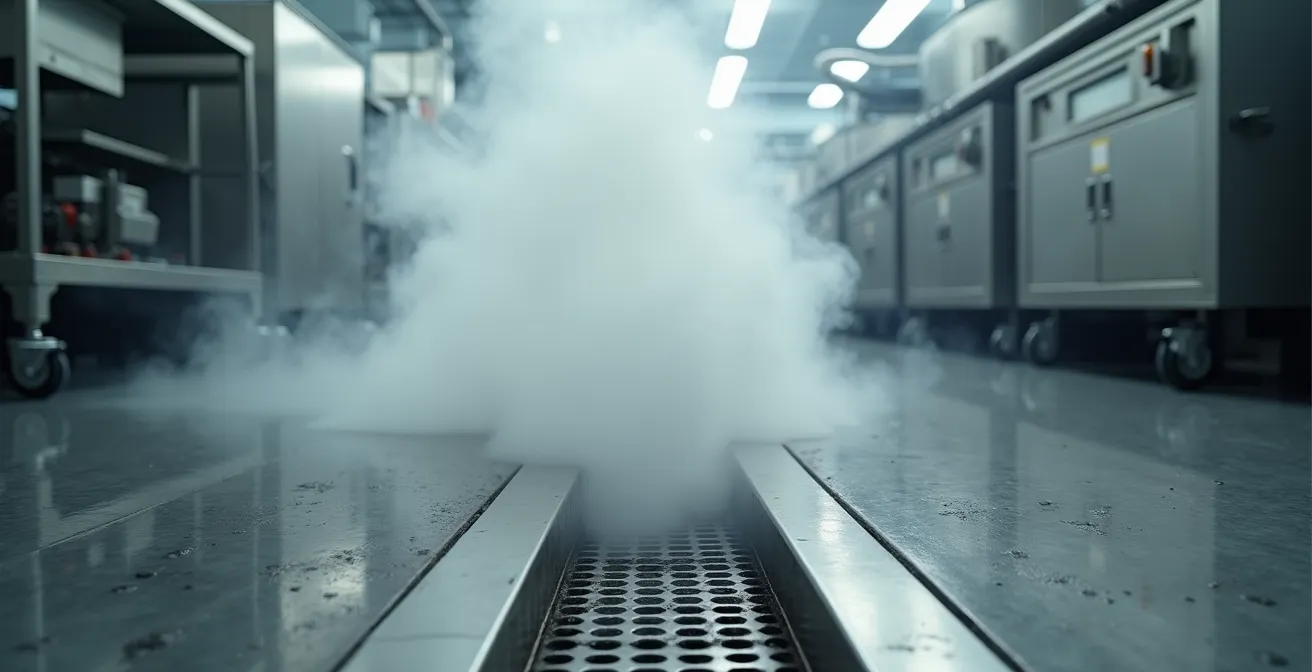
Trench drains in food processing, beverage, and pharmaceutical facilities represent a unique challenge. They must not only handle chemical loads but also withstand the extreme thermal shock of steam cleaning and hot water wash-downs. While polymer concrete is often proposed as a robust alternative to standard concrete, it has a critical vulnerability when compared to stainless steel: a high coefficient of thermal expansion and susceptibility to micro-cracking under rapid temperature changes.
Polymer concrete has a thermal expansion coefficient that is significantly higher than that of stainless steel. When a 120°C steam jet hits the cool surface of a drain, the polymer concrete expands rapidly and unevenly. This repeated cycling of extreme expansion and contraction creates microscopic cracks in the surface. While invisible at first, these micro-cracks become a serious hygiene risk. They create a porous surface that harbors moisture, nutrients, and ultimately, bacteria, creating an ideal environment for biofilm to grow deep within the material where it is shielded from surface cleaning.
Stainless steel, by contrast, is non-porous and has a much lower coefficient of thermal expansion. It handles the thermal shock of steam cleaning without any degradation to its surface. Its smooth, inert surface offers no purchase for bacteria, making it exceptionally easy to clean and keep sterile. This is why stainless steel is the preferred material for meeting the stringent hygiene standards of the Canadian Food Inspection Agency (CFIA) and pharmaceutical GMP. The risk of bacterial growth in polymer concrete cracks requires more frequent and intense inspection and maintenance, whereas a stainless steel drain provides a more reliable, long-term hygienic solution.
| Property | 316L Stainless Steel | Polymer Concrete |
|---|---|---|
| Thermal Expansion Coefficient | 16.5 x 10⁻⁶/°C | 25-35 x 10⁻⁶/°C |
| Steam Jet Resistance (120°C) | Excellent – No degradation | Poor – Micro-cracking occurs |
| Surface Porosity | Non-porous | Develops micro-cracks over time |
| Bacterial Growth Risk | Minimal – Smooth surface | High – Cracks harbor bacteria |
| CFIA Compliance | Full compliance | Requires frequent inspection |
Now that you have a comprehensive understanding of the multiple failure modes—chemical, mechanical, and thermal—the path forward is clear. The correct specification of your industrial piping is not just a line item on a blueprint; it is a strategic decision that directly impacts operational uptime, product safety, and long-term profitability. To ensure your next project is built on a foundation of reliability, the next logical step is to perform a detailed risk and lifecycle cost analysis for your specific application.