
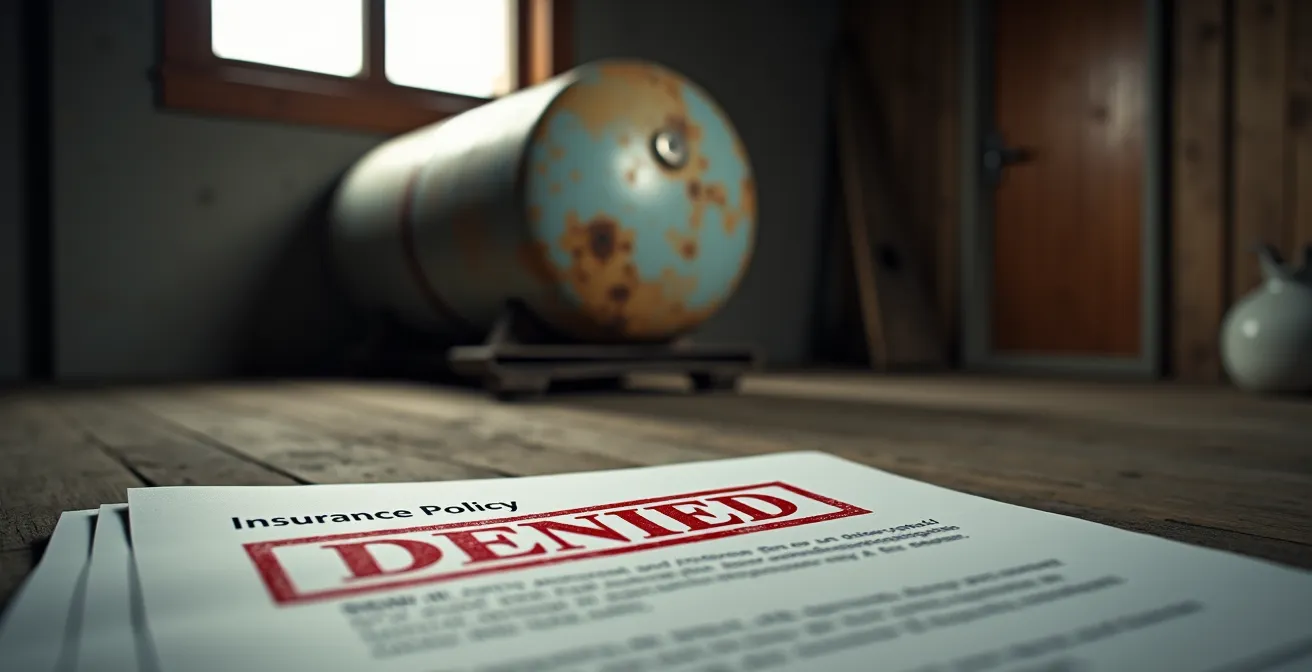
Your insurer’s 20-year rule isn’t just a deadline; it’s a clear warning about a significant financial and legal liability sitting in your basement.
- The primary danger is invisible internal corrosion, a silent process that can lead to catastrophic leaks without any outward signs of failure.
- In Quebec, removing a tank involves a strict legal compliance chain, including licensed contractors (RBQ) and environmental certification (MELCCFP) that is non-negotiable for future insurance or property sales.
Recommendation: Stop viewing this as a forced expense. Treat it as a strategic decommissioning of a major financial risk, leveraging substantial government grants to transition to a safer, more efficient heating system.
So, the letter arrived. The one from your insurance company, stating in no uncertain terms that they will no longer cover your property if that oil tank in the basement is over 20 years old. The immediate reaction is often a mix of panic and frustration. The common advice you’ll hear from neighbours or online forums is simple: “You just have to replace it.” But this advice misses the point entirely and dangerously oversimplifies the situation.
As an insurance broker specializing in residential risks, I can tell you this isn’t about an arbitrary age limit. It’s about a series of interconnected financial and legal tripwires that your old tank represents. Insurers aren’t just being difficult; they are reacting to a well-documented history of catastrophic, multi-million dollar cleanups resulting from tank failures. The age of the tank is simply their line in the sand to manage a risk they no longer wish to bear—a risk that now falls squarely on your shoulders.
The real issue isn’t just the tank itself, but the hidden liabilities it carries: invisible corrosion that can’t be seen from the outside, buried oil lines that are illegal under Quebec law, and a complex web of environmental regulations that govern its removal. For a Quebec homeowner, this is a crisis that requires a strategic plan, not just a quick fix.
This guide will cut through the noise. We will dissect the real risks your insurer sees, explain the non-negotiable legal steps for removal in Quebec, and map out the cost-effective path forward. This is about turning a moment of crisis into a long-term upgrade for your home’s safety and value.
To navigate this complex issue, we will explore the critical aspects you must understand. The following sections break down everything from identifying hidden dangers to understanding the financial incentives for making a change, providing a clear roadmap for your decision-making process.
Summary: Navigating the End of Your Oil Tank’s Insurability
- Fuite de réservoir à l’huile : comment repérer la corrosion interne invisible ?
- Enlever une tank à l’huile : pourquoi faut-il absolument un certificat de disposition écologique ?
- Odeur de mazout dans la maison : est-ce normal au démarrage ou une fuite dangereuse ?
- Prix du litre de mazout vs kWh électrique : le comparatif qui fait mal au portefeuille
- Ligne d’huile enfouie dans le béton : pourquoi devez-vous la condamner immédiatement ?
- Démantèlement de fournaise à l’huile : les étapes et les coûts cachés de la conversion
- Ramonage de chaudière : à quelle fréquence faut-il brosser l’échangeur pour garder le rendement ?
- Is the Hydro-Québec Dual-Energy Rate Worth It for Your Home?
Oil tank leak: how to spot invisible internal corrosion?
The single greatest reason your insurer wants nothing to do with your old tank is a threat you cannot see: internal corrosion. While the outside of a tank might look pristine, moisture from condensation inevitably settles at the bottom, underneath the oil. Over years, this water causes the steel to rust from the inside out. This process is silent, relentless, and the number one cause of unexpected leaks. Your tank can appear perfectly fine one day and be leaking litres of toxic fuel into your foundation the next.
The problem is widespread. In Quebec, the situation is particularly pressing, where the average oil tank age is a startling 28 years, well beyond the 20-year threshold set by most insurers. This means thousands of homes are sitting on a ticking environmental and financial time bomb. A visual inspection is useless against this hidden threat. The only reliable method to assess the integrity of your tank is through ultrasonic thickness testing.
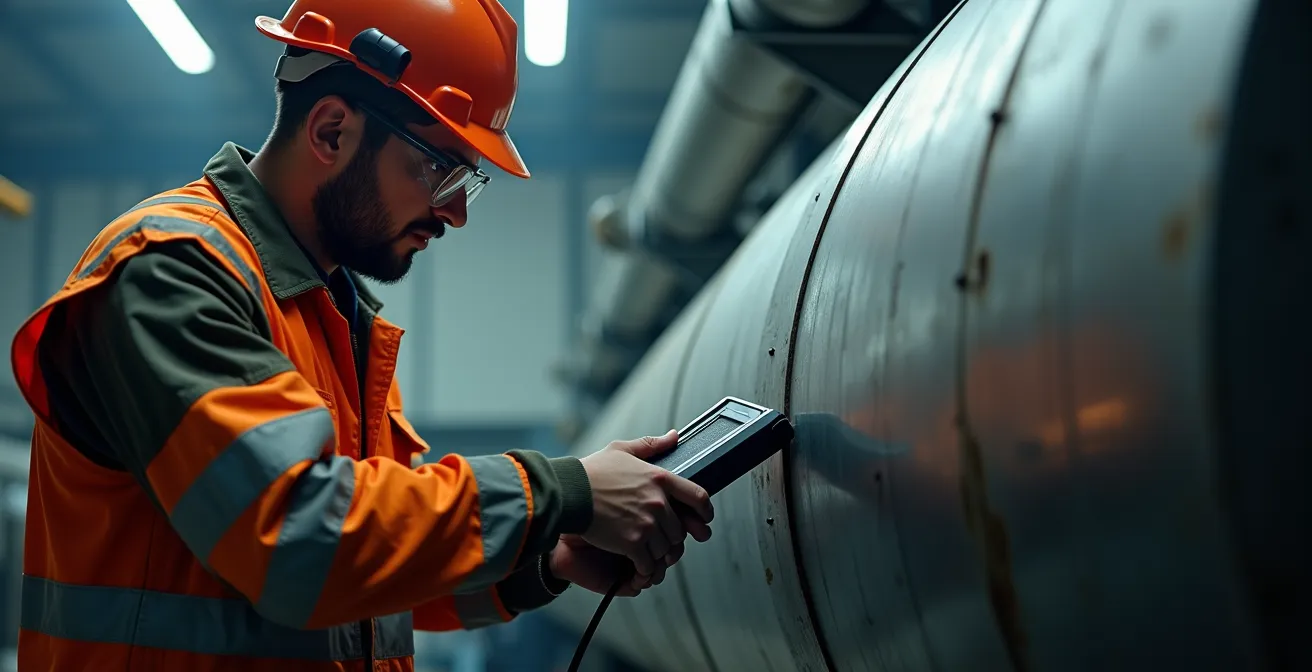
As the image shows, a certified technician uses an EPA-approved device to measure the precise thickness of the tank’s steel walls. This is not a “do-it-yourself” task. This inspection provides hard data on the extent of internal deterioration. Some programs, like TankSure, even offer a warranty if the tank passes inspection, which can be a crucial document to present to your insurer to argue for a temporary extension of your coverage. Without this test, you are simply guessing about your tank’s condition, and your insurer will always assume the worst.
Removing an oil tank: why is an ecological disposal certificate absolutely necessary?
If you decide to remove your oil tank—either because it failed an inspection or you’re converting systems—you enter a strictly regulated process in Quebec. You cannot simply have a handyman haul it away. The removal must be performed by a contractor licensed by the Régie du bâtiment du Québec (RBQ) and registered with the Ministère de l’Environnement, de la Lutte contre les changements climatiques, de la Faune et des Parcs (MELCCFP). Upon completion, you must receive an ecological disposal certificate.
This certificate is not just a piece of paper; it is your legal proof that the tank and any residual fuel were handled and disposed of according to provincial environmental laws. Without it, you could face immense difficulties. If you try to sell your home, the buyer’s notary will almost certainly demand it. If you switch to a new insurance provider, they will require it as proof the liability has been removed. As outlined by environmental consultants like Terrapex, obtaining proper permits under the Environment Quality Act involves a detailed process that protects you from future claims. An environmental consulting firm can help ensure that all steps, including soil assessment and proper documentation, are handled correctly, as highlighted by the comprehensive services they offer to navigate MELCCFP requirements.
Hiring a legitimate company is paramount. A fraudulent contractor might offer a cheap cash deal, but they could illegally dump the tank, leaving you liable for massive cleanup costs and fines if it’s traced back to you. To protect yourself, you must verify the credentials of any company you hire.
Your Action Plan: Vetting a Quebec Oil Tank Removal Company
- Ask for their Régie du bâtiment du Québec (RBQ) license number and verify it online. Ensure they hold the specific subclass for petroleum equipment.
- Request their MELCCFP registration number for environmental services to confirm they are authorized to handle contaminated materials.
- Confirm that a certified professional will be on-site and that mandatory soil sampling will be conducted around the tank area to check for contamination.
- Request a sample of their ecological disposal certificate and the final report you will receive for your records.
- Ask for their protocol and estimated costs if soil contamination is discovered, as this can significantly increase the scope of the project.
Oil smell in the house: normal at startup or a dangerous leak?
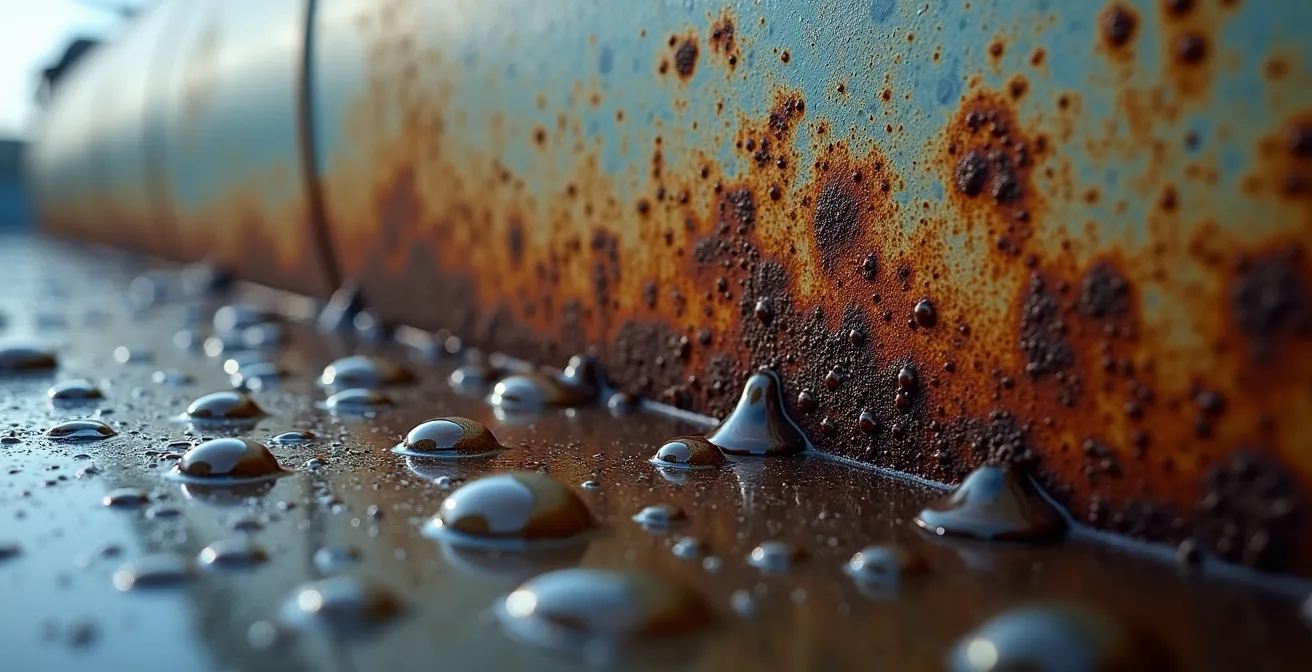
A faint, brief smell of oil or soot when your furnace kicks on after a long period of inactivity can be normal. It’s often just the system burning off accumulated dust. However, a persistent, strong, or oily smell is a major red flag that signals a potential fuel leak. This is a serious hazard that demands immediate attention. Fuel leaks not only pose a fire risk but also release volatile organic compounds (VOCs) into your home’s air, which can cause headaches, dizziness, and other health issues.
Given that about 40% of all oil spills in Canada come from domestic tanks, this is not a risk to be taken lightly. A leak can originate from the tank itself, the fuel lines, the filter, or the burner connections. The source can be as obvious as a dripping valve or as subtle as a pinhole leak from internal corrosion, often caused by the very condensation that plagues older tanks in Quebec’s cold, damp basements.
If you detect a strong fuel smell, do not hesitate. Your immediate priority is safety. Shut down your heating system using the emergency switch (usually a red switchplate at the top of the basement stairs). If the fumes are overpowering or you suspect a fire risk, evacuate the house and call 911 immediately. For environmental emergencies, you should contact Urgence-Environnement Quebec at 1-866-694-5454. For non-urgent health concerns related to fume inhalation, call Info-Santé at 811. Do not operate any electrical switches or appliances, as a spark could ignite the fumes. Ventilate the area by opening windows, then call a certified HVAC technician to diagnose the source of the leak.
Price of oil per litre vs. electricity per kWh: the comparison that hurts the wallet
Beyond the safety and insurance risks, there is a harsh financial reality to heating with oil: it is expensive and getting more so. The price of heating oil is volatile, subject to global market fluctuations, and is steadily increasing due to federal carbon taxes. When you’re forced to consider replacing your tank, it’s the perfect time to do the math and evaluate the long-term cost of staying with oil versus converting to a more stable and cost-effective system, like an electric heat pump or a dual-energy setup.
The numbers are stark. While the upfront cost of conversion can seem daunting, the long-term savings are significant, especially when factoring in the generous grants available to Quebec residents to encourage this transition. For instance, programs like Chauffez Vert and LogisVert offer substantial financial assistance to help homeowners make the switch. A dual-energy system, in particular, can offer the best of both worlds: efficient electric heating for most of the year and a backup fuel source for the coldest days, all while qualifying for Hydro-Québec’s preferential rates.
This table illustrates the long-term financial calculus. While oil heating has no available grants for system maintenance, converting to a dual-energy or electric heat pump system is heavily subsidized, with programs like Hydro-Québec’s offering up to $7,300 in assistance, dramatically lowering the 10-year projected cost.
| Heating Method | Annual Cost Range | Available Grants | 10-Year Projection |
|---|---|---|---|
| Oil Heating (Traditional) | $2,000 – $5,500 | None | $35,000+ (with carbon tax increases) |
| Dual-Energy (Electric/Gas) | $1,200 – $3,000 | Up to $7,300 | $20,000 (with Rate DT savings) |
| Natural Gas Only | $500 – $2,000 | None | $15,000 |
| Electric Heat Pump | $800 – $2,500 | Up to $6,700 | $18,000 |
Oil line buried in concrete: why must you condemn it immediately?
If your property has an oil supply line running from the tank to the furnace that is buried in or under a concrete slab, you have a serious problem that requires immediate action. This type of installation is not just a bad idea; it’s a direct violation of safety codes and is explicitly prohibited. From an insurance perspective, a buried oil line is an uninsurable, high-risk feature that must be decommissioned.
The risk is immense and hidden. The copper line is susceptible to corrosion, and even a pinhole leak can go undetected for years, slowly saturating the soil and concrete beneath your home with heating oil. This can lead to widespread contamination that can travel into foundation drains and spread throughout your property, resulting in cleanup costs that can easily exceed hundreds of thousands of dollars. Quebec-based firms like Environnement PH have documented cases where a seemingly minor buried line led to extensive soil decontamination projects, underscoring the legal mandate for soil sampling during any underground tank work.
The legal standing is unequivocal. The federal government’s regulations, which are adopted by reference in Quebec, are crystal clear on this matter. As stated by the Storage Tank Systems Regulations under the Canadian Environmental Protection Act:
Burying an oil supply line is prohibited by the Code sur le stockage et la manipulation des produits pétroliers adopted by reference in Quebec regulation, making any such existing installation non-compliant and uninsurable.
– Storage Tank Systems Regulations, Canadian Environmental Protection Act
If you have a buried line, you must have it professionally abandoned. This involves disconnecting it, purging it of all fuel, and capping it at both ends. A new, visible, and protected supply line must be installed above the floor. Ignoring this is not an option; it’s a guaranteed way to have your insurance cancelled and to be held fully liable for any resulting environmental damage.
Dismantling an oil furnace: the steps and hidden costs of conversion
Converting from an oil furnace is a multi-stage project with several potential “hidden costs” that go beyond the price of the new heating system. A complete and proper decommissioning involves more than just swapping out the furnace and tank. As a homeowner, you need to be aware of the full scope of work to budget accurately and avoid surprises.
One of the first and most critical steps is to check for asbestos. If your home was built before 1990, there’s a significant chance that asbestos-containing materials were used to insulate the furnace, ductwork, or boiler pipes. This requires professional testing and, if positive, abatement by a certified contractor, which can add several thousand dollars to the project. Another major consideration is your electrical system. A modern electric heat pump requires a dedicated, high-amperage circuit that older electrical panels may not be able to support. An upgrade by a licensed electrician (a member of the CMEQ) is often necessary.
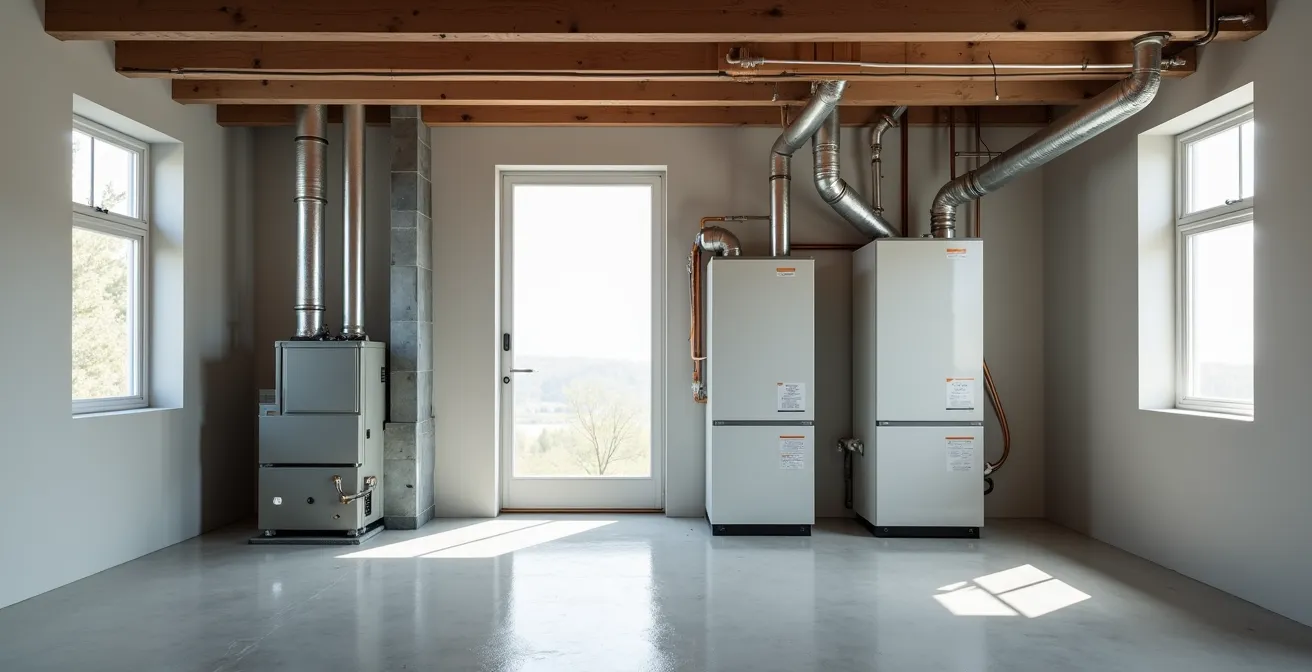
Finally, there’s the chimney. Your oil furnace vented through a chimney, but a new electric system won’t need it. You’ll need to decide whether to have it capped to prevent moisture and animal intrusion or to have a new liner installed if it will be used by another appliance like a gas water heater. Fortunately, significant financial aid can offset these costs. Through combined programs like Chauffez Vert and the Canada Greener Homes Grant, Quebec homeowners can receive grants up to $10,000 for converting from oil to an eligible heat pump system, which makes the entire project much more financially viable.
- Asbestos Testing & Abatement: Mandatory for pre-1990 homes, a potentially significant cost.
- Electrical Panel Upgrade: Often required to handle the load of a new heat pump.
- Oil Tank Removal: Must be done by an RBQ-licensed contractor.
- Chimney Modification: Capping or relining the existing chimney.
Boiler sweeping: how often should you brush the heat exchanger to maintain efficiency?
For homeowners who are not yet ready or able to convert from oil, maintaining your existing system at peak efficiency is not just about saving money—it’s a critical part of risk management. The heart of your furnace’s efficiency is the heat exchanger. As oil burns, it produces soot, which is a powerful insulator. A layer of soot just a few millimetres thick on the heat exchanger’s surfaces can drastically reduce its ability to transfer heat to the air or water, forcing your furnace to run longer and burn more fuel to heat your home.
This inefficiency has a direct financial cost. Considering that Canadian homes typically consume between 1,000 to 3,500 litres of oil annually, even a 10% loss in efficiency due to a dirty system can mean wasting hundreds of dollars each winter. More importantly for your insurer, a poorly maintained, soot-clogged system is a safety hazard. It can lead to improper combustion, the production of carbon monoxide, and an increased risk of a “puff-back”—a small explosion of unburned fuel vapour that can send soot and smoke throughout your entire house, causing extensive damage.
To prevent this, your oil furnace or boiler requires annual professional servicing. This is not optional maintenance; it’s essential. During a service call, a technician will thoroughly brush the heat exchanger to remove all soot buildup, replace the nozzle and oil filter, and perform combustion analysis tests to ensure the system is burning cleanly and efficiently. A clean, well-tuned system is not only more economical to run but also significantly safer, a fact that your insurance provider values. Keeping detailed service records can also be helpful in demonstrating responsible ownership should you ever need to make a claim.
Key takeaways
- The 20-year insurance rule is driven by the high risk of invisible internal corrosion, not just the tank’s age.
- Proper oil tank removal in Quebec is a legal process requiring licensed contractors (RBQ) and an official ecological disposal certificate for future insurance and property sales.
- Converting from oil is a strategic investment in your property’s safety and value, with significant government grants available in Quebec to lower the upfront cost.
Is the Hydro-Québec Dual-Energy Rate Worth It for Your Home?
For many Quebec homeowners backed into a corner by their old oil tank, the Hydro-Québec dual-energy program represents the most intelligent and financially sound path forward. It’s not just an alternative; it’s a strategic upgrade that leverages Quebec’s low electricity costs while maintaining a backup fuel source (like natural gas or propane) for peak cold periods. This approach directly addresses the primary weakness of all-electric heat pumps: reduced efficiency in deep-winter temperatures.
The system is elegantly simple. You install a central heat pump that works in tandem with your new (or existing) gas or propane furnace. The system automatically uses the highly efficient heat pump for the majority of your heating needs. Only when the outside temperature drops below a set threshold (typically -12°C or -15°C, depending on your region) does it seamlessly switch to the backup fuel. This allows you to heat with low-cost electricity for over 70% of the heating season. In return for helping reduce demand on the electrical grid during winter peaks, Hydro-Québec rewards you with its preferential Rate DT, which provides a lower price per kilowatt-hour year-round.
Case Study: Dual-Energy Savings for a Montreal Home
Hydro-Québec’s own data demonstrates the clear benefit. For an average 160m² home in Montreal, switching to Rate DT can generate significant annual savings. By using electricity for the bulk of heating and even for summer air conditioning, customers benefit from the lower electricity rate all year. The system’s automatic switching ensures comfort is never compromised while drastically reducing overall energy costs and grid strain. As confirmed by Hydro-Québec’s analysis of Rate DT, this dual-energy approach is a win-win for both the homeowner and the province’s energy management goals.
The financial incentives, combined with the long-term energy savings and elimination of oil-related risks, make dual-energy a compelling solution. It transforms the forced decision of replacing an old oil tank into a proactive investment in your home’s future value, comfort, and environmental footprint.
The letter from your insurer isn’t an eviction notice; it’s a call to action. By understanding the real risks of internal corrosion and the strict legal framework in Quebec, you can strategically plan your conversion. This turns a moment of crisis into a long-term upgrade for your home’s safety, value, and efficiency. The next step is to get professional evaluations and start exploring the substantial grant options available to you.