
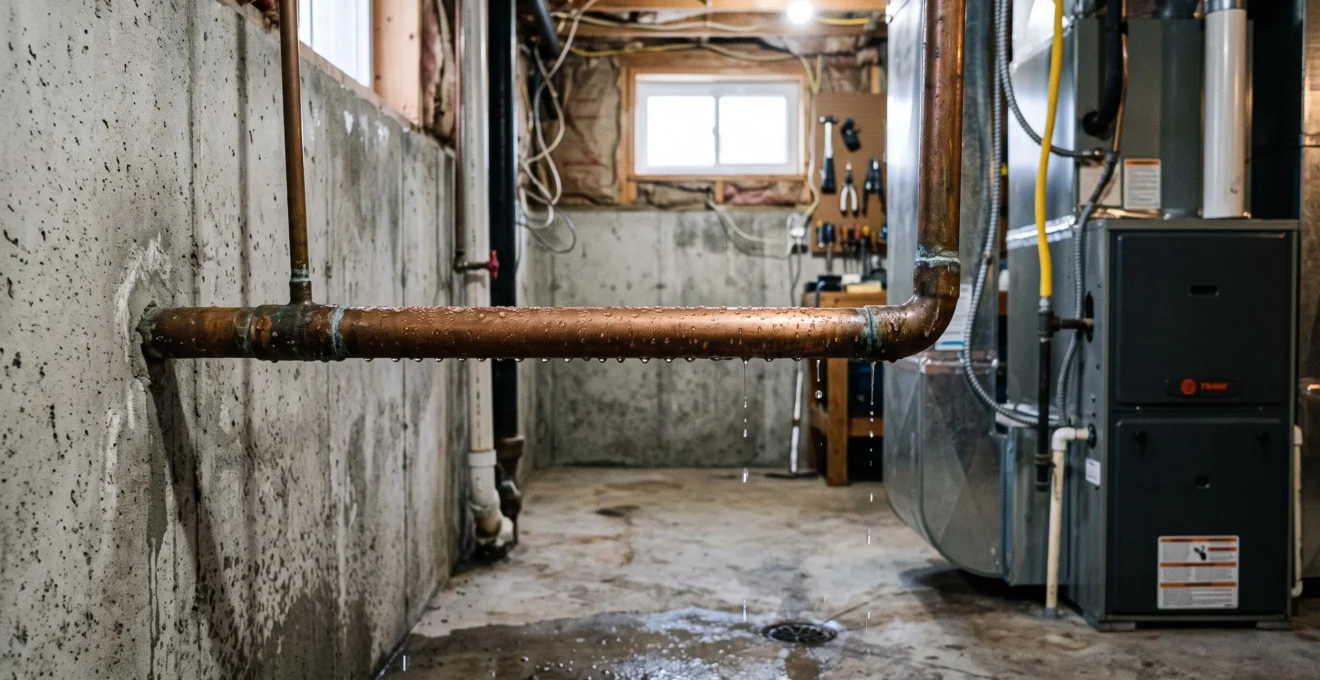
By mid-July, the concrete under the refrigerant lines in a Verdun basement is wet again. The copper beads up, droplets fall at a steady rhythm into a shallow puddle, and a musty smell has settled into the laundry corner. Nothing looks broken: the system cools, the thermostat holds its setpoint, the condensate pan is clear.
That contradiction between visible water and a functioning system explains why bare refrigerant lines get tolerated for two or three summers. The moisture is not a defect. It is the predictable outcome of a cold surface sitting in humid air, and its consequences build slowly: damp framing, conditions that favour mould, and a cooling system fighting heat it was never meant to absorb.
Direct answer: Insulation matters on cold refrigerant lines because their surface temperature sits below the dew point of basement air, which makes condensation continuous rather than occasional. Left bare, those lines deposit water on surrounding materials, create damp conditions that support mould growth, and absorb unwanted heat before it reaches the compressor. The fix is a vapour-tight, continuously sealed insulation, not better ventilation alone.
General information, not a site diagnosis: this article explains principles and selection criteria for Quebec basement conditions. Visible mould, suspected refrigerant leaks, or work on assemblies separating dwelling units call for assessment by a qualified contractor and verification with the Régie du bâtiment du Québec before any work begins.
The physics behind AC pipe condensation in humid Quebec mechanical rooms
A semi-buried basement in the Montreal region behaves like a moisture reservoir during the cooling season. Foundation walls stay cool, air circulation around the mechanical equipment is poor, and continental humid summers push warm, moist air into every unconditioned corner. Practitioners commonly describe unconditioned Quebec basements as sitting in the 60 to 80 % relative humidity range during summer; treat that as an order of magnitude to confirm with an inexpensive hygrometer rather than as a published statistic, since the figure varies with drainage, dehumidification and occupancy.
The other half of the equation is the suction line, the larger of the two copper lines returning cold refrigerant vapour to the outdoor unit. Its surface commonly runs in the 4 to 10 °C range during operation, a value that depends on the refrigeration cycle rather than on the model installed, so anyone comparing specifications to choose a suitable home air conditioner will encounter the same physical constraint. Verify your own line temperature with a surface thermometer if precision matters for your decision.
Dew point in 30 seconds: when air can no longer hold its moisture
Warm air carries water vapour. Cool that same air and it reaches a temperature where the vapour must become liquid: the dew point. Any surface colder than the dew point of the surrounding air collects water, continuously, for as long as the temperature gap exists. Dew point rises with humidity, which is why a damp basement turns cold pipes into collection surfaces while a dry one does not.
The familiar version of this is a glass of iced drink on a humid patio: water appears on the outside of the glass, not from inside it. The difference in a mechanical room is duration and location. The patio glass sweats for twenty minutes onto a table; refrigerant lines sweat for weeks onto joists, subfloor and stored materials, inside an enclosed space where opening a window in July often introduces more humidity than it removes.
Your basement’s condensation recipe
Air at roughly 23 °C and 70 % relative humidity has a dew point near 17 °C, a value you can reproduce with any psychrometric chart or dew point calculator using your own readings. Compare that to a suction line in the 4 to 10 °C range and the gap is unambiguous: the pipe surface is far below the point where vapour condenses, so water forms whenever the system runs.
This is where cold-pipe insulation parts ways with the hot water pipe insulation many homeowners have already installed. On a hot pipe, the goal is slowing heat loss, and a fibrous wrap does that even if vapour passes through it. On a cold pipe, vapour that migrates through a permeable material simply condenses deeper inside, against the cold copper, saturating the insulation from within. The material then holds water against the pipe instead of keeping it away.
How uninsulated AC piping damages your HVAC system and building structure
Two distinct problems run in parallel. The first is thermal: a bare suction line absorbs heat from warm basement air along its entire length, so part of the system’s capacity is spent cooling the mechanical room instead of the living space. Longer run times and higher consumption follow. Published Quebec-specific figures quantifying that loss for residential line sets were not available for this article, so expect a measurable but site-dependent effect rather than a fixed percentage.
The second problem is mechanical. Heat gain along the suction line alters the superheat conditions the compressor was designed around and increases the work it performs per cooling hour. On a system only a few years into its service life, that added strain is the quiet form of damage: nothing fails this season, but operating conditions drift away from design assumptions.
- Stage one, visible condensation: droplets on bare copper during cooling cycles, occasional puddles under the lines.
- Stage two, persistent dampness: staining on concrete or joists, a musty odour that returns each summer, cardboard and stored materials absorbing moisture.
- Stage three, biological growth: colonization of damp porous surfaces near the lines, odour becoming constant rather than seasonal.
- Stage four, material degradation: softened or rotting wood in contact with repeatedly wetted surfaces, degraded adjacent insulation, repairs extending beyond the mechanical room.
Progression speed depends on humidity, air movement and the materials involved, so stages cannot be pinned to fixed dates. The health dimension, by contrast, is documented. The Health Canada mould indoor air guideline identifies condensation of moisture on surfaces as a principal cause of mould growth in homes and states that “mould growth in residential buildings may pose a health hazard”, with risk depending on exposure and, for asthma symptoms, on allergic sensitization. Because individual responses vary widely, Health Canada sets no exposure limit and recommends controlling humidity, repairing water damage and cleaning visible or hidden mould.
Health risk for respiratory conditions: the CCOHS indoor air quality mould guidance notes that moulds can worsen allergy symptoms including wheezing, chest tightness, shortness of breath and nasal congestion, and that people who are immunosuppressed face elevated risk. It also flags standing water around air conditioning drip pans as a moisture contributor. In a household with asthma or allergies, persistent dampness in the mechanical room moves from a property question to a health priority, and the underlying moisture source must be corrected before cleanup, since contaminated porous materials such as drywall or ceiling tile generally have to be removed and replaced.
Which insulation materials actually work in high-humidity mechanical spaces
Selection on a cold line is governed by vapour permeability first and thermal resistance second. A material can carry an attractive R-value and still fail within a season if water vapour reaches the copper through it or around it. The practical question is therefore not which product is best, but which product keeps humid air permanently away from a surface running below the dew point.
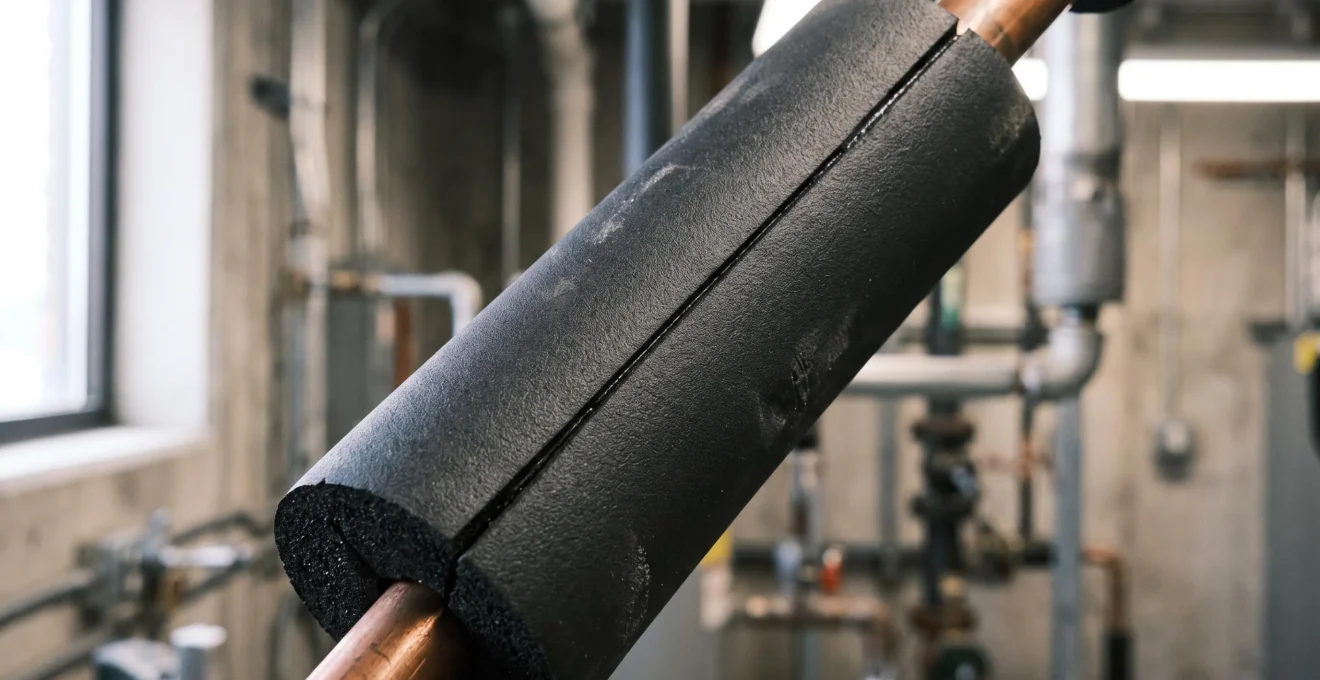
Measure the room before buying anything. A hygrometer reading taken during a hot, humid afternoon, with the air conditioner running, tells you more about material requirements than any product label. The bands below are practical selection guidance rather than code thresholds; confirm vapour permeability and temperature ratings on the manufacturer’s technical data sheet for the product you are considering.
| Measured relative humidity | Materials that generally hold up | Main failure mode to watch |
|---|---|---|
| Below roughly 60 % (dehumidified or dry basement) | Fibrous insulation only if paired with a continuous, fully sealed vapour barrier | Any unsealed seam or tear admits vapour, which condenses inside the wrap |
| Roughly 60 to 70 % | Pre-formed elastomeric rubber sleeves, where the closed-cell structure acts as its own vapour barrier | Gaps at elbows, fittings and custom lengths |
| Above roughly 70 % (typical unconditioned Quebec basement) | Closed-cell foam or elastomeric products with sealed seams, combined with dehumidification of the space | Compression at pipe hangers and incomplete sealing at terminations |
The cheap split-tube fibrous insulation displayed near the plumbing aisle is designed for hot water lines, where vapour transmission is irrelevant. Installed on a suction line in a 75 % humidity basement, it becomes a wet sponge held against cold copper, which is worse than leaving the pipe bare because the moisture is now hidden.
- Measured humidity above 70 %? Restrict the shortlist to closed-cell products and plan for dehumidification.
- Lines accessible along straight runs with standard diameters? Pre-formed elastomeric sleeves become realistic for careful self-installation.
- Numerous elbows, tight clearances or lines passing between dwelling units? Weigh professional installation, where continuity is easier to guarantee.
- Budget pressure? Spend it on vapour-tight material and sealing accessories rather than on extra thickness, since a thick permeable wrap still condenses internally.
Requirements for mechanical spaces, vapour barriers and fire-rated assemblies fall under the Code national du bâtiment as adopted in Quebec, with oversight by the Régie du bâtiment du Québec. Specific clauses change between editions, so confirm applicable requirements with your municipal building department or a licensed contractor rather than relying on a general description.
Critical installation zones requiring extra attention in mechanical rooms
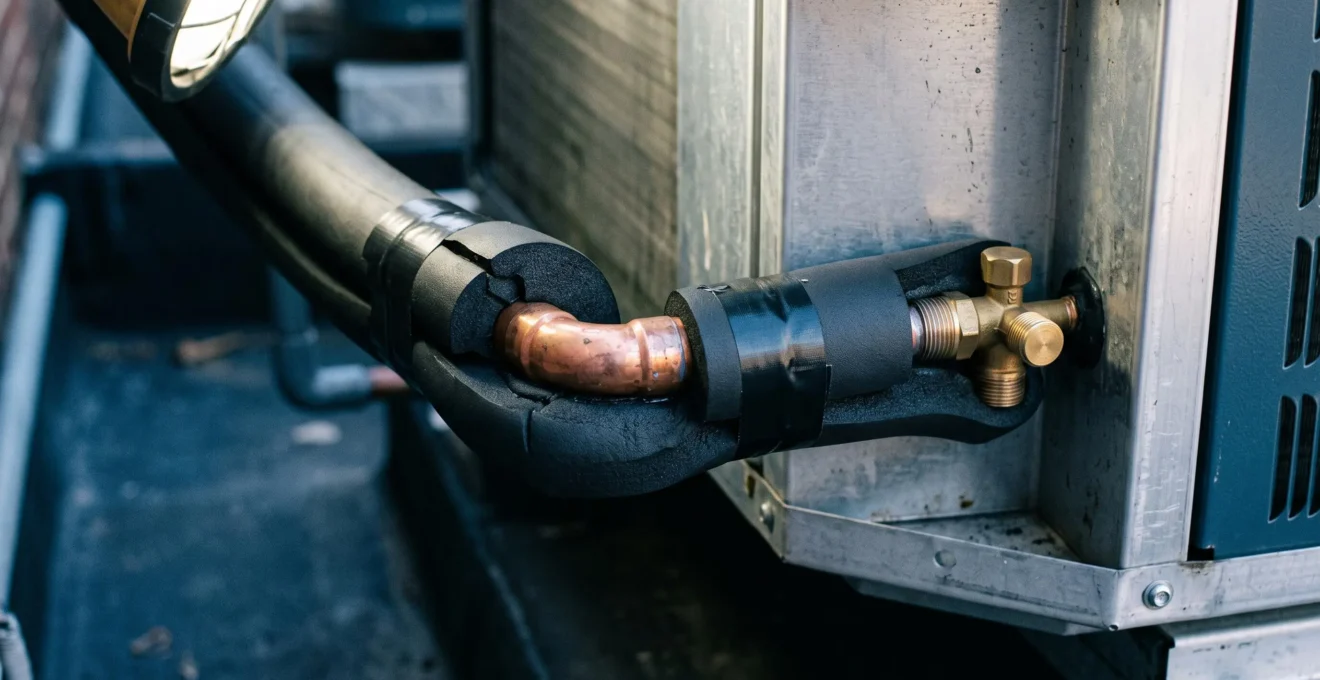
Insulation fails at interruptions, not along straight runs. A line that is 95 % covered but open at two elbows still produces a steady drip, because those exposed centimetres remain below the dew point while now sitting above properly insulated sections that will shed the water onto the floor. Continuity of the vapour seal is the performance criterion, not the quantity of material used.
- Longitudinal seams fully bonded or taped along their entire length, with no opened section.
- Butt joints compressed together and sealed using the overlap and adhesive specified in the manufacturer’s installation instructions.
- Elbows and fittings covered with pre-formed pieces or carefully cut sections, with no bare copper visible.
- Wall and floor penetrations insulated through the assembly, with the vapour seal maintained on both sides.
- No compression at hangers or supports, since crushed insulation loses both thickness and seal integrity.
- Condensate drain lines clear and functioning, so a separate leak is not mistaken for refrigerant line condensation.
- Service valves treated with removable sections that can be resealed after maintenance.
Sealing products matter as much as the insulation itself: tapes and mastics must keep their bond at refrigerant line temperatures, which not all general-purpose products do. The same vapour-control logic applies elsewhere in the building envelope, and homeowners dealing with insulating pipes in crawl spaces face a comparable continuity challenge under different temperature conditions.
Penetrations between units may trigger a code review: in a duplex or triplex, refrigerant lines crossing a floor or wall separating dwelling units pass through assemblies that may carry fire-resistance requirements. Sealing such a penetration is regulated work, and improvising with ordinary foam or tape can compromise both compliance and insurance coverage. Verify the status of the assembly with your municipal building department or a licensed contractor before insulating through it.
When to call an HVAC professional versus tackling insulation yourself
Sliding a pre-formed sleeve over an accessible straight run is within reach of a methodical homeowner. Diagnosing a suspected refrigerant issue, remediating mould, or sealing a rated penetration is not. The useful distinction is based on the conditions in the room, not on general confidence with tools.
- Do you see or smell mould? Address the moisture source and the contamination with qualified help before covering anything.
- Are the lines reachable without dismantling equipment or working in a confined space? If not, professional access tools and experience pay for themselves.
- Do the lines cross between dwelling units or through a rated assembly? Verify requirements before touching the penetration.
- Are you comfortable with slow, detail-driven work where a two-centimetre gap undoes the result? Honest answers prevent a redo.
- Does the system show other symptoms, such as reduced cooling or ice on the lines? That points to a service call, not an insulation project.
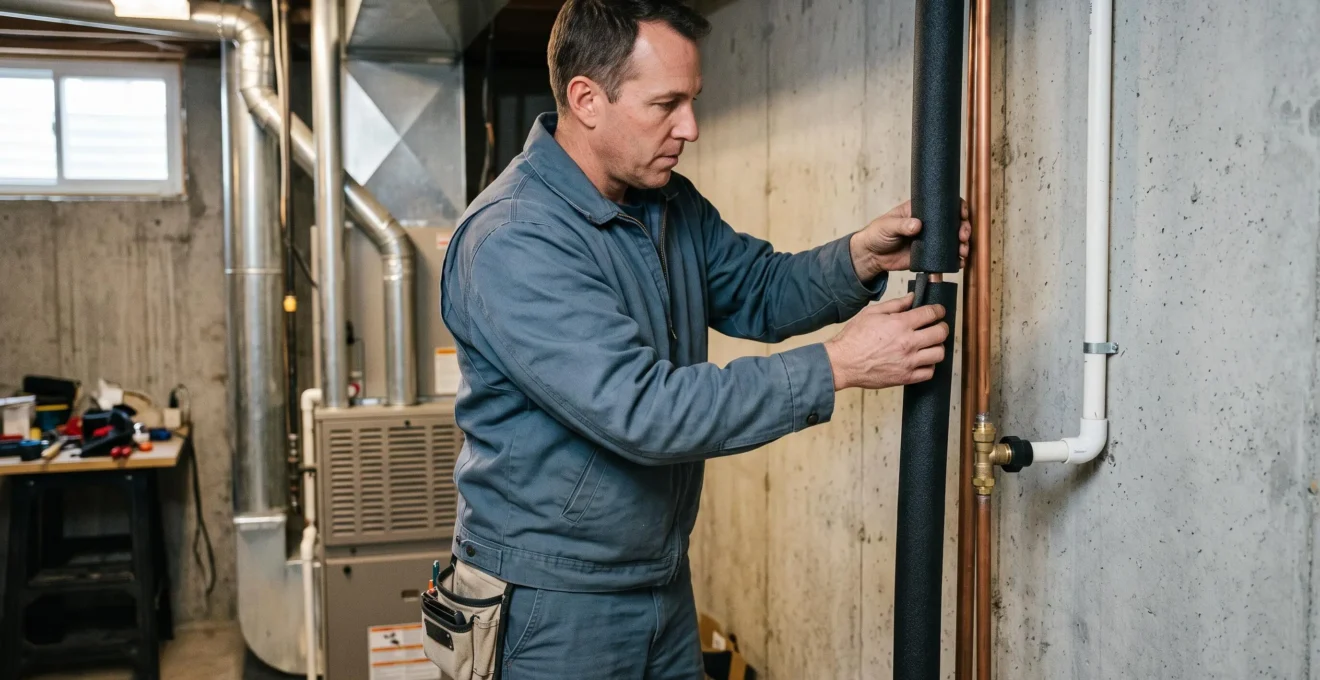
Professional versus self-installation: the complete picture
- Professional advantages: continuity of the vapour seal at difficult geometries, correct sealing products, documentation of the work, and recourse if the result fails.
- Professional constraints: labour cost, scheduling during peak cooling season, and variability between contractors.
- Self-installation advantages: material cost only, immediate action before the next heat wave, and lasting understanding of your own mechanical room.
- Self-installation constraints: no warranty, quality risk concentrated at joints and elbows, and possible compliance questions in multi-unit buildings.
Current market pricing for materials and installation in the Montreal area varies with system size, access and scope, and no verified provincial reference was available for this article, so collect at least two written quotes with a clearly defined scope. Confirm the contractor’s licence status directly with the Régie du bâtiment du Québec and ask for proof of liability insurance before work starts.
Sustaining performance: inspection routines and efficiency monitoring
Insulation is a maintained component, not a permanent fix. Two short inspections a year, one in spring before the cooling season and one in early fall, catch the small separations and compressions that precede a return of condensation.
- Scan the full length of both lines for surface moisture or wet marks underneath.
- Check every seam and butt joint for separation or lifted tape.
- Inspect elbows, valves and terminations for exposed copper.
- Note any musty odour, which often signals moisture you cannot see.
- Feel for damp spots along the insulation surface and at penetrations.
- Look for physical damage from storage, pests or accidental contact.
- Write down what you find so the next inspection becomes a comparison.
Performance can also be tracked indirectly. Recording cooling-season electricity consumption before and after the work, alongside thermostat run-time data where available, gives a baseline you control. Compare similar summers rather than consecutive months, since weather differences easily outweigh the effect being measured.
Quebec energy programs may help fund a broader efficiency project
According to the Rénoclimat program official Quebec government page updated in October 2025, the provincial program has no planned end date and still accepts new applications, while the federal Canada Greener Homes Grant component stopped accepting new applicants on 1 October 2025. Program terms and amounts change, so confirm eligibility and current funding before committing to a scope of work.
Pairing refrigerant line insulation with other envelope or mechanical upgrades generally makes more sense within such a program than treating it as an isolated repair, and homeowners planning that route will find the application logic detailed in this overview of Quebec energy renovation grants.
The droplet on the copper is the same physics as the droplet on a cold glass. What changes in a basement mechanical room is that nobody wipes the table, the moisture lands on wood and concrete, and the system producing it runs for three months straight. Understanding the dew point gap turns that puddle from a summer annoyance into a measurable condition with a defined, verifiable solution.