
For any commercial or institutional project in Quebec, specifying Type L copper is the only professionally responsible choice to ensure long-term system integrity and mitigate liability.
- Type M’s thinner wall is non-compliant for critical applications like gas lines and cannot withstand the dynamic stresses of commercial systems.
- Quebec’s Construction Code, influenced by factors like frost heave and high-pressure fixtures, implicitly and explicitly demands the robustness of Type L.
Recommendation: Immediately audit all project specifications to replace any Type M designations with Type L for domestic water and gas distribution in non-residential buildings to prevent future failures and ensure compliance.
As an engineer or contractor, the choice between Type L and Type M copper piping often appears to be a simple line item in a budget—a trade-off between material cost and perceived quality. The conventional wisdom suggests Type M is sufficient for many above-ground domestic water applications, saving the client a significant percentage on initial outlay. This perspective, however, is dangerously simplistic and fails to account for the unique demands of commercial buildings and the specific regulatory environment in Quebec.
Viewing this decision through the lens of cost alone ignores the concept of ‘technical debt.’ Specifying the thinner-walled Type M in a commercial context is not a saving; it is a deferral of cost, risk, and potential failure. The true question isn’t whether you can save money now, but what the long-term cost of a premature failure will be in terms of water damage, business interruption, and professional liability. The standards are not arbitrary; they are based on the physics of fluid dynamics, material science, and decades of in-field failure analysis.
This guide moves beyond the surface-level debate. We will dissect the technical and legal imperatives that govern copper pipe specification in Quebec’s commercial sector. We will examine why the thicker wall of Type L is not a luxury but a fundamental requirement for system integrity, from withstanding underground soil stress to resisting erosion-corrosion from high-velocity water flow. This is a framework for making a defensible, code-compliant, and professionally sound specification every time.
To navigate this critical subject with the required precision, this article details the essential differences, code requirements, and practical implications. The following sections provide a clear roadmap for specifying the correct copper pipe, ensuring the safety, longevity, and compliance of your plumbing systems in Quebec.
Summary: When Is Type L Copper Mandatory Instead of Type M in Quebec Commercial Buildings?
- Blue (L) vs. Red (M): How to Identify Copper Thickness at a Glance?
- Why Pay 30% More for Type L in Your Residential Water Service Line?
- Water Velocity: Why Does Type L Better Resist Erosion from Turbulence?
- Copper for Propane Gas: Why Is Type G or L Required for Safety?
- Bending Copper: Why Does Type L Bend Better Without Kinking?
- Institutional Toilets: How to Choose Indestructible Fixtures?
- Type M or Type L: Which Is Mandatory for Potable Water in Quebec?
- Why Do Residential Valves Fail Within Months in Industrial Applications?
Blue (L) vs. Red (M): How to Identify Copper Thickness at a Glance?
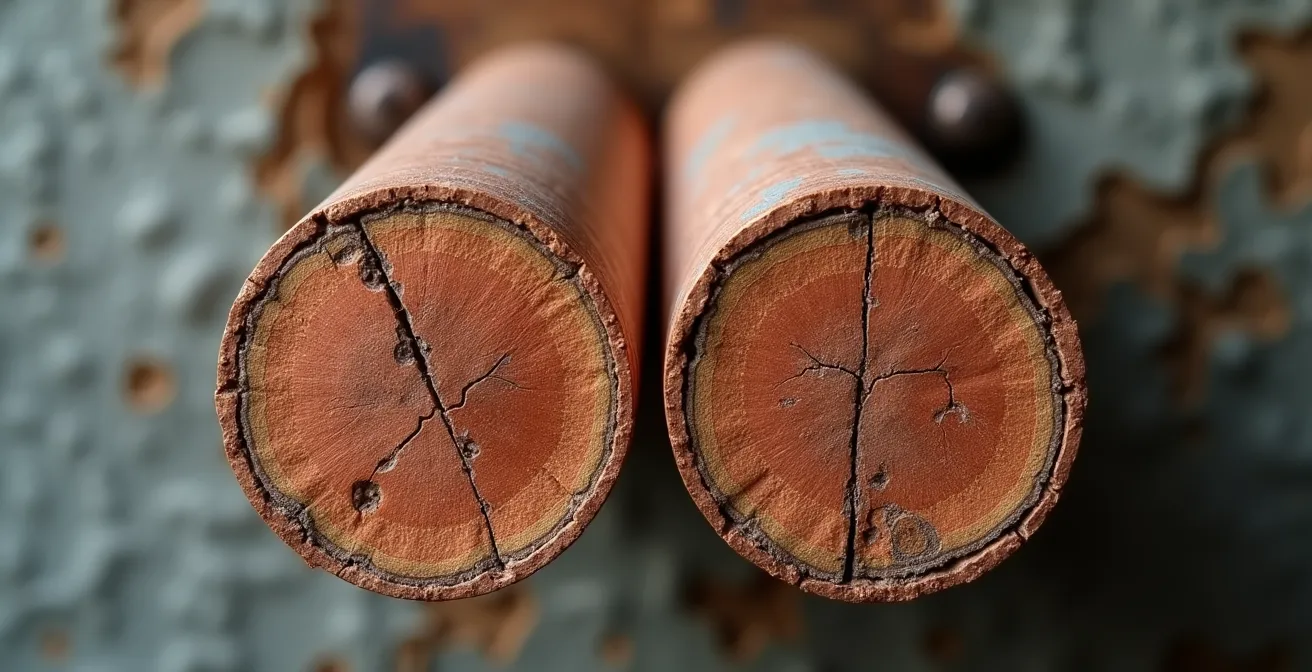
Before any specification or installation, positive identification of the pipe type is a non-negotiable first step. Relying on assumptions is a direct path to non-compliance. The primary differentiators between Type L and Type M copper are wall thickness and the corresponding color-coded markings. Type L, designated by blue printing, has a significantly thicker wall than Type M, which is marked with red printing. This is not a trivial distinction; an engineering analysis shows that Type L contains 42% more copper material per length than Type M for a given diameter. For example, a 3/4-inch Type L pipe has a nominal wall thickness of 0.045 inches, whereas its Type M counterpart measures only 0.032 inches.
While the color coding is the most immediate visual cue, it cannot be the sole point of verification, especially in older installations where markings may be faded or obscured. The legally binding identifier is the ASTM standard ink stamp on the pipe’s surface. A professional inspection must confirm this marking. In its absence, the only definitive method is direct measurement of the wall thickness with precision calipers. This physical verification is the ultimate arbiter of compliance and must be performed if any doubt exists.
Your Verification Checklist: Identifying Copper Pipe in Quebec
- Visual Check: Look for blue printing (Type L) or red printing (Type M) as the initial indicator, which are the standard color codes used in Canada.
- Binding Identification: Locate and verify the ASTM standard ink stamps on the pipe surface, as this is the legally binding identifier of the pipe type.
- Certification Mark: Check for CSA (Canadian Standards Association) certification marks to ensure the pipe complies with the Quebec Construction Code.
- Direct Measurement: If markings are worn or absent, use precision calipers to measure the actual wall thickness. A 3/4-inch pipe measuring ≈0.045″ is Type L; ≈0.032″ is Type M.
- Code Confirmation: Always cross-reference your findings with the project’s approved plans and specifications and the relevant sections of the Quebec Construction Code.
Why Pay 30% More for Type L in Your Residential Water Service Line?
The argument for specifying Type L copper begins with its most critical application: the underground water service line. While this article focuses on commercial buildings, the logic for residential use establishes an important baseline. Here, the initial cost savings of Type M are dwarfed by the immense risk and expense of future failure. An underground leak is not a simple repair; it involves excavation, landscape restoration, and significant disruption. The thicker wall of Type L provides essential protection against the unique challenges of Quebec’s climate, particularly frost heave and soil stress during extreme winter conditions. This added material provides a crucial buffer against mechanical damage from shifting soil and ground settlement.
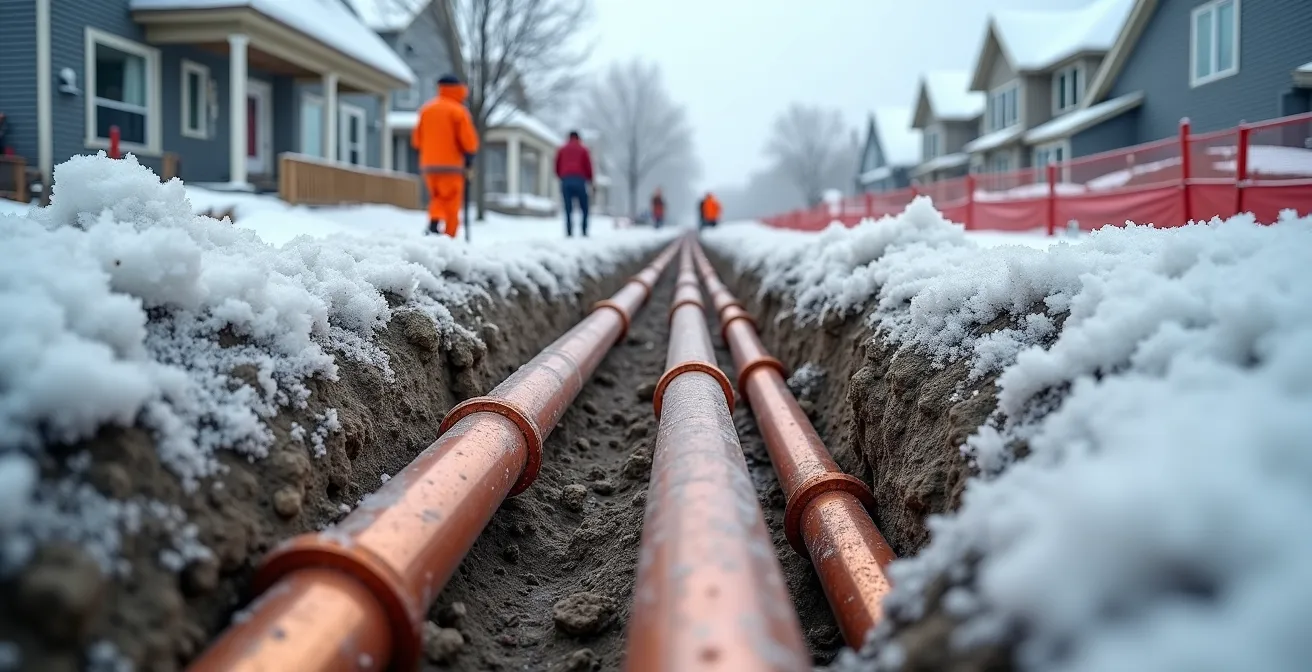
This resilience translates directly into longevity. While Type M may be acceptable in some jurisdictions for certain uses, its lifespan is significantly shorter under pressure. Reputable plumbing industry data indicates that Type L pipes can last 80-100 years, while Type M may fail in as little as 20-30 years. For a component buried beneath a foundation or driveway, this difference is the defining factor. In Quebec, many local building codes have already made this choice explicit, specifying that only Type L may be used for underground water supply lines. Specifying anything less is a failure to design for the expected service life of the building.
Quebec Construction Code and Underground Water Lines
In Quebec residential plumbing systems, Type L copper pipes are the most common for water supply lines under pressure, with some local building codes specifying that only Type L be used. The thicker walls provide essential protection against Quebec’s unique challenges of frost heave and soil stress during extreme winter conditions.
Water Velocity: Why Does Type L Better Resist Erosion from Turbulence?
In commercial buildings, plumbing systems are subjected to far more demanding conditions than in residential settings. Multi-story buildings require higher pressures to serve upper floors, and commercial fixtures often produce higher flow rates. This is where the physics of erosion-corrosion becomes a critical factor. Water moving at high velocity, especially with turbulence caused by fittings and direction changes, can physically scour the interior surface of a copper pipe. Over time, this erosion thins the pipe wall from the inside out, leading to pinhole leaks and eventual failure.
The thicker wall of Type L provides a significantly greater tolerance for this erosive action. While industry standards provide recommended maximum velocities for all copper pipe, the extra material in Type L acts as a crucial safety margin. This is particularly important in hot water recirculation systems, where the combination of high temperature and constant flow accelerates erosion. While Type M might function for a time, it operates with a much smaller margin for error. Any unforeseen pressure fluctuations or design flaws that increase velocity can push it past its point of failure much faster than Type L.
Furthermore, the structural integrity of Type L is superior. The added thickness means engineering specifications confirm Type L provides a higher burst pressure rating, making it inherently more suitable for the higher static pressures found in risers for commercial towers and institutional buildings. Specifying Type M in these applications introduces an unacceptable level of risk for catastrophic failure.
The Copper Development Association provides clear guidelines on this. As shown in the table below, while maximum velocities may appear similar for cold water, the recommendations become much more stringent for hot water systems, where erosion-corrosion is most aggressive.
| Pipe Type | Cold Water Max Velocity | Hot Water (up to 140°F) | Hot Water (above 140°F) |
|---|---|---|---|
| Type M & L | 8 fps (2.4 m/s) | 5 fps (1.5 m/s) | 2-3 fps (0.6-0.9 m/s) |
| Recirculation Systems | N/A | 2 fps (0.6 m/s) | 2 fps (0.6 m/s) |
This table, based on a long-standing analysis of plumbing system design, underscores the need for conservative design, especially in hot water systems. The thicker wall of Type L provides the necessary resilience to stay safely within these parameters over the life of the system.
Copper for Propane Gas: Why Is Type G or L Required for Safety?
When dealing with fuel gas lines, including natural gas and propane, the margin for error is zero. The regulations governing these installations are absolute and carry the force of law. In this context, the specification of Type M copper is not just a poor choice; it is illegal and constitutes gross professional negligence. The governing standard in Quebec is the CAN/CSA-B149.1 Natural Gas and Propane Installation Code, which is adopted by law via the Quebec Construction Code.
This code explicitly prohibits the use of Type M copper for gas distribution. As stated in the Quebec Construction Code’s requirements:
Using Type M for gas is illegal in Quebec, as per the CAN/CSA-B149.1 Natural Gas and Propane Installation Code, which is adopted by law in the province.
– Quebec Construction Code, Chapter II – Gas Requirements
The reasoning is based on mechanical strength. Gas lines are often connected using flare fittings, which place significant stress on the pipe wall. The thin wall of Type M is susceptible to cracking or deforming under the compressive force of a flare nut, creating a leak. Furthermore, gas lines within a building are subject to vibration and minor movements. The ductility and thickness of Type L (or the even heavier Type K) are required to withstand this mechanical stress over decades without fatiguing. A gas leak is a life-safety issue, and the code’s prescription of thicker-walled pipe is a non-negotiable safeguard.
Professional Liability and Non-Compliant Gas Piping
Using non-compliant Type M copper for gas lines in a Quebec commercial building would result in immediate project failure upon inspection by the Régie du bâtiment du Québec (RBQ). It would also void all insurance coverage in the event of an incident, such as a fire or explosion, and expose the specifying engineer and installing contractor to severe professional and legal liability. The mandatory use of Type L or K ensures the pipe walls can withstand the mechanical stress from flare fittings and building vibrations, as required by the Quebec Construction Code.
Bending Copper: Why Does Type L Bend Better Without Kinking?
Beyond its pressure rating and corrosion resistance, Type L copper offers a significant practical advantage on the job site: its superior bendability. For a plumbing contractor, this translates directly into labor savings and higher-quality installations, a crucial factor in the high-labor-cost market of Quebec. When bending a pipe, the outer wall is stretched while the inner wall is compressed. The thinner wall of Type M has less material to accommodate this stress, making it highly susceptible to kinking or collapsing, which creates a flow restriction and a weak point.
Type L’s greater wall thickness provides the necessary material to form a smooth, uniform bend without deformation. The technical specifications demonstrate a 3/4-inch Type L pipe’s 0.045″ wall provides substantially more material to work with compared to Type M’s 0.032″ wall. This allows plumbers to create precise bends, reducing the number of fittings required in a system. Fewer fittings mean fewer solder joints, which in turn leads to several key benefits:
- Reduced material costs from fewer elbows and couplings.
- Significant decrease in soldering time and associated labor expenses.
- Elimination of multiple potential leak points, increasing the long-term reliability of the system.
- Smoother internal flow patterns, which reduces turbulence and the risk of erosion-corrosion, a key requirement in sensitive applications like hospitals and data centers.
In a complex commercial installation with numerous direction changes, the ability to bend pipe rather than install fittings can cut installation time dramatically. It is a hallmark of a high-quality, professional installation. The inability of Type M to reliably handle bending makes it an inferior choice from a workmanship perspective, in addition to its technical limitations.
Institutional Toilettes: How to Choose Indestructible Fixtures?
While the title asks about fixtures, the reliability of any fixture—especially in a high-use institutional setting like a school, hospital, or stadium in Quebec—is entirely dependent on the piping that supplies it. Institutional fixtures, particularly toilets and urinals, often use commercial flushometers. These valves release a high volume of water at high pressure in a very short time, creating a phenomenon known as water hammer—a hydraulic shockwave that reverberates through the supply pipes.
This repeated, violent pressure spike places immense stress on the entire plumbing system. The thinner wall of Type M copper is highly susceptible to failure from metal fatigue under these conditions. Over time, the constant hammering can cause the pipe to weaken and eventually burst. This is a primary reason why plumbing specifications for publicly funded buildings in Quebec, such as schools and hospitals, universally require Type L copper for all domestic water distribution. The goal is to ensure a 50+ year lifespan and minimize long-term maintenance costs, and Type L’s robustness is essential to achieving that.
The choice is not about the fixture itself being indestructible, but about creating a supply system that can withstand the fixture’s normal, aggressive operation for decades. As industry experience shows, Type M can fail from metal fatigue due to water hammer in commercial flushometers, leading to catastrophic and costly water damage. Specifying Type L in these environments is the only way to build a truly resilient system that protects the owner’s investment and prevents service interruptions. The thicker pipe wall provides the necessary dampening and strength to absorb the hydraulic shock without compromising its integrity.
Quebec Public Building Plumbing Standards
Plumbing specifications for publicly funded buildings in Quebec, including schools and hospitals, commonly require Type L copper pipes for all domestic water distribution. This is to ensure a 50+ year lifespan and minimize long-term maintenance. The thicker walls of Type L are specified precisely to withstand the intense water hammer created by commercial flushometers and to resist physical damage in exposed institutional settings.
Type M or Type L: Which Is Mandatory for Potable Water in Quebec?
After examining the technical reasons—from erosion resistance to water hammer—the ultimate question for a specifier in Quebec is what the code mandates. The Quebec Construction Code, which incorporates Chapter III, Plumbing, of the National Plumbing Code of Canada with Quebec amendments, sets the minimum legal standard. While the code may permit Type M for certain above-ground, low-pressure residential applications, this permission does not translate to the commercial sphere.
In commercial and institutional buildings, the combination of higher pressures, greater flow rates, the risk of water hammer, and the need for a 50+ year service life makes Type M an inappropriate and risky choice. While the code might not have a single sentence that says “Type M is forbidden in all commercial buildings,” it achieves the same result through performance requirements and references to other standards. The code requires systems to be durable and safe; as we have seen, Type M fails to meet that standard under typical commercial stresses.
Professional plumbing guides and best practices are unequivocal on this point. As one leading guide summarizes the professional consensus:
Type L is commonly used for commercial settings, underground installations and places where plumbing fixtures need extra reinforcement. Some building codes even require Type L for certain applications.
– Neighbourhood Plumbing, Professional Plumbing Standards Guide
For any specifier in Quebec, the path of professional diligence is clear. Where the code allows for interpretation, best practice and liability considerations must guide the decision. Given the minimal cost difference relative to the total project budget and the immense cost of failure, specifying Type L copper for all domestic water distribution in commercial buildings is the only defensible professional standard. It is the choice that aligns with the intent of the code, which is to ensure safe, durable, and long-lasting plumbing installations.
Key Takeaways
- Type L’s thicker wall is not an upgrade but a baseline requirement for the mechanical and hydraulic stresses of commercial plumbing systems.
- Quebec’s Construction Code and associated gas codes explicitly or implicitly mandate Type L for critical applications like gas lines, underground service, and high-pressure systems.
- Specifying Type M in a commercial context is a ‘technical debt’ that exposes the project and professionals to significant risks of premature failure, water damage, and liability.
Why Do Residential Valves Fail Within Months in Industrial Applications?
The principle of matching material to application extends beyond the pipe itself to every component in the system. The failure of residential-grade components in demanding environments provides a stark analogy for the Type M vs. Type L debate. A residential ball valve, for instance, might be rated for a certain pressure but is not designed for the frequent cycling, vibration, or potential for water hammer found in an industrial or even a heavy commercial process line. It fails not because it is defective, but because it is fundamentally mismatched to the operational demands.
This is precisely the case with Type M copper in commercial applications. It is a residential-grade material being asked to perform a commercial-duty job. The consequences of this mismatch are severe. In Quebec’s heavy industries, such as the pulp and paper mills in the Saguenay region or the dairy processing plants in Granby, even Type L is sometimes insufficient. For applications with constant vibration, high temperatures, or corrosive materials, the even heavier-walled Type K copper is often specified to ensure durability. This context demonstrates how far removed Type M is from being a suitable choice for any demanding environment.
The financial argument for using a cheaper component evaporates when the cost of failure is properly calculated. The initial saving of a few hundred dollars by using Type M on a commercial riser is rendered meaningless by the potential for a six-figure cost in water damage and business interruption when it fails.
This comparative analysis highlights the true cost of specifying an inadequate material. The initial savings are trivial compared to the potential downstream costs of failure.
| Factor | Type M Initial Savings | Potential Failure Cost |
|---|---|---|
| Material Cost Difference | ~30% less expensive | N/A |
| Failed Valve Replacement | Minimal savings | $500-$1,000 |
| Burst Pipe in Commercial Tower | $200-$500 saved initially | $100,000+ in water damage |
| Business Interruption | N/A | Thousands per day |
| Emergency Repair Costs | N/A | 3-5x normal rates |
As this financial breakdown from an analysis of industrial pipe applications shows, the risk-reward calculation overwhelmingly favors specifying the more robust material from the outset.
In conclusion, the decision to specify Type L copper in Quebec commercial buildings is not a matter of preference but of professional obligation. It is a direct response to the demands of the building code, the physics of commercial plumbing systems, and the duty to mitigate long-term risk for the client. To choose Type M is to prioritize a trivial initial saving over the longevity, safety, and integrity of the entire building. For the discerning engineer or contractor, the choice is clear. Your specifications are a permanent record of your professional judgment; ensure they reflect a commitment to quality and durability. Audit your current and future project documents now to ensure compliance and protect your professional standing.