
In summary:
- Your first move is always to stop the source. Immediately locate and shut off the main water valve.
- Safety first: Assess electrical risk. If water is near outlets or the breaker panel, do not touch it. Evacuate and call 911 if needed.
- The correct call order is critical in Quebec: Call an emergency plumber FIRST to mitigate damage, then call your insurance broker.
- Begin damage control by moving essential documents and electronics, then elevating furniture off the wet floor.
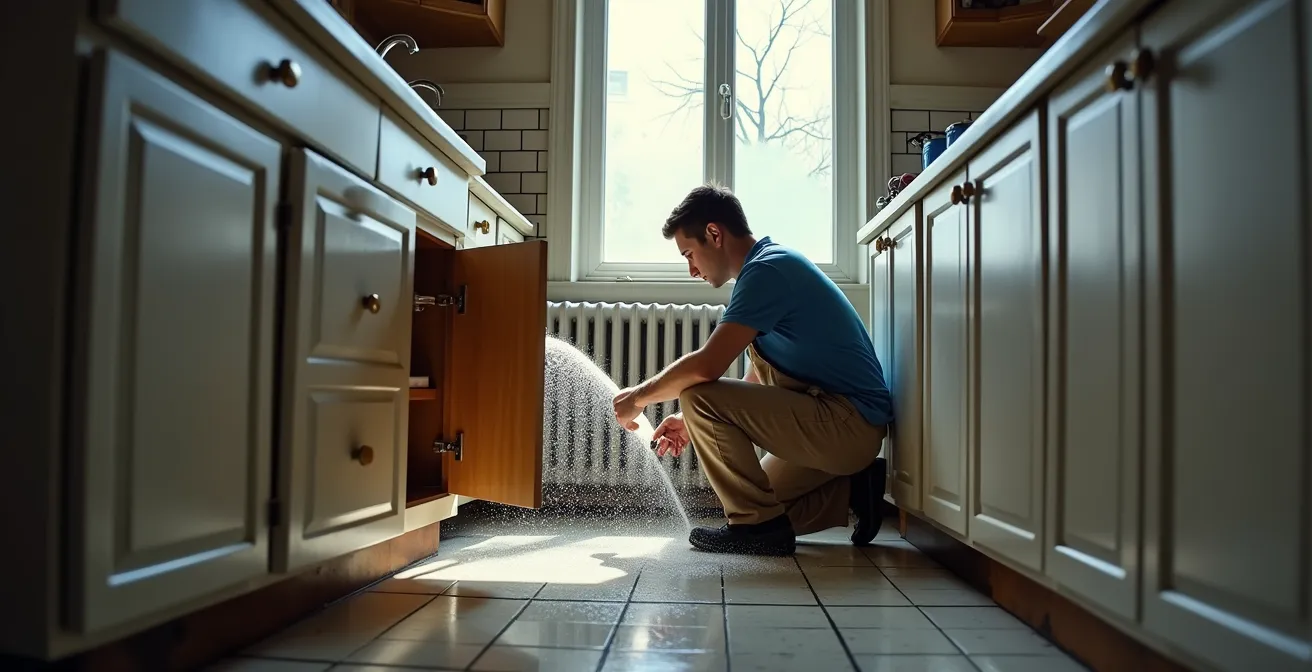
The sound is unmistakable. First a drip, then a stain spreading across the ceiling, and finally a steady stream of water. In this moment, panic is the natural response, but it’s also your greatest enemy. Most homeowners know the basics—turn off the water, call a plumber—but the chaos of a real-time flood can make even simple tasks feel overwhelming. The order in which you act, and the specific choices you make in these first few minutes, can mean the difference between a manageable repair and a catastrophic loss.
This is not just another checklist. This is a 10-minute crisis management protocol, a calm and direct guide designed specifically for the realities of Quebec homes. We will move beyond the generic advice and focus on a prioritized sequence of actions. We will implement a “damage triage” system for your belongings and follow “the golden sequence” for making calls, ensuring you fulfill your legal “duty to mitigate damages” under your Quebec insurance policy. This guide provides the clarity you need to take control when every second counts.
To navigate this emergency effectively, this article is structured as a step-by-step guide. We’ll walk you through locating the main water shut-off in common Quebec house types, assessing electrical dangers, performing damage control, and understanding who to call and when. Follow these steps to protect your home and your peace of mind.
Summary: Your Emergency Water Leak Action Plan
- Where to Find the Main Water Shut-Off in a 1950s Quebec Home?
- Repair Tape and Clamps: Do They Actually Work on a Pressurized Pipe?
- Water and Electricity: When to Shut Off the Main Breaker with Your Feet in Water?
- Tarps and Lifting: How to Save Your Furniture While Water is Flowing?
- Plumber or Insurer First: The Call Order That Changes Everything
- How to Shut Off a Single Fixture Without Turning Off the Whole House
- Ball Valve vs. Gate Valve: Which One Will Still Close After 10 Years?
- Who Pays for the Damage When a Pipe Bursts Inside Your Wall?
Where to Find the Main Water Shut-Off in a 1950s Quebec Home?
Your absolute first priority is to stop the flow of water. In the stress of the moment, locating the main shut-off valve can feel like a scavenger hunt. The stakes are high; water damage tops the list of home insurance claims in Quebec, making this single action the most important one you will take. In older Quebec homes, particularly post-war bungalows built in the 1950s and 60s, the valve is not always in an obvious place. Forget the garage or utility closet; you need to think like a plumber from that era.
Start in the basement. The main water line enters your home from the street, so head to the foundation wall that faces the road. Look for a pipe, typically copper or older galvanized steel, emerging through the concrete. The valve will be located on this pipe, usually within the first few feet of where it enters the house. It might have a round, wheel-like handle (a gate valve) or a straight, lever-like handle (a ball valve). In many municipalities, the incoming pipe or valve is painted blue for easy identification. In a duplex or triplex, the main shut-off for all units may be in a shared, and sometimes locked, furnace room. If you cannot find it or access it, your next call should be to your city’s public works department (dial 311 in Montreal and many other cities) to request an emergency curb stop shut-off at the street.
Repair Tape and Clamps: Do They Actually Work on a Pressurized Pipe?
Once the main water supply is off, you might face a persistent drip or small stream from the remaining water in the pipes. You may be tempted to reach for that roll of “miracle” repair tape. While these temporary fixes can be useful, their effectiveness varies dramatically depending on the type of pipe and the nature of the leak. They are a tool for damage control, not a permanent repair. Their goal is to contain a small leak for the hours it takes for a professional plumber to arrive, preventing further saturation of drywall and flooring.
For modern PEX (plastic) or copper pipes with a pinhole leak, a pipe clamp or a self-fusing silicone tape can be moderately effective. However, on older, corroded galvanized steel pipes, these solutions are often useless and can even be dangerous. Applying a clamp can crush the brittle pipe, turning a small leak into a major break. According to plumbing experts in Montreal, the reliability of these emergency fixes is highly conditional.
| Pipe Type | Repair Method | Effectiveness | Duration |
|---|---|---|---|
| PEX (Modern) | SharkBite Cap | Excellent | Hours to Days |
| Copper | Pipe Clamp | Good | Hours |
| Galvanized Steel | Silicone Tape | Poor (Risk of crushing) | Minutes |
A better temporary solution, if you have access, is an epoxy putty or a push-to-connect cap like a SharkBite. These are available at most Quebec hardware stores like RONA, BMR, or Canadian Tire. But remember, these are strictly stop-gap measures. Your primary goal is to stop the main flow, and your second is to get a licensed plumber on the way.
Water and Electricity: When to Shut Off the Main Breaker with Your Feet in Water?
This is the most dangerous part of any home flood. Water and electricity are a lethal combination, and your safety, and that of your family, overrides any concern about property. The rule is simple and non-negotiable: if the water level is high enough to be in contact with electrical outlets, or if the area around your main electrical panel is wet, you must establish a Safe Zone Protocol. Do not attempt to turn off the power yourself.
The visual below illustrates a common scenario in a Quebec basement. Even if the panel itself is above the water, the risk of electrocution from unseen wiring or a compromised ground is immense. Your only safe action is to evacuate the area immediately.
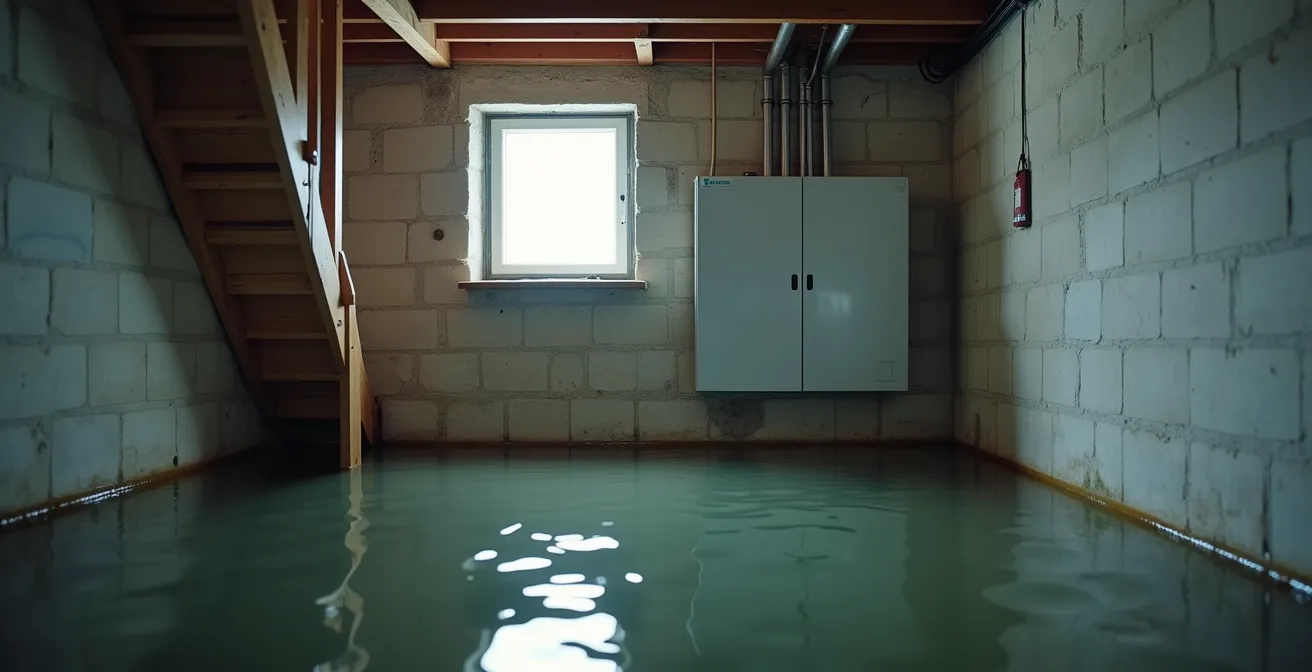
Official guidelines are crystal clear on this point. Your priority is to get everyone out of the house and then make two calls: first to 911 to report the hazardous situation, and second to the Hydro-Québec emergency line for your region to have them cut the power to your home remotely. As the Quebec Emergency Services Guidelines state:
If you are standing in water, DO NOT TOUCH THE PANEL. Instead, call 911 and the Hydro-Québec emergency line.
– Emergency Response Protocol, Quebec Emergency Services Guidelines
Only if you can access your breaker panel from a completely dry area should you consider shutting off the power yourself. If it is safe, flip the main 100 or 200-amp breaker at the top or bottom of the panel. If you can’t identify it, shut off all individual breakers one by one, prioritizing circuits for major appliances like the ‘fournaise’ (furnace) and ‘chauffe-eau’ (water heater).
Tarps and Lifting: How to Save Your Furniture While Water is Flowing?
With the water and electrical situations controlled, your focus shifts to damage triage. This isn’t about frantically moving everything; it’s a calculated effort to save your most valuable and vulnerable items first. The goal is to get things off the floor and protected from ongoing drips. Start by moving small, high-value items to a dry, upper floor. This includes personal documents (passports, legal papers), electronics (laptops, hard drives), and irreplaceable sentimental items like photo albums.
Next, focus on furniture. Not all furniture is created equal when it comes to water damage. Solid wood items are susceptible to swelling and warping, but can often be saved if elevated quickly. Particle board furniture, common from stores like IKEA, is the most vulnerable; it will act like a sponge, swell, and often disintegrate, making it a high priority to lift. Upholstered items like sofas and chairs will soak up contaminated water, leading to mold and bacteria, so they must also be protected. Use whatever you have on hand to get furniture legs off the floor. Plastic blocks, bricks, or even sealed food cans will work. In a true Quebec fashion, empty 4L milk jugs or a stack of hockey pucks make excellent, stable risers.
Your Quebec Household Triage Priority Plan
- Papers & Electronics: Immediately move passports, laptops, and important documents to a higher floor or a safe, dry location.
- Solid Wood Furniture: Lift legs off the floor using stable, waterproof items like 4L milk jugs or hockey pucks to prevent swelling.
- Particle Board Furniture: Prioritize elevating items from stores like IKEA, as they will disintegrate quickly once saturated.
- Upholstered Items: Protect sofas and chairs from absorbing water. If possible, move them or use large plastic containers like municipal “Diable” recycling bins as waterproof shields.
- Contain & Divert: Use WeatherTech-style rubber car mats or rolled-up towels to create small dams, directing water flow towards a floor drain if you have one.
For items directly under a ceiling leak, use plastic tarps or even garbage bags to create a shield. If possible, funnel the drip into a bucket to contain the water and prevent it from spreading further across the floor.
Plumber or Insurer First: The Call Order That Changes Everything
With the immediate threats contained, you’ll reach for your phone. Who you call first—a plumber or your insurance company—is one of the most consequential decisions you’ll make. The answer is unequivocal in Quebec: call a 24/7 emergency plumber first. This isn’t just practical advice; it’s tied to your obligations under your home insurance policy. The law and your contract require you to take all reasonable steps to “mitigate damages,” which means stopping the problem from getting worse.
As the Insurance Bureau of Canada clarifies for policyholders, waiting for an insurer’s approval before stopping a major leak can be seen as a failure to meet this duty. This could potentially lead to a reduction in your claim payout.
Under Quebec insurance law, the insured has a duty to ‘mitigate damages.’ Waiting for an insurer’s permission before stopping a leak can be grounds for reducing a claim payout.
– Insurance Bureau of Canada, Quebec Insurance Guidelines
Once the plumber is on their way, your second call is to your insurance broker (‘courtier d’assurance’) or your insurance company’s 24-hour claims line. Your broker can be a valuable ally, helping you navigate the claims process with providers like Intact, Desjardins, or La Capitale. While on the phone, start documenting everything. Take photos and videos of the leak’s source and all affected areas and items. This evidence will be crucial for your claim. Be aware that you have the right to choose your own restoration contractor; you do not have to use the one recommended by your insurer. For any disputes, the Autorité des marchés financiers (AMF) provides the official Info-Assurance line for Quebec policyholders.
How to Shut Off a Single Fixture Without Turning Off the Whole House
In some cases, the leak is clearly coming from a single source, like an overflowing toilet or a burst supply line under a sink. If you can safely access it, shutting off the water to just that fixture is a much faster and less disruptive solution than cutting water to the entire house. These individual shut-off valves, called “fixture stops” or “angle stops,” are your first line of defense for localized leaks.
Look for them in these locations:
- Sinks: Look in the cabinet directly underneath the sink. You should see two small, oval-handled valves, one for hot and one for cold. Turn both handles clockwise (righty-tighty) until they are firm.
- Toilets: Look on the wall behind or beside the toilet, near the floor. You’ll see a single valve with a small handle connected to a flexible hose running up to the tank. Turn it clockwise to shut off the water.
- Washing Machines: Check the wall behind the machine. There should be two valves, similar to a garden hose spigot, for the hot and cold water lines. Turn both clockwise to close them.
This close-up shows a modern, reliable quarter-turn ball valve. A simple 90-degree turn of the handle is all that’s needed to shut off the flow.
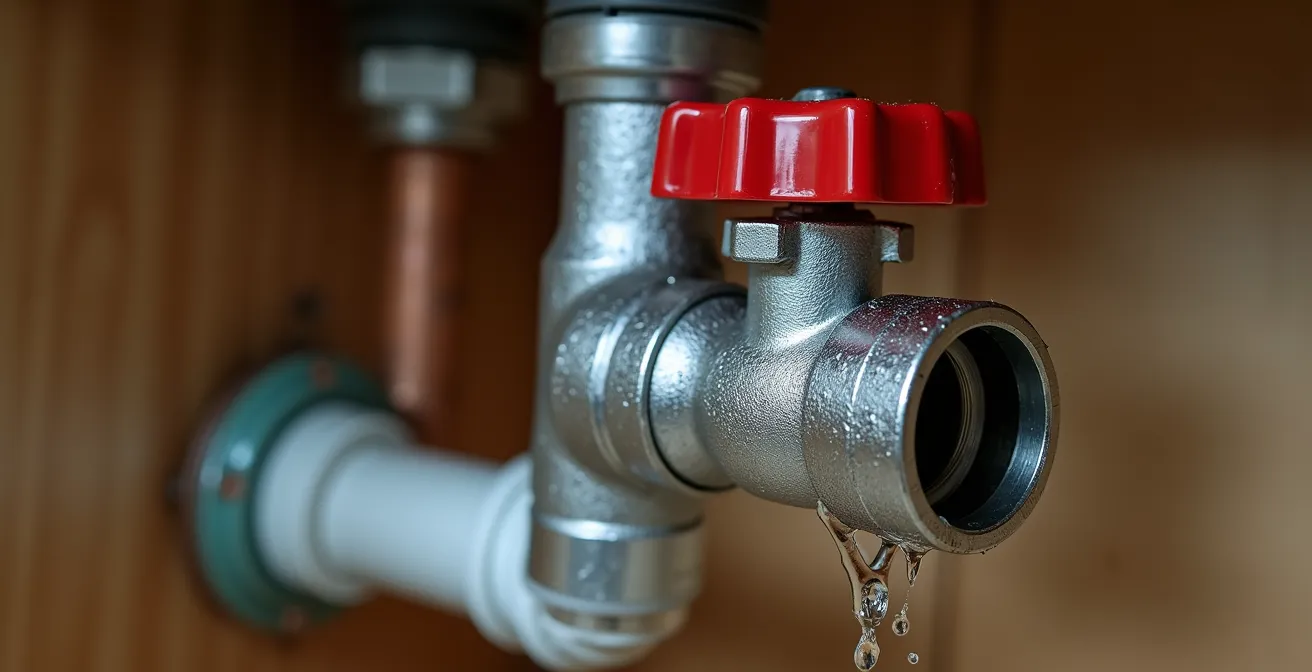
A crucial warning for older Quebec homes: these valves are often multi-turn gate valves that haven’t been touched in years. They can be seized due to mineral buildup. If the handle won’t turn with firm hand pressure, do not force it with a wrench. You risk breaking the valve stem, which will create a new, unstoppable gusher. In this situation, your only option is to revert to shutting off the main water supply for the entire house.
Ball Valve vs. Gate Valve: Which One Will Still Close After 10 Years?
When you rush to your main shut-off, you expect it to work. But in many older homes, the valve itself can be the point of failure. The difference between the type of valve installed in your home—a ball valve versus a gate valve—is the difference between control and catastrophe. A gate valve (‘vanne à guillotine’) uses a round, multi-turn handle to lower a “gate” inside the pipe. Over time, minerals in the water cause this gate to seize in the open position. When you try to turn the handle in an emergency, it either won’t budge or the stem will snap off, leaving it useless.
A ball valve (‘vanne à bille’), on the other hand, uses a lever handle that makes a simple quarter-turn (90 degrees). This rotates a metal ball with a hole through it. It has fewer moving parts and is far less prone to seizing, making it vastly more reliable after years of inactivity. For this reason, plumbers and municipalities across Canada strongly recommend replacing old gate valves with ball valves as a preventative measure.
This table highlights the stark differences in long-term reliability for homeowners.
| Feature | Ball Valve | Gate Valve |
|---|---|---|
| Operation | Quarter-turn (90°) | Multiple turns |
| Reliability after 10 years | Excellent – resistant to mineral buildup | Poor – notorious for seizing |
| Maintenance | Minimal | Regular exercise needed |
| Initial Cost | Higher | Lower |
| Long-term Value | Better – lower maintenance | Higher maintenance costs |
Valve industry analysis confirms that while a ball valve may have a slightly higher initial cost, its superior reliability and lifespan of over 10 years make it far more economical over time. If you have an old gate valve, ask your plumber to replace it with a ball valve during your next service call. It’s a small investment in peace of mind that pays massive dividends in an emergency.
Key Takeaways
- Act Fast and Safely: Your first actions should be to shut off the main water supply and then, only if it is completely safe to do so, turn off the main electrical breaker. Your personal safety is the top priority.
- Mitigate First, Report Second: In Quebec, you have a duty to minimize damage. Call an emergency plumber immediately to stop the leak *before* you call your insurance company. This is crucial for your claim.
- Document Everything: From the moment you spot the leak, use your phone to take extensive photos and videos of the damage. This documentation is your most powerful tool during the insurance claim process.
Who Pays for the Damage When a Pipe Bursts Inside Your Wall?
Once the immediate crisis is over, the question of cost inevitably arises. Who is financially responsible for the repairs and the resulting water damage? The answer in Quebec depends on your living situation: homeowner, tenant, or condo owner. For a homeowner, the situation is generally straightforward. As explained by Info-Assurance Quebec, a standard home insurance policy typically covers “sudden and accidental” water damage from sources inside the home, like a burst pipe or a faulty appliance hose. It’s important to note that damage from external sources, like overland flooding, requires separate, additional coverage (an “endorsement”).
For tenants and condo owners, the lines of responsibility are more complex. A tenant is generally not responsible for damage from a burst pipe unless their negligence caused it. The landlord’s building insurance would typically cover the damage to the structure. In a condominium, responsibility is divided by the Quebec Civil Code and, more specifically, your building’s ‘déclaration de copropriété’ (declaration of co-ownership). This is the single most important document. Generally:
- The ‘syndicat de copropriété’ (condo corporation) and its insurance are responsible for damage to the building’s structure and common areas (‘parties communes’).
- The individual ‘copropriétaire’ (condo owner) is responsible for insuring their personal belongings and any improvements they’ve made to their unit (‘parties privatives’).
Disputes between landlords and tenants are handled by the Tribunal administratif du logement (TAL), which is Quebec’s official authority for rental matters. For any insurance-related disagreements, the AMF’s Info-Assurance line is your go-to resource for impartial advice.
Now that the immediate crisis is managed, the most important step is preventative. Take 15 minutes today to locate and label your main water shut-off valve, your fixture shut-offs, and your electrical panel. Put the numbers for an emergency plumber and your insurance broker in your phone. This preparation is the best insurance policy of all.
Frequently Asked Questions About What to Do in the First 10 Minutes of a Major Water Leak?
Who pays for the damage when a pipe bursts inside my wall?
In Quebec, this depends on your status. For homeowners, standard insurance typically covers sudden internal pipe bursts. For tenants, the landlord’s insurance is responsible unless the tenant was negligent. For condo owners, the building’s insurance covers common areas, while your personal insurance covers your unit’s improvements and belongings, as defined by your ‘déclaration de copropriété’.
Should I call my insurer or a plumber first after a major water leak?
Always call an emergency plumber first in Quebec. Your insurance policy requires you to take reasonable steps to “mitigate damages.” Waiting for your insurer’s permission before stopping the leak could negatively impact your claim. Once a plumber is on the way, then call your insurance broker or company.
How can I find the main water shut-off in an older Quebec house?
In most older homes, especially 1950s bungalows, check the basement along the front foundation wall facing the street. Look for a copper or galvanized steel pipe coming through the concrete. The valve (either a round wheel or a lever handle) will be on this pipe. It may be painted blue by the municipality.