
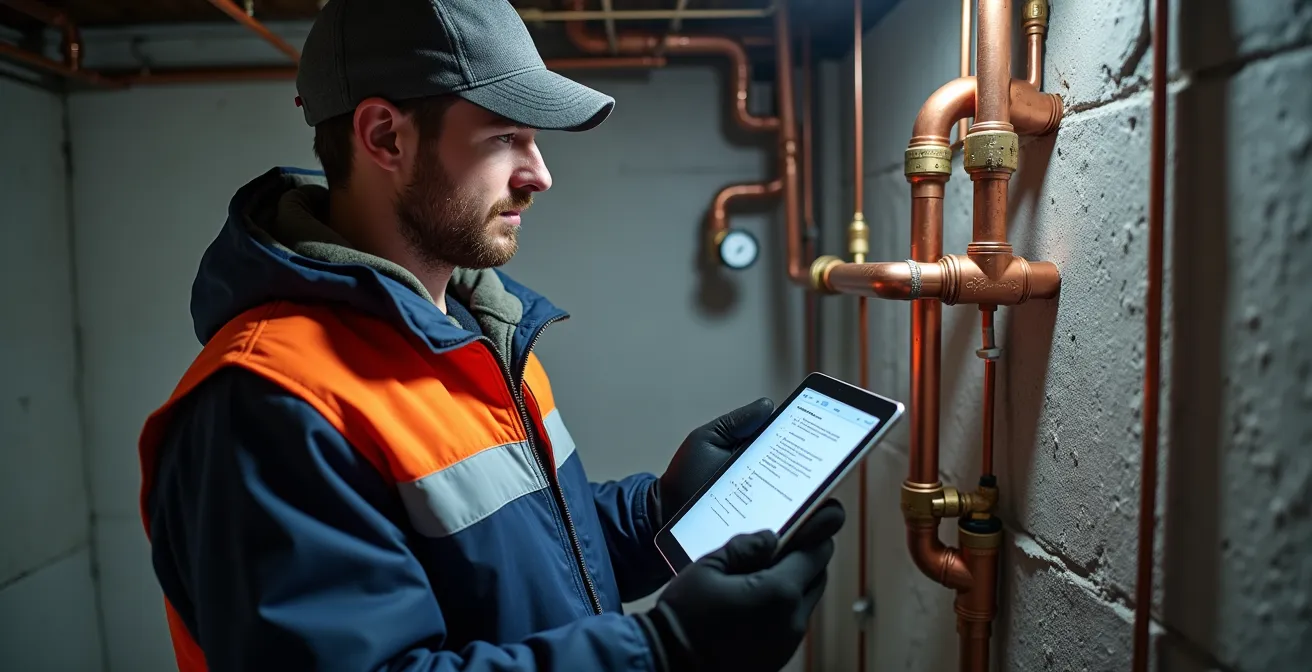
A standard pre-winter plumbing check isn’t enough in Quebec; your insurer can deny a water damage claim by citing simple maintenance oversights as “negligence.”
- Most homeowners focus on tasks like disconnecting hoses but miss critical points like rubber washing machine hoses or failing grout, which are common reasons for claim denial.
- The key to securing your coverage is not just doing the maintenance, but creating an irrefutable documentation trail (photos, videos, certified invoices) that proves proactive care.
Recommendation: Transform your seasonal checklist into an “insurability audit” by documenting every inspection and repair, especially those performed by a CMMTQ-certified plumber.
As a home insurance broker in Quebec, I see the same tragedy play out every spring. A homeowner discovers extensive water damage after the thaw, files a claim with confidence, and is met with a denial. The reason? A “negligence clause” was triggered by an issue they never even considered, like a burst washing machine hose or a slow leak from a shower they thought was fine. The standard advice—”insulate your pipes” and “disconnect your hoses”—is dangerously incomplete. It protects your pipes but does little to protect your insurance policy.
The harsh reality of a Quebec winter, with its dramatic freeze-thaw cycles, puts unique stress on a home’s plumbing system. Insurers are acutely aware of this and scrutinize water damage claims for any sign of poor maintenance. A blackened line of grout or a five-year-old rubber hose isn’t just an aesthetic issue; it’s a red flag that can void your coverage, leaving you with a bill that can easily exceed five figures. This is why a simple maintenance checklist is insufficient. You need an insurability audit.
This guide reframes your pre-winter preparation. We will move beyond the obvious tasks and focus on the critical inspection points that insurers look for. Each section is designed not just to tell you what to check, but to explain the insurance risk behind it and, most importantly, how to create a documentation trail that will make your claim undeniable. This is your proactive defense against the financial devastation of a denied water damage claim.
This comprehensive guide details the essential plumbing checks that protect both your home and your insurance coverage. Discover the critical points to inspect, why they matter to Quebec insurers, and how to properly document your diligence.
Summary: Your Essential Pre-Winter Plumbing Insurance Audit
- Joints de douche noircis : quand faut-il les refaire pour éviter l’infiltration ?
- Inspection des évents de toit : comment repérer les fissures dans le scellant ?
- Pompe de puisard (Sump Pump) : le test de la chaudière d’eau est-il suffisant ?
- Tuyaux de laveuse en caoutchouc : pourquoi les assureurs exigent-ils de l’acier tressé ?
- Photos et factures : comment prouver votre entretien en cas de litige ?
- L’erreur de rénovation qui annule votre assurance habitation en cas de dégât d’eau
- Clapet antiretour : comment savoir s’il fonctionne encore après 5 ans ?
- Who Pays for the Damage When a Pipe Bursts Inside Your Wall?
Joints de douche noircis : quand faut-il les refaire pour éviter l’infiltration ?
That blackened or crumbling grout in your shower is more than a cosmetic nuisance; it’s a flashing neon sign for potential water infiltration. From an insurer’s perspective, failing to address compromised grout is a clear sign of neglected maintenance. Over a winter, these tiny cracks allow water to seep into wall cavities, leading to mold, rot, and structural damage. This gradual leakage is often discovered months later, and a claims adjuster can argue that your inaction contributed to the loss. This can result in a partial or even full denial of your claim.
The financial stakes are high. Slow, persistent leaks are insidious, and the cost to remediate the resulting mold and structural decay can be enormous. Data from the Canadian insurance industry shows that the average cost of water damage from gradual leaks often exceeds $25,000. This is precisely the kind of expensive, preventable damage that your pre-winter audit is designed to avoid. Documenting that you’ve inspected and repaired your grout is a critical piece of your proactive care portfolio.
Your Action Plan: Grout Integrity Audit
- Perform the ‘dime test’: Press a dime firmly into the grout lines. If the edge sinks in or the grout feels soft, its structural integrity is compromised and it’s no longer waterproof.
- Check for color variations: Consistently blackened areas, even after cleaning, indicate persistent moisture retention within the grout, a precursor to mold growth inside the wall.
- Run your finger along grout lines: If the grout feels powdery or crumbles under light pressure, it has failed and needs to be replaced immediately.
- Use a digital moisture meter: Test the walls adjacent to the shower. Any reading above 15% moisture content strongly suggests an active water infiltration that requires urgent attention.
- Document your findings: Before winter arrives, take clear, dated photos of your grout’s condition (whether good or bad) and any repairs made. This is your evidence for insurance records.
By treating your shower grout not as a cleaning task but as a crucial waterproofing inspection, you shift from passive homeowner to a proactive risk manager, a stance your insurer will appreciate in the event of a claim.
Inspection des évents de toit : comment repérer les fissures dans le scellant ?
Your home’s plumbing doesn’t stop at the ceiling. Plumbing vents, which penetrate the roof to equalize pressure and allow drainage, are a primary entry point for water if not perfectly sealed. In Quebec, the sealant around these vents is under constant assault from the elements. The main culprit is the region’s notorious freeze-thaw cycle, which puts immense stress on roofing materials.
This macro shot shows the devastating effect of a Quebec winter on roof vent sealant. The visible cracks are not just cosmetic; they are direct pathways for water during the spring thaw.

As the image illustrates, once micro-fissures form in the fall, winter moisture gets in. When it freezes, it expands, widening the cracks. A detailed case study on Quebec homes highlights this specific risk: standard asphalt-based sealants can fail in as few as 2-3 winters. The study revealed that during a freeze, water trapped in these micro-fissures can expand by up to 300%, turning a tiny flaw into a significant leak path. When ice dams form on the roof, water backs up and flows directly through these compromised seals, often leading to damage in ceilings and walls that isn’t discovered until much later.
Case Study: The Quebec Freeze-Thaw Cycle’s Impact on Roof Sealants
Quebec typically endures 40-50 freeze-thaw cycles each winter. A study of Montreal-area homes demonstrated that common asphalt-based sealants failed within 2-3 seasons under these conditions. In contrast, elastomeric sealants rated for -40°C maintained their integrity for over 7 years. This proves that using material ill-suited for the local climate can be interpreted as negligence by an insurer, as the failure was predictable.
Before the first snowfall, visually inspect the sealant around all plumbing vents. Look for any signs of cracking, peeling, or pulling away from the pipe. Documenting this with photos—and receipts for any new, cold-rated sealant applied—adds another layer of proof to your maintenance file.
Pompe de puisard (Sump Pump) : le test de la chaudière d’eau est-il suffisant ?
Pouring a bucket of water into the sump pit to see if the pump turns on is the most common test, but from an insurance standpoint, it’s dangerously inadequate for a Quebec winter. It confirms the pump works *right now*, but it fails to test the two most likely points of failure during a critical event: the discharge line’s vulnerability to freezing and the pump’s reliance on grid power. An ice storm that knocks out power and a frozen discharge pipe that creates an ice dam are precisely the scenarios that lead to catastrophic basement floods.
An insurer will want to see that you’ve considered these region-specific risks. Simply saying “I tested the pump” isn’t enough when the flood was caused by a frozen-shut outlet pipe. The most critical data point to remember is that, according to Canadian property insurance data, a staggering 90% of basement flooding occurs during power outages. This statistic alone proves that a sump pump without a reliable, tested battery backup system offers a false sense of security.
A complete pre-winter audit of your sump pump system must go far beyond the bucket test. You need to ensure the entire system is resilient against freezing and power loss. Here are the essential steps:
- Discharge Line Integrity: Ensure the discharge line extends at least 6 feet from your foundation and has a constant downward slope (1/4 inch per foot) to prevent water from sitting and freezing inside the pipe.
- Freeze Protection: Install a specialized freeze-resistant discharge attachment (like an IceGuard). This allows water to escape even if the end of the pipe is blocked by snow or ice.
- Battery Backup Test: The most crucial step. Unplug the main pump and repeatedly test the backup system until you are certain it will activate and run. Test it monthly, as batteries can fail without warning.
- Discharge Point Clearance: During winter, make a weekly habit of clearing snow and ice away from the discharge point outside to prevent blockages.
By documenting these extra steps—photos of your sloped discharge line, the IceGuard installation, and a log of battery backup tests—you demonstrate a level of proactive care that is difficult for any claims adjuster to dispute.
Tuyaux de laveuse en caoutchouc : pourquoi les assureurs exigent-ils de l’acier tressé ?
Those black rubber hoses connecting your washing machine are one of the most common and easily preventable causes of catastrophic water damage claims. From an insurance broker’s viewpoint, they are a ticking time bomb. Rubber degrades over time, becoming brittle and prone to developing bulges and cracks. A burst hose can release over 2,000 litres of water per hour, causing tens of thousands of dollars in damage within a very short time. For this reason, many Quebec insurers now consider the presence of old rubber hoses to be an act of negligence.
The Insurance Bureau of Canada has become increasingly clear on this point. In their guidelines, they stress that predictable equipment failures are the homeowner’s responsibility. As their spokesperson noted in the most recent Quebec guidelines:
A burst rubber hose is considered negligence in Quebec insurance policies, automatically voiding water damage coverage
– Insurance Bureau of Canada, 2024 Quebec Home Insurance Guidelines
This isn’t a grey area; it’s a black-and-white rule. The solution is simple and inexpensive: replace them with braided steel hoses. These hoses have a much higher burst pressure and a significantly longer lifespan, making them the standard required by most major insurers.
The difference in performance and insurance status is stark. This comparison shows why the small investment in steel hoses provides an incredible return by safeguarding your coverage.
| Feature | Rubber Hoses | Braided Steel Hoses |
|---|---|---|
| Lifespan | 3-5 years | 10+ years |
| Burst Pressure | 150-200 PSI | 250-300 PSI |
| Insurance Status | Often grounds for claim denial | Required by Desjardins, Intact, La Capitale |
| Cost | $15-20 | $35-45 |
| ROI if prevents one claim | N/A | 625x return ($25,000 saved vs $40 cost) |
Before winter, inspect your hoses. If they are rubber and more than three years old, replace them. Take a dated photo of the new braided steel hoses installed on your machine. This single picture can be the difference between a fully covered claim and a devastating financial loss.
Photos et factures : comment prouver votre entretien en cas de litige ?
In an insurance dispute, the burden of proof is on you, the homeowner. Saying “I perform regular maintenance” is meaningless without evidence. A claims adjuster’s job is to validate the claim, and if there’s ambiguity, their default position is often to deny. This is where your documentation trail becomes your most powerful asset. It transforms your word into a verifiable, timestamped record of proactive care that an insurer cannot easily dismiss.
A well-organized digital file is your best defense. It should contain photos, videos, receipts for materials, and itemized invoices from certified professionals. This isn’t just about proving you did something; it’s about proving you did it correctly and at the right time. For example, an invoice that just says “Plumbing work: $200” is weak. An invoice that says “Annual backwater valve inspection, cleaning, and function test” and includes the plumber’s CMMTQ certification number is an ironclad piece of evidence.
Case Study: How Documentation Won a $35,000 Quebec Insurance Dispute
A Montreal homeowner faced a denied claim for $35,000 in basement water damage. The insurer cited negligence due to a failed backwater valve. However, the homeowner was prepared. They presented a digital folder containing timestamped photos of their annual valve maintenance for the past three years, alongside itemized invoices from a CMMTQ-certified plumber detailing the inspection and cleaning. Faced with this indisputable proof of proactive care, the insurer reversed their decision and approved full coverage for the claim. This case perfectly illustrates that documentation is not administrative work; it is financial defense.
Creating this binder is straightforward if you’re systematic. Here’s how to build your digital defense file:
- Create a Central Hub: Set up a dedicated cloud folder (Google Drive, Dropbox) clearly labeled “Home Maintenance – Insurance Records [Your Address]”.
- Document DIY Work: For tasks you do yourself, record a short video of the completed work. Use a timestamping camera app so the date is visibly embedded in the video file itself.
- Digitize All Receipts: Immediately photograph receipts for any materials purchased, from sealant to plumbing fittings, ensuring the date is clearly legible.
- Demand Itemized Invoices: When hiring a professional, insist on an invoice that lists the specific tasks performed. Vague descriptions are worthless in a dispute.
- Verify CMMTQ Certification: Crucially for Quebec, ensure your plumber’s CMMTQ (Corporation des maîtres mécaniciens en tuyauterie du Québec) certification number is printed on every invoice. This proves you hired a qualified professional.
This process may seem tedious, but it takes only a few minutes after each task. In the event of a claim, this small effort can be worth tens, if not hundreds, of thousands of dollars.
L’erreur de rénovation qui annule votre assurance habitation en cas de dégât d’eau
Many well-intentioned homeowners undertake DIY renovations to improve their homes, especially finishing basements. However, one mistake in this process can have a catastrophic insurance consequence: performing plumbing work without a certified professional. In Quebec, the rules are stringent and non-negotiable. Any modification to your plumbing system beyond the most basic faucet replacement must be done by a plumber holding a valid CMMTQ certification. Failure to comply is not a minor oversight; it’s a direct violation of the Quebec Construction Code.
This is the ultimate hidden trap. A pipe fitting installed incorrectly by an amateur during a renovation five years ago can fail today, causing a major flood. When the insurer’s investigator discovers the non-compliant work, they have clear grounds to void your entire water damage claim, regardless of any other maintenance you’ve performed. The argument is simple: the root cause of the loss was an illegal and substandard installation, which constitutes gross negligence.
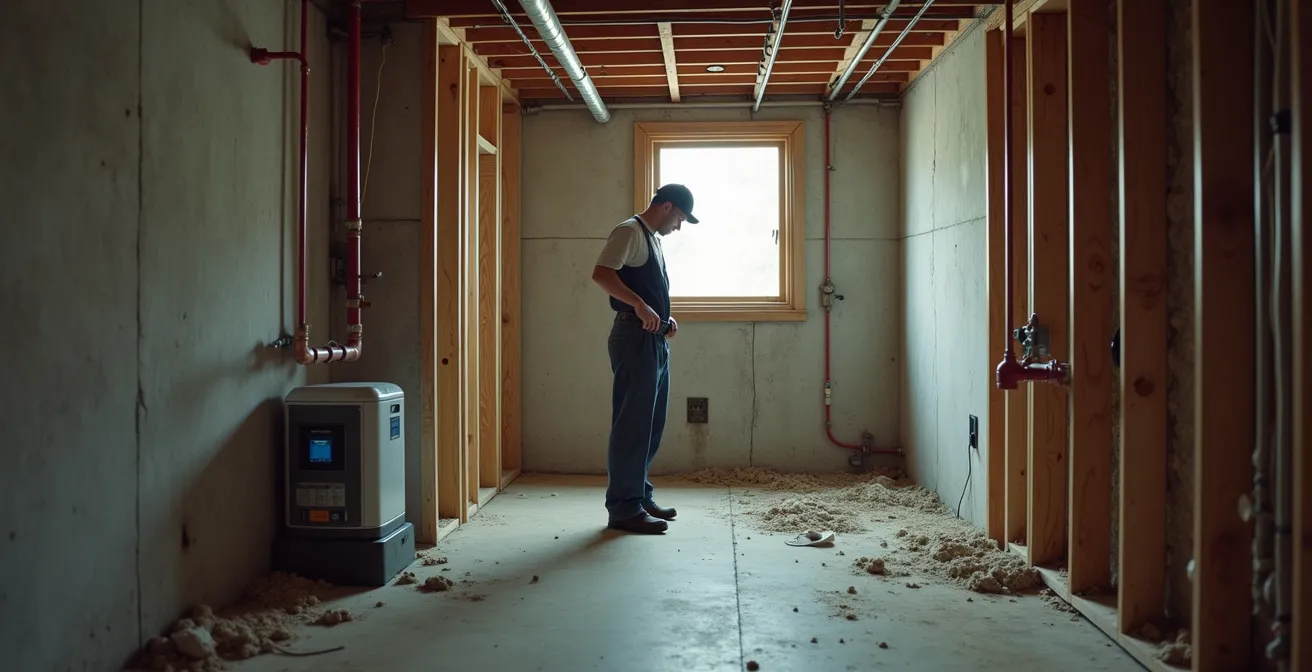
This wide shot of a proper basement renovation highlights the complexity of modern plumbing, which should only be handled by certified professionals to maintain insurance validity.
The Régie du bâtiment du Québec (RBQ), the province’s construction authority, is unequivocal on this matter. Their guidelines are designed to protect homeowners, and insurers use them as the gold standard for defining proper installation and maintenance.
Under Quebec Construction Code, all plumbing work beyond basic faucet replacement must be performed by a CMMTQ-certified plumber or risk complete insurance void.
– Régie du bâtiment du Québec, 2024 Quebec Construction Code Guidelines
Before winter, if you have any doubts about past renovation work, it is wise to have your system inspected by a CMMTQ-certified plumber. An invoice from them stating your system is “up to code” can be an invaluable document, effectively neutralizing the risk of a past DIY mistake jeopardizing your future coverage.
Clapet antiretour : comment savoir s’il fonctionne encore après 5 ans ?
A backwater valve is your home’s last line of defense against a municipal sewer backup, a common event during the rapid snowmelt of a Quebec spring. This simple flap is designed to close automatically when the city’s sewer system is overwhelmed, preventing sewage from flooding your basement. However, these valves are not “set it and forget it” devices. After five years, their reliability significantly decreases due to debris accumulation, corrosion, or seizure of the flap mechanism. An old, untested valve is functionally the same as no valve at all in the eyes of an insurer.
The context in Quebec makes this device essential. The province has a history of severe urban flooding caused by a combination of heavy rainfall and rapid thaw overwhelming aging municipal infrastructure. The infamous 2012 floods are a stark reminder of this vulnerability.
Case Study: The 2012 ‘Year of the Urban Flood’ in Quebec
Environment Canada’s designation of 2012 as ‘The Year of the Urban Flood’ came after a series of storms battered the province. One system that hit Montreal led to an estimated $260 million in insured damages, primarily from sewer backups into basements. This event highlighted the absolute necessity of a fully functional backwater valve, as homes with working valves were largely spared, while those without, or with failed valves, suffered catastrophic losses.
Given this risk, annual inspection is a requirement for maintaining your insurance coverage for sewer backup. The good news is that this inspection is straightforward, and many municipalities, including Montreal, offer subsidies to encourage installation. Through programs like RénoPlex, homeowners may be eligible for significant financial assistance to install or replace these critical devices.
Your annual pre-winter audit must include these steps:
- Locate and Open: Find the valve, typically in a box set into your basement floor with a clear or removable cover.
- Test Flow and Flap: Pour a large bucket of water down a nearby drain (like a laundry sink) and watch the valve. You should see the water flow freely and the flap move.
- Manual Check: Carefully lift the flap by hand. It should move freely without sticking. If it’s stiff or seized, it needs immediate service.
- Clean Debris: Check for any debris (hair, grit, etc.) that could prevent the flap from sealing completely and clean it out.
- Document: Take a dated photo of the clean, open valve with the flap in the open position as proof of your inspection.
For a valve over five years old, consider a professional service from a CMMTQ plumber. Their invoice provides superior documentation and peace of mind that your home is protected from the next major thaw.
Key Takeaways
- Your primary goal is not just maintenance, but creating an irrefutable “documentation trail” with photos and certified invoices to combat potential negligence claims.
- Specific Quebec risks, like the freeze-thaw cycle and reliance on CMMTQ-certified plumbers for any modifications, are key factors insurers use to evaluate claims.
- Simple, low-cost upgrades, like switching to braided steel washing machine hoses, can eliminate common reasons for automatic claim denial and offer an enormous return on investment.
Who Pays for the Damage When a Pipe Bursts Inside Your Wall?
When a pipe bursts inside a wall, the question of “who pays” can be complex, especially in Quebec’s legal framework. The answer depends heavily on three factors: the type of property you own (single-family home vs. condo), the location of the burst pipe, and most importantly, your ability to prove you were not negligent. For any homeowner, the initial damage to your belongings and the unit itself is typically covered by your personal home insurance, but the insurer will immediately investigate the cause to determine liability.
If the cause is deemed to be a lack of maintenance (e.g., you failed to prevent freezing by keeping the heat too low), your claim can be denied. In a condominium (divided co-ownership), the situation is even more complex. A pipe serving only your unit is your responsibility, but a main supply pipe serving multiple units is typically the responsibility of the condo corporation. A dispute can easily arise between your personal insurer and the corporation’s insurer, leaving you caught in the middle. Having a clear record of your own maintenance is crucial to prove your diligence and protect your interests.
The following table breaks down the fundamental differences in responsibility, which every Quebec property owner should understand.
| Aspect | Single-Family Homeowner | Condo Owner (Divided Co-ownership) |
|---|---|---|
| Main supply pipe in wall | Owner’s insurance covers | Condo corporation’s insurance (if serving multiple units) |
| Fixture pipe inside unit | Owner’s insurance covers | Personal insurance covers (private portion) |
| Documentation needed | Proof of proactive maintenance | Review of co-ownership declaration is required |
| Typical deductible | $500 – $1,000 | Personal deductible + potential corporation deductible |
| Negligence impact | Claim denial is possible | Both personal and corporation insurers may deny claims |
Ultimately, your best protection is a proactive approach. By following the audit steps outlined in this guide and meticulously documenting your efforts, you build a powerful defense. This record of proactive care demonstrates to any insurer that you have fulfilled your obligations as a responsible homeowner, placing you in the strongest possible position to secure full coverage for your claim.
Frequently Asked Questions About Quebec Plumbing and Insurance
What constitutes negligence in Quebec pipe burst claims?
In Quebec, common examples of negligence that lead to claim denial include turning off the heat entirely while away in winter, leaving windows open, or failing to maintain a minimum indoor temperature of 12°C (55°F). Uncertified plumbing work and ignoring known issues like failing rubber hoses are also considered clear negligence.
How can condo owners protect themselves?
Condo owners should proactively request and review the condo corporation’s annual maintenance log, especially for shared plumbing and backwater valves. It’s also crucial to review the corporation’s insurance policy before winter to understand its coverage limits and deductibles, which you may be partially responsible for, to identify any gaps you need to cover with your personal policy.
What temperature prevents pipe freezing in Quebec?
To prevent pipes from freezing, you must maintain a minimum indoor temperature of 12°C (55°F) at all times, even when you are away. Due to Quebec’s potential for extreme and sudden cold snaps, this recommended minimum is often higher than in other, more temperate provinces.