
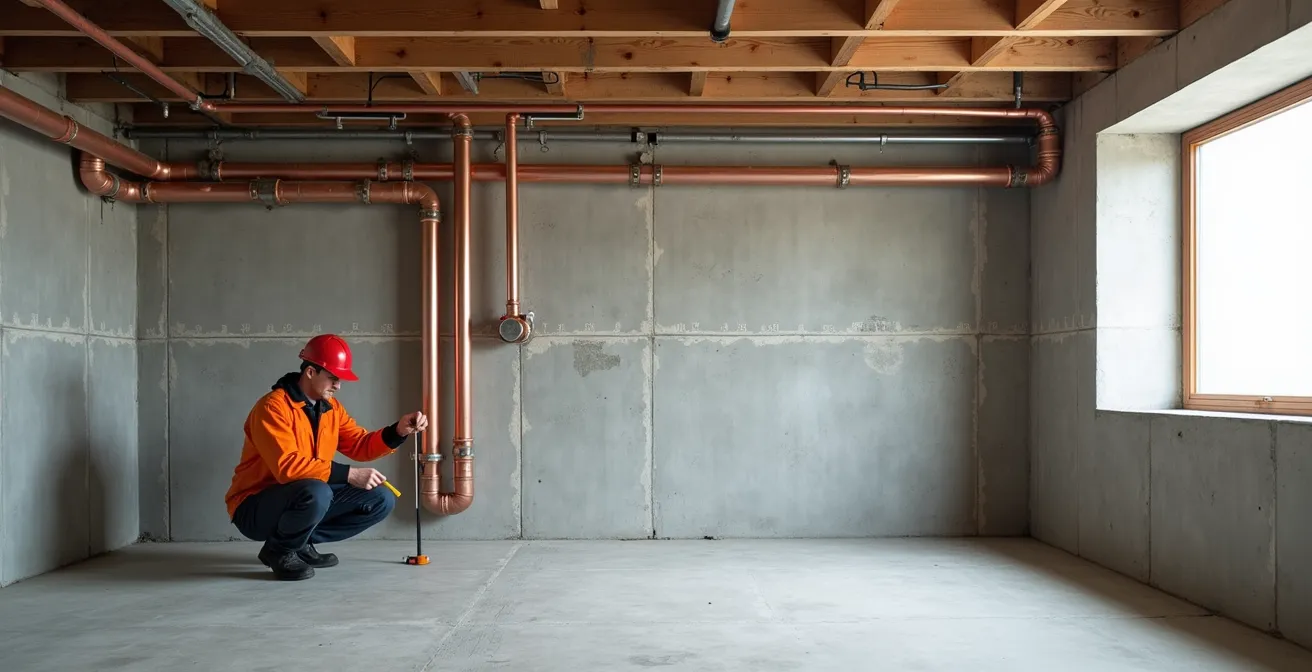
Converting a basement in Quebec is a smart investment, but misinterpreting the plumbing code often leads to budget overruns and failed inspections.
- Key regulations go beyond simple permits, involving mandatory backwater valves, strict venting rules, and the potential loss of “grandfathered” rights during renovation.
- Adding a new dwelling unit fundamentally changes the building’s classification, triggering stricter, near-commercial plumbing standards.
Recommendation: Treat the Quebec plumbing code not as a checklist, but as a risk-management framework to protect your property investment from unforeseen liabilities and costly rework.
For a real estate investor in Quebec, converting a basement into a legal rental unit is a proven path to increasing property value and generating cash flow. You’ve likely budgeted for drywall, flooring, and electrical work. You’ve factored in the need for a building permit and hiring a licensed plumber. But the true financial risk of these projects often lies hidden within the pages of Chapter III of the Quebec Construction Code, which governs plumbing. The common approach is to see these rules as a simple checklist, but this view is dangerously incomplete.
The real challenge isn’t just installing the right parts; it’s understanding the financial triggers and structural liabilities that separate a profitable plex from a legal and financial quagmire. A minor change can unexpectedly void your property’s “droits acquis” (grandfathering rights), forcing a complete and costly system-wide upgrade. An improperly vented pipe doesn’t just fail an inspection; it creates a long-term health hazard and liability for you as the landlord. The code isn’t a bureaucratic hurdle; it’s a risk management framework for your investment.
This guide moves beyond the basics. We will dissect the critical, often misunderstood, plumbing regulations that specifically impact basement apartment conversions in Quebec. We will analyze the precise moments a simple renovation becomes a major overhaul, explore the non-negotiable rules for venting and drainage, and provide the blueprint for getting your plumbing plans approved by the municipality on the first attempt. This is not just about compliance; it’s about protecting your capital and ensuring the long-term viability of your investment.
This article provides a detailed breakdown of the essential regulatory considerations. The following summary outlines the key sections we will cover to help you navigate the complexities of the Quebec plumbing code with an expert’s foresight.
Summary: Navigating Quebec’s Plumbing Code for Basement Conversions
- Why do the plumbing rules for a restaurant differ from those of a house?
- Bathroom renovation: when do you lose your grandfathering rights on old plumbing?
- Plumbing vent: the roofing mistake that causes sewer odors in the duplex
- How to separate stormwater from wastewater to avoid a municipal fine?
- What plumbing plans to provide the city to get your permit on the first try?
- Universal bathroom: the design mistakes that make it non-compliant
- Blue (L) vs. Red (M): how to identify copper thickness at a glance?
- Why must commercial buildings test their backflow preventers annually?
Why do the plumbing rules for a restaurant differ from those of a house?
The question seems abstract, but it gets to the heart of the matter for an investor: when you add a self-contained dwelling unit to a single-family home, you are fundamentally changing its classification and, more importantly, its risk profile. The plumbing code treats this transition seriously. A basement apartment isn’t just an extra bathroom; it’s a separate household with its own kitchen, laundry, and sanitation needs. The load on the drainage and water supply systems increases exponentially, moving it closer to a semi-commercial or multi-unit residential building in the eyes of the code.
This increased density brings higher liability. A sewage backup or water contamination event no longer affects one family, but two, doubling your potential legal and financial exposure as a landlord. Consequently, the code imposes stricter requirements to mitigate these risks. The most fundamental of these is the backwater valve. Indeed, since 2011, backwater valves are mandatory in all new buildings and for any new accommodation created in a basement in many Quebec municipalities like Montreal to prevent catastrophic sewer backups.
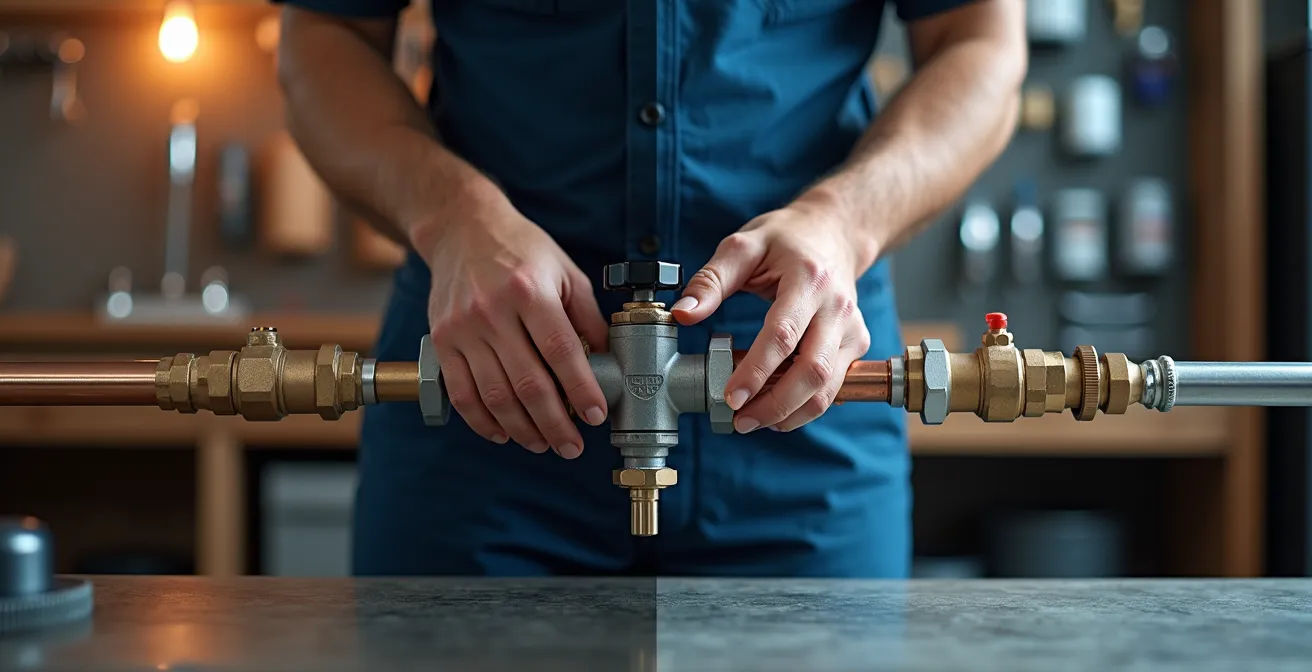
The image below provides a visual metaphor for this shift: on one side, the simplicity of a single-family home’s plumbing, and on the other, the more robust and sectioned-off infrastructure required when you elevate your property to a multi-unit dwelling. This isn’t just about adding pipes; it’s about building a resilient, safe, and legally compliant system.
This upgraded system must be planned meticulously. Key considerations include not only the mandatory backwater valve but also independent shut-offs for tenant separation, correctly sized drain pipes to handle the increased load, and a venting system designed for a multi-fixture environment. For an investor, viewing the project through this “semi-commercial” lens from the start is the key to accurate budgeting and avoiding costly surprises.
Your action plan: Key plumbing requirements for a basement apartment
- Install a mandatory backwater valve (clapet anti-retour) for all basement fixtures to prevent sewer backup.
- Create independent water shut-off valves for landlord-tenant separation and easier maintenance.
- Verify drain pipe sizing according to the increased load from the second kitchen (refer to minimum diameters in Quebec Code Chapter III).
- Design and install a proper venting configuration that serves all fixtures in the new dwelling unit independently.
- Investigate the need for separate water metering infrastructure, as required by municipalities like Gatineau or Longueuil for new units.
Bathroom renovation: when do you lose your grandfathering rights on old plumbing?
One of the most significant financial triggers in a basement conversion is the loss of “droits acquis,” or grandfathering rights. Many older Quebec homes have plumbing systems that do not meet modern code standards. As long as you perform minor repairs, these systems are tolerated. However, the moment you undertake a substantial renovation, you cross a threshold that voids these rights and mandates a full upgrade to current code. For an investor, knowing exactly where this line is can be the difference between a minor expense and a five-figure budget overrun.
Case Study: The Grandfathering Trap in a Montreal Duplex
An investor purchased a 1970s duplex with a finished basement containing a simple powder room (toilet and sink). The plan was to add a shower to create a full bachelor apartment. This single act—adding one fixture and altering the drain configuration—was deemed a “substantial alteration” by the city inspector. This triggered a complete loss of grandfathering rights for the basement’s plumbing. The investor was subsequently required to break the concrete floor to install a mandatory backwater valve, run a new 3-inch vent stack all the way to the roof, and replace sections of old drain lines, adding over $15,000 in unforeseen costs to the project.
The Quebec Construction Code is specific about what constitutes a “substantial alteration.” It’s not just about the dollar value of the work. The following table, based on common municipal interpretations of the Code, outlines the most common triggers that will force you to bring the entire system up to standard. The key takeaway is that any work beyond a simple like-for-like fixture replacement is a potential trigger.
| Work Type | Grandfathering Status | Code Requirement |
|---|---|---|
| Moving more than one fixture | Lost | Full code compliance required |
| Altering drain stack | Lost | Complete system upgrade needed |
| Simple fixture replacement | Maintained | Like-for-like allowed |
| Adding single fixture | Partial | New work must comply |
For an investor, the strategy is clear: either your project is a purely cosmetic update, or you must budget for a full plumbing system upgrade from the outset. There is very little middle ground. Attempting to “sneak in” a new bathroom without addressing the underlying infrastructure is the most common and costly mistake made in basement conversions.
Plumbing vent: the roofing mistake that causes sewer odors in the duplex
Proper venting is arguably the most misunderstood aspect of basement plumbing, yet it’s critical for both functionality and tenant safety. A plumbing vent has two primary functions: it allows air to enter the drain system to prevent water from being siphoned out of P-traps (which block sewer gas), and it allows noxious and potentially explosive sewer gases to be safely expelled above the roofline. An error in the venting system is a direct threat to your tenants’ health and a massive liability for you as the property owner.
A common but dangerous shortcut is the use of an Air Admittance Valve (AAV), or “cheater vent.” These are small, spring-loaded devices that open to let air in but are supposed to remain closed to block sewer gas. While they may be permitted for single, hard-to-vent fixtures like a kitchen island in some jurisdictions, they are not a compliant solution for venting an entire new dwelling unit. As the National Plumbing Code of Canada, as amended for Quebec, clarifies, a new dwelling requires a dedicated, properly installed vent stack that terminates to the open air. Relying on an AAV is a code violation waiting to be flagged.
The second major error occurs on the roof. Even with a proper vent stack, its termination point is crucial. If the vent is too short, it can be blocked by snow in winter. If it’s too close to a window, a door, or a mechanical air intake, the expelled sewer gases can be drawn back into the living space, creating the “mystery sewer smell” that plagues many duplexes and triplexes. The code specifies clear distances to prevent this:
- Terminate the vent stack a minimum of 6 inches (15 cm) above the roofline or the anticipated snow accumulation level.
- Maintain a minimum distance of 3 feet (1 m) from any window, door, or air intake.
- Keep the termination 10 feet (3 m) away from any neighbouring property’s fresh air intakes.
- Ensure the vent cap is an approved model designed to resist frost closure during Quebec’s harsh winters.
For an investor, skimping on the vent is a false economy. The cost of running a proper vent stack from the basement to the roof is a necessary investment in the safety, comfort, and long-term compliance of your rental unit.
How to separate stormwater from wastewater to avoid a municipal fine?
A significant hidden cost in basement apartment projects, especially in older Montreal boroughs and other established Quebec cities, is the mandatory separation of stormwater and sanitary sewer lines. Historically, many homes were built with a single “combined” sewer pipe that carried both rainwater from the roof gutters and foundation drains, as well as wastewater from toilets and sinks, to the municipal main. Modern environmental regulations forbid this practice to avoid overwhelming water treatment plants during heavy rainfall.
When you apply for a permit to add a dwelling unit, the municipality will often use this as a trigger to enforce the separation of these systems at your expense. This is not a minor plumbing job; it often involves excavation outside the building to install a new, separate line for stormwater, or extensive work inside to reroute foundation drains to a sump pump. The costs can easily run into thousands of dollars, a detail rarely included in a novice investor’s budget.
The regulations are strict. As confirmed by Montreal’s municipal regulations, significant fines are imposed for the illegal discharge of stormwater into the sanitary sewer. This includes water from your foundation’s French drain (drain français). A common setup in older basements is to have the French drain empty into a floor drain, which connects to the sanitary sewer. This is now illegal. When creating a new apartment, you will be required to install a sump pump system. The sump pump must discharge its water to a designated storm sewer, a drainage ditch, or a dry well on your property—never into the sanitary sewer system. This requirement alone can be a major “financial trigger,” turning a simple renovation into a significant excavation and plumbing project.
As an investor, due diligence is critical. Before purchasing a property for conversion, you or your master plumber must investigate the existing sewer configuration. Is it combined or separate? If it’s combined, you must factor the cost of separation into your initial investment analysis. Ignoring this can completely derail the profitability of your project.
What plumbing plans to provide the city to get your permit on the first try?
For an investor, time is money. Delays in obtaining a building permit can push back your entire project timeline, costing you months of potential rental income. The plumbing section of a permit application is one of the most common sources of rejection due to insufficient detail. To achieve “permit velocity” and get your project approved on the first submission, your plans must be meticulously prepared and leave no room for interpretation by the city’s plan reviewer.
Submitting a simple floor plan showing fixture locations is not enough. The municipality requires a detailed technical diagram that demonstrates full compliance with Chapter III of the plumbing code. This is not a task for an amateur; these plans must be prepared and signed by a licensed master plumber (CMMQ). While there is a cost to this service, it is a crucial investment to avoid costly delays. The cost of the permit itself is relatively minor; for example, the base fee is around $96.74 per dwelling unit for new apartment creation in many Quebec jurisdictions, but the cost of a rejected application in terms of lost time is far greater.
p>Your plumbing submission package must contain a complete set of diagrams and specifications. To ensure a smooth approval process, make sure your master plumber includes the following essential elements in the plans:
- Full Isometric Plumbing Diagram: A 3D-style drawing showing every pipe, fitting, and connection for the entire system (drains, vents, and water lines).
- Pipe Diameters: Clearly label the diameter of every single pipe, from the 4-inch main stack to the 1.5-inch sink drains and 2-inch vent lines.
- Material Specifications: Indicate the type of material for all pipes (e.g., ABS, PVC System 15, copper Type L for underground lines).
- Backwater Valve Details: Show the exact location and specify the model of the mandatory backwater valve.
- Drain Slopes: All horizontal drain lines must be marked with their slope, which must be a minimum of 2% (1/4 inch per foot) to ensure proper flow.
- Venting Method: Detail the venting strategy for every fixture, including pipe sizes and the path to the main vent stack and its roof termination.
Think of your plumbing plans as a legal contract with the city. The more detailed and professional they are, the faster your project can move from paper to reality. An incomplete plan is an immediate red flag for inspectors and reviewers, signaling a potential lack of professional oversight.
Universal bathroom: the design mistakes that make it non-compliant
While not mandatory for a simple basement apartment in a duplex, accessibility standards become a non-negotiable legal requirement the moment your building is classified as a triplex or larger. If your project involves converting a duplex into a triplex by adding a basement unit, you will be subject to the accessibility requirements of the Quebec Construction Code. This has profound implications for the plumbing design of your new bathroom and kitchen, and ignorance of these rules can lead to orders to demolish and rebuild non-compliant work.
The goal of universal design is to ensure a person in a wheelchair can use the facilities safely and independently. This goes far beyond simply installing grab bars. The plumbing rough-in itself must be positioned with extreme precision. For example, a standard vanity cabinet is an obstruction. A compliant bathroom requires a wall-mounted sink. The water supply and drain lines cannot be placed in the standard location; the drain (P-trap) must be offset towards the back wall to provide a minimum of 685mm (27 inches) of clear knee space underneath. The sink itself must be installed at a maximum height of 865mm (34 inches) from the floor.
The shower is another area fraught with potential errors. A standard shower stall with a curb is not compliant. You must create a curbless, roll-in shower. This requires the bathroom floor to be sloped at a precise 2% grade towards a linear drain to prevent water from spilling into the rest of the room. Furthermore, to prevent scalding, a thermostatic mixing valve is mandatory to maintain a constant, safe water temperature. Faucets must also be lever-handle or sensor-activated, as round knobs can be impossible for individuals with limited hand strength to operate. These are not aesthetic choices; they are legal requirements that directly impact the plumbing layout from the very first phase of construction.
For an investor planning a project that will result in three or more units, consulting an architect or designer familiar with accessibility codes is essential, in addition to your master plumber. Getting the plumbing rough-in wrong at the start will make it impossible to achieve compliance later without demolishing finished walls and floors.
Blue (L) vs. Red (M): how to identify copper thickness at a glance?
In plumbing, not all copper pipes are created equal. The choice between different types of copper is not merely a matter of price; it’s a critical decision governed by the Quebec Construction Code that impacts the longevity and legality of your installation. Using the wrong type of copper pipe in the wrong application is a code violation that can lead to premature failure, leaks, and costly repairs, representing a direct threat to your investment. For an investor, understanding this distinction is key to ensuring your plumber is using the correct materials.
Copper pipes are graded by their wall thickness, and this is conveniently indicated by a colour code printed on the pipe itself. The three main types you will encounter are:
- Type M (Red): This is the thinnest-walled and least expensive copper pipe. It is permitted for most above-ground domestic water lines inside the heated envelope of the building.
- Type L (Blue): This pipe has a thicker wall than Type M, making it more durable and resistant to damage. It is the legal minimum requirement for any water lines that will be buried underground or in a concrete slab.
- Type K (Green): This is the thickest and most durable type, typically reserved for the main water service line coming into the building from the municipal supply.
The most common and costly mistake in basement apartments is using the cheaper Type M (Red) copper for water lines that run under the new concrete slab to supply the basement kitchen or bathroom. This is a direct code violation. The ground shifts and can be corrosive, and the thinner walls of Type M pipe are simply not rated for this stress. As plumbing expert Bob Vila notes, this is a dangerous shortcut. In his guide on copper pipe types, he warns:
Using the cheaper Type M copper for underground water lines to the new apartment is a code violation in Quebec and can lead to premature failure.
– Bob Vila, Copper Pipe Types Guide
A pinhole leak in a pipe buried under several inches of concrete can go undetected for months, causing soil erosion, foundation damage, and mold growth—a nightmare scenario for any landlord.
As the property owner, you are ultimately responsible for the compliance of the work. During construction, take a moment to visually inspect the materials. If you see red-marked copper pipe being laid in a trench before the concrete is poured, you must stop the work immediately. Insist on the use of Type L (Blue) copper for all underground water lines. This small detail is a major indicator of a contractor’s professionalism and your project’s long-term durability.
Key Takeaways
- Grandfathering rights are fragile: Adding or moving more than one fixture can trigger a mandatory, full-system upgrade to the current code, a major unforeseen cost.
- Venting is non-negotiable: A new dwelling unit requires a dedicated vent stack to the roof; Air Admittance Valves (AAVs) are not a compliant solution for venting a whole apartment.
- Detailed plans are your fastest path to a permit: A complete isometric diagram signed by a master plumber is the best investment to avoid costly delays with the city.
Why must commercial buildings test their backflow preventers annually?
The title’s focus on “commercial buildings” brings us full circle to the core principle: when you become a multi-unit landlord, you must adopt a commercial mindset toward risk management and maintenance. The single most important piece of protective equipment in your basement apartment is the backwater valve (clapet anti-retour). Its job is to automatically slam shut to prevent the entire municipal sewer system from backing up into your tenant’s apartment during a heavy storm. But this device is not a “set it and forget it” solution. It’s a mechanical device with moving parts that can fail if not maintained.
A valve clogged with debris or seized by corrosion is no better than having no valve at all. In the event of a sewer backup, a failed valve would result in catastrophic damage, and your insurance company could potentially deny your claim if you cannot prove a history of regular maintenance. This is why organizations like the Corporation des Maîtres Mécaniciens en Tuyauterie du Québec (CMMTQ) are adamant about preventative care. Official recommendations state that maintenance must be carried out at least once a year to ensure proper functioning. This isn’t just a suggestion; it’s a fundamental part of your responsibility as a landlord to provide a safe and habitable space.
This annual maintenance is a simple but critical task that you or your designated maintenance person can perform. It’s your final line of defense in protecting your investment. The process involves:
- Performing a pre-winter inspection: Clean the valve in October or November before the ground freezes.
- Checking after major rainstorms: Ensure no debris has washed back and is obstructing the flap.
- Inspecting the mechanism: Remove the access cover and manually check that the flap moves freely and the hinge is clean.
- Verifying the seal: Check the rubber gasket for any cracks or hardening and replace it if it’s damaged.
- Documenting everything: Keep a simple log with dates of when you performed the maintenance. This documentation is invaluable for insurance purposes.
Successfully navigating the Quebec plumbing code is the first step. The final, ongoing step is diligent maintenance. By treating your multi-unit property with the professionalism of a commercial building manager, you safeguard your tenants, protect your asset, and ensure the long-term profitability of your real estate investment.
Now that you are equipped with this knowledge, the next logical step is to have your specific project plans reviewed by a certified master plumber who can identify any potential compliance issues before they become costly problems. An expert audit is the best insurance for your investment.