
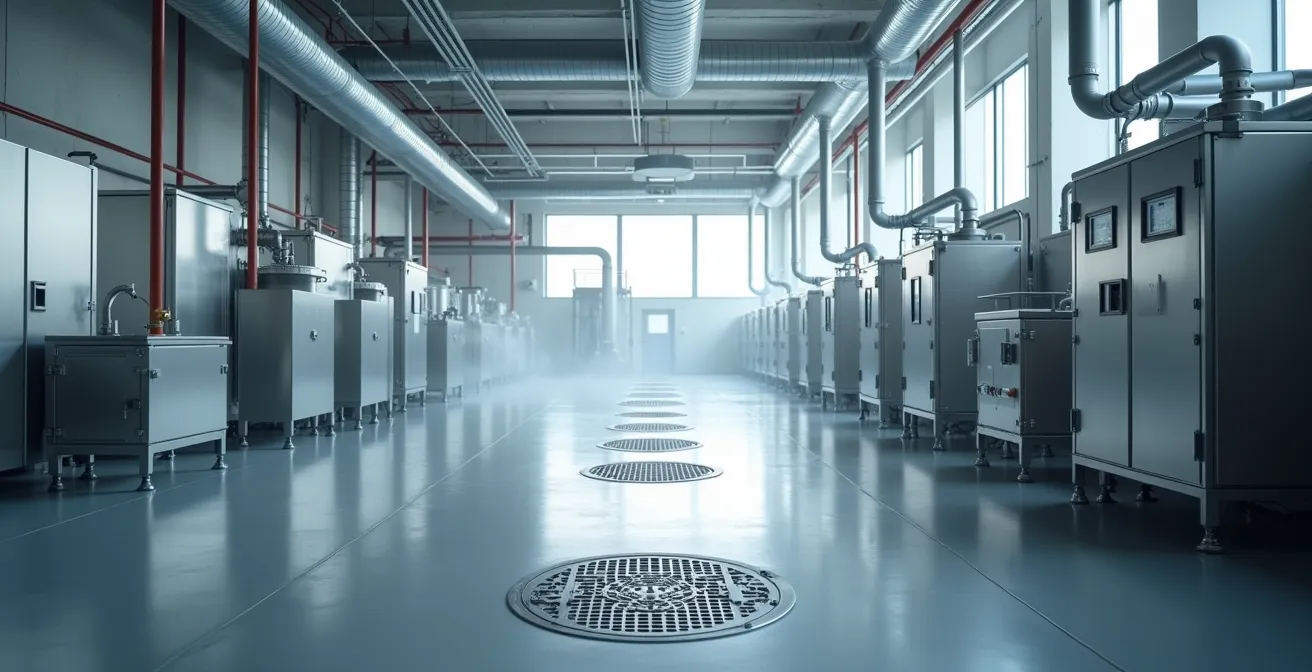
In Quebec’s food industry, compliant plumbing isn’t a cost center—it’s a core driver of operational uptime, safety, and profitability.
- Chronic failures in standard materials like PVC are not accidents; they are predictable outcomes of mismatched specifications that lead to expensive, unplanned downtime.
- Poor system design, especially in compressed air and drainage, directly translates into a significant energy penalty on your Hydro-Québec bill.
- Strategic component selection, from valves to seals, is fundamental to meeting CNESST safety mandates for procedures like lockout-tagout and preventing catastrophic product contamination.
Recommendation: Adopt a Total Cost of Ownership (TCO) approach for all plumbing infrastructure decisions, prioritizing material integrity and system design over minimal upfront investment.
For a food processing plant manager in Quebec, an unexpected production stoppage is the ultimate nightmare. Whether it’s a burst pipe flooding the production floor, a failed CNESST audit due to an unsafe installation, or a product recall from contamination, the root cause can often be traced back to a seemingly minor component of the plumbing infrastructure. The operational continuity and profitability of your entire facility depend on the integrity of these networks, which operate under extreme thermal and chemical stress.
Many facility managers believe that following the basic Quebec Construction Code and opting for stainless steel is sufficient. This approach, however, overlooks the nuanced and brutal reality of the food processing environment. Standard solutions often fail to account for the aggressive cleaning agents, high-temperature discharges from Clean-in-Place (CIP) systems, and the specific composition of food byproducts. This gap between basic compliance and operational reality is where catastrophic failures and creeping inefficiencies are born.
The key isn’t simply to meet the minimum standards set by MAPAQ or the CNESST. The true strategic advantage lies in understanding *why* these standards exist and how to engineer a plumbing system that exceeds them. This guide shifts the perspective from plumbing as a compliance-driven expense to a strategic asset for mitigating risk and enhancing productivity. We will analyze the specific failure points within Quebec food plants and provide the engineering rationale needed to make robust, long-term decisions.
This article provides a detailed engineering breakdown of the most critical plumbing systems in a food processing environment. By exploring the specific challenges and optimal solutions for each, you will gain the necessary insights to build a more resilient, efficient, and compliant facility.
Summary: A Plant Manager’s Guide to High-Performance Plumbing in Quebec
- Why boiling water destroys standard PVC drains in a few months?
- Emergency eyewash stations: the distance and temperature rules to respect
- Pressure losses in compressed air: how the wrong pipe slows down your production?
- Predictive maintenance of pumps: how to avoid a complete plant shutdown?
- Industrial grease separators: how to size them to avoid backflow?
- EPDM or Viton seals: which one withstands industrial cleaning chemicals?
- Stainless 304 vs. 316L: which resists the chlorinated products in your plant?
- Why Are Gate Valves Critical for Lockout-Tagout Procedures in Quebec?
Why boiling water destroys standard PVC drains in a few months?
Standard PVC (Polyvinyl Chloride) piping, commonly used in commercial construction, has a maximum operating temperature of around 60°C (140°F). When a Clean-in-Place (CIP) system discharges its cycle, the water temperature can easily exceed 85°C (185°F). This thermal shock causes the PVC to soften, deform, and ultimately fail. The result is not just a leak, but a complete structural breakdown of your drainage system, leading to unplanned downtime, potential floor damage, and microbial contamination risks. This isn’t a random failure; it’s a predictable outcome based on material science.
The financial impact extends far beyond the cost of replacing a pipe. Repeated failures contribute to a high Total Cost of Ownership (TCO) when you factor in labor for emergency repairs and, most importantly, lost production hours. For a high-volume facility, a single day of downtime can represent a financial loss that dwarfs the initial savings of choosing a cheaper material. The solution involves specifying materials designed for high-temperature service. CPVC (Chlorinated Polyvinyl Chloride) can handle temperatures up to 93°C (200°F), offering a more robust alternative. For the most demanding applications involving both high temperatures and corrosive chemicals, stainless steel or specialized alloys become necessary.
Case Study: The Hidden Cost of Corrosion in a Cheese Plant
A cheese processing plant experienced severe corrosion in its 304L stainless steel CIP return lines, a problem caused by the high chloride content inherent in cheese processing. A subsequent upgrade to 316L stainless steel, typically more corrosion-resistant, also failed within a mere three months. This rapid and repeated failure highlighted the extreme nature of the chemical environment. The ultimate solution required implementing components made from AL-6XN, a superalloy with superior resistance to chloride-induced corrosion, demonstrating that even standard “upgrades” can be insufficient without a thorough chemical compatibility analysis.
Assessing the full lifecycle cost is essential. An investment in the correct material from the outset, such as CPVC or stainless steel for CIP discharge lines, prevents the recurring cycle of failure and repair, directly protecting your plant’s operational availability and bottom line. This proactive approach turns a potential liability into a reliable asset.
Emergency eyewash stations: the distance and temperature rules to respect
In any Quebec facility where employees handle injurious corrosive materials, the CNESST strictly enforces regulations for emergency eyewash and shower stations. These are not optional amenities; they are critical life-safety devices. The primary standard referenced is ANSI Z358.1, which dictates that an injured worker must be able to reach a station within 10 seconds of unobstructed travel (approximately 17 meters or 55 feet). Furthermore, the station must provide a continuous flow of tepid water for a minimum of 15 minutes. This duration is critical to thoroughly flush chemicals from the eyes and body to prevent permanent damage.
The concept of “tepid” water is specifically defined and is a frequent point of failure during audits, especially given Quebec’s cold winters. Industry standards mandate a controlled water temperature between 16°C and 38°C (60-100°F). Water that is too cold can induce hypothermia and prevent a worker from flushing for the full 15 minutes, while water that is too hot can exacerbate a chemical injury. Achieving this temperature range reliably requires a thermostatic mixing valve (TMV), a non-negotiable component for any compliant system in a variable-temperature environment.
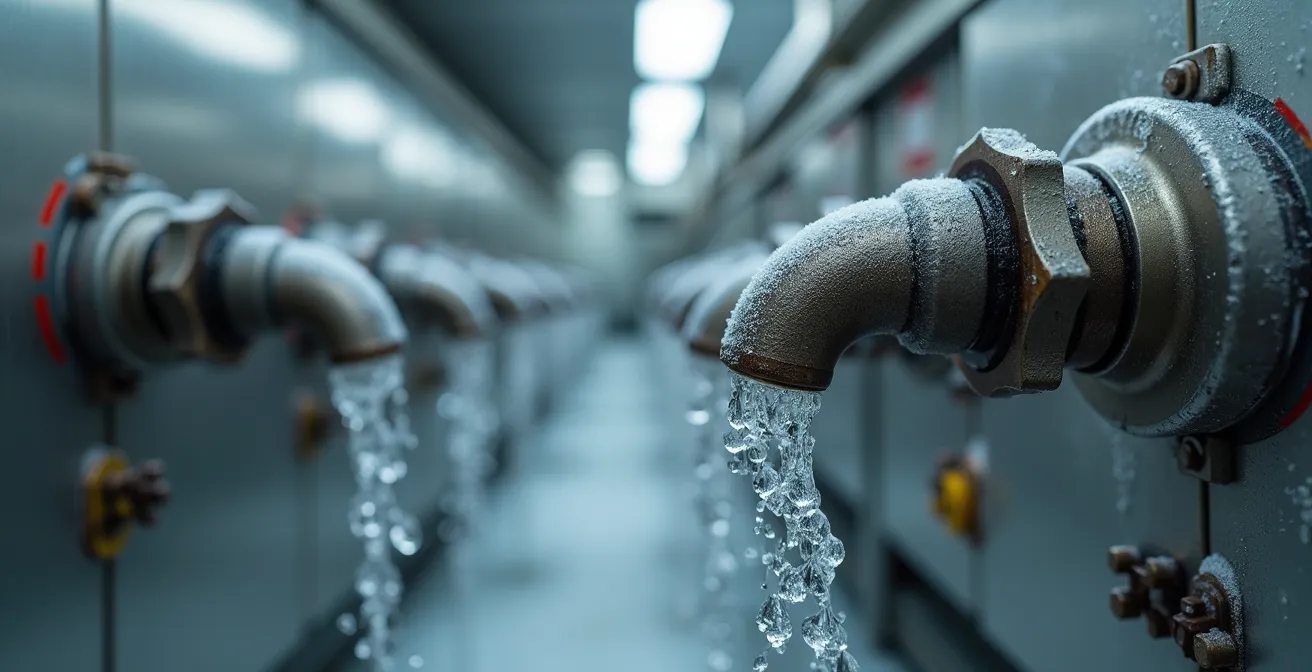
The table below outlines the key requirements and how they are enforced by the CNESST. Regular documented inspections, including weekly activation tests to verify flow and clear lines, are mandatory. Failure to comply can result in significant fines and work stoppages, but more importantly, it places your employees at unacceptable risk.
This table, based on guidance from safety equipment suppliers, clarifies the alignment between ANSI standards and CNESST enforcement priorities in Quebec.
| Requirement | ANSI Z358.1-2014 | Quebec CNESST Enforcement |
|---|---|---|
| Access Time | Within 10 seconds (≈55 feet) | Strictly enforced during inspections |
| Water Temperature | 60-100°F (16-38°C) tepid | Critical in winter conditions |
| Flow Duration | Minimum 15 minutes continuous | Required with backup systems |
| Inspection Frequency | Weekly activation, annual inspection | Documentation required for audits |
Pressure losses in compressed air: how the wrong pipe slows down your production?
Compressed air is often called the “fourth utility” in a food processing plant, powering everything from pneumatic actuators on packaging lines to air knives for drying. However, it is also one of the most expensive utilities to produce. Any inefficiency in the distribution system translates directly to higher energy consumption and a larger Hydro-Québec bill. A primary source of this inefficiency is pressure drop—the loss of pressure between the compressor and the point of use. While some pressure drop is unavoidable, excessive loss caused by poor piping choices is a significant and unnecessary operational cost.
Old or improperly specified piping materials, like galvanized steel, are a major culprit. Over time, these pipes corrode and develop internal scale, which creates friction and restricts airflow, forcing your compressors to work harder (and consume more electricity) to maintain the required pressure at the tool. This inefficiency is not trivial; it is estimated that a 10 PSI pressure drop can cost Quebec facilities over $10,000 annually in wasted electricity for a typical system. This is a direct, measurable “energy penalty” for suboptimal plumbing.
The solution is to use piping materials with smooth, non-corroding internal surfaces. Modern aluminum and stainless steel piping systems are designed specifically for compressed air, offering minimal friction loss and maintaining their integrity over decades. Optimizing the system layout with proper “loop” configurations instead of long linear runs also ensures that pressure and flow are evenly distributed, preventing equipment from being “starved” of air during peak demand. Participating in programs like the Hydro-Québec Energy Efficiency for Businesses Program can even provide incentives for upgrading your compressed air system, delivering a rapid return on investment. The right piping isn’t just a conduit; it’s a key component of your plant’s energy management strategy.
Predictive maintenance of pumps: how to avoid a complete plant shutdown?
Pumps are the heart of a food processing facility, moving everything from raw ingredients to finished products and cleaning solutions. The failure of a single critical pump can bring an entire production line to a halt. Traditional maintenance strategies are often reactive (fixing the pump after it breaks) or based on a fixed time schedule, which may not align with the actual condition of the equipment. This approach risks either premature replacement of healthy components or, far worse, catastrophic failure during peak production.
Predictive maintenance (PdM) offers a more intelligent, data-driven alternative. By installing IoT (Internet of Things) sensors to continuously monitor key indicators like vibration, temperature, and power consumption, it’s possible to detect the subtle signs of impending failure long before it happens. An increase in vibration, for example, could indicate bearing wear or shaft misalignment. A gradual rise in motor temperature might signal lubrication issues. This data provides an early warning, allowing your maintenance team to schedule repairs during planned downtime, rather than scrambling during a production crisis.

The return on investment for a PdM program is clearest when you consider the cost of failure. For a Quebec maple syrup producer, a critical lobe pump failure during the short, intense spring harvest season can result in financial losses that far exceed the cost of the pump itself. The value of lost production, spoiled product, and emergency labor can be astronomical. By shifting from a reactive to a predictive model, you are not just maintaining equipment; you are actively managing operational risk and safeguarding production continuity. This approach transforms maintenance from a cost center into a strategic tool for maximizing uptime and profitability.
Implementing a PdM program requires an initial investment in sensors and monitoring software, but the ability to prevent even a single major shutdown often provides a payback period of less than a year. It’s a fundamental shift in how maintenance is viewed and executed in a modern, competitive food processing environment.
Industrial grease separators: how to size them to avoid backflow?
Industrial grease separators, or grease traps, are not just a best practice; they are a regulatory requirement in Quebec to prevent fats, oils, and grease (FOG) from entering the municipal sewer system. An undersized or poorly maintained separator is a recipe for disaster. When its capacity is overwhelmed, it can lead to foul-smelling backflows into your facility, creating unsanitary conditions, attracting pests, and potentially contaminating production areas. This can trigger a MAPAQ-mandated shutdown and result in significant municipal fines for non-compliance.
Properly sizing a grease separator is a technical calculation, not a guess. The primary factors to consider are the flow rate and the grease production volume. The flow rate is determined by the number and type of fixtures draining into it (e.g., three-compartment sinks, floor drains in a cooking area, dishwashers). Each fixture has a designated drainage fixture unit (DFU) value, and the sum of these values determines the required flow capacity in gallons per minute (GPM). Sizing based on pipe diameter alone is a common and critical error that leads to undersizing.
Equally important is the grease retention capacity, which is directly related to the volume and type of food being produced. A poultry processing plant, for instance, will generate significantly more FOG than a bakery. The separator must be large enough to allow hot, greasy water to cool sufficiently, enabling the FOG to separate and rise to the surface while solids settle at the bottom. The rule of thumb is a minimum retention time, often 20-30 minutes, to allow for this physical separation. An undersized unit will not provide adequate retention time, allowing FOG to pass straight through into the sewer lines, where it solidifies and causes blockages. Choosing the right size is a crucial step in preventing costly backups and ensuring environmental compliance.
EPDM or Viton seals: which one withstands industrial cleaning chemicals?
In a sanitary plumbing system, the seal or gasket is one of the smallest and cheapest components, yet its failure can have the most devastating consequences. A degraded seal can create microscopic crevices where bacteria thrive, leading to product contamination. If a seal fails completely, it can cause a leak that results in product loss and costly cleanup. It’s estimated that a contaminated product batch from seal failure can cost upwards of $10,000, not including the potential brand damage from a recall. The choice of seal material is therefore a critical control point for both safety and profitability.
The decision between EPDM and Viton (a brand name for FKM) is not about which is “better,” but which is correct for the specific application. The determining factor is chemical compatibility. EPDM (Ethylene Propylene Diene Monomer) is the workhorse of the dairy and beverage industries. It offers excellent resistance to water-based products, steam, and the acidic and caustic solutions commonly used in CIP cycles. However, it performs poorly when exposed to petroleum-based oils or solvents.
Conversely, Viton (Fluorocarbon) excels where EPDM fails. It has superior resistance to oils, fats, and many solvents, making it the ideal choice for applications involving oil-based flavorings, processing oily products, or where solvent-based cleaning might occur. The trade-off is that it generally has a lower temperature range and is more expensive than EPDM. Using the wrong material—for example, an EPDM seal in an oil-based flavoring line—will lead to rapid swelling, degradation, and certain failure. The table below provides a clear comparison of common seal materials.
This selection guide, based on industry expertise, outlines the primary uses and resistances of common food-grade seal materials relevant to the Quebec food industry.
| Seal Material | Best For | Chemical Resistance | Temperature Range |
|---|---|---|---|
| EPDM | Dairy/Beverage (acid/caustic) | Excellent for water-based | -40°C to 150°C |
| Viton | Oil-based flavoring operations | Superior for oils/solvents | -20°C to 200°C |
| Silicone | High-temperature sterilization | Moderate | -60°C to 230°C |
| PTFE | Extreme chemical exposure | Universal resistance | -200°C to 260°C |
Stainless 304 vs. 316L: which resists the chlorinated products in your plant?
The term “stainless steel” is often used as a blanket solution for food processing, but not all stainless steel is created equal. The two most common grades, 304 and 316L, have one crucial difference: the addition of molybdenum in 316L. This element gives it significantly enhanced resistance to corrosion from chlorides, which are prevalent in the food industry in the form of salts, chlorinated water, and certain cleaning agents. Using the wrong grade can lead to pitting corrosion, a localized form of decay that can compromise the structural integrity and hygienic status of your equipment and piping.
For many applications in Quebec with low-chloride municipal water, such as in a Montreal-based bakery, Type 304 is often sufficient and more cost-effective. It provides excellent general corrosion resistance and is perfectly suitable for most food products. However, the decision becomes critical in environments with elevated chloride levels. For example, in a seafood processing plant in the Gaspésie region, exposure to saltwater makes the use of 316L mandatory to prevent rapid deterioration. Similarly, if your plant uses highly chlorinated sanitizers, 316L is the safer and more durable choice, preventing premature failure and ensuring long-term compliance with CFIA (Canadian Food Inspection Agency) standards.
Making the right choice requires a site-specific analysis. Testing your local water supply for chloride content is a prudent first step. Calculating the 10-year lifecycle cost, including potential replacement and downtime from using a less-resistant material, will almost always justify the higher initial investment in 316L for at-risk applications. Documenting the rationale for your steel grade selection is also a key part of demonstrating due diligence during a CFIA audit. This isn’t just a material choice; it’s a calculated risk management decision.
Action Plan: Stainless Steel Selection for Quebec Food Processing
- Test Chloride Levels: Analyze your local water supply to establish a baseline chloride concentration before specifying stainless grade.
- Assess Environmental Exposure: Mandate 316L for facilities with high salt exposure, such as seafood processing in Gaspésie, or high-chlorine sanitation protocols.
- Evaluate Low-Risk Applications: Consider Type 304 as an acceptable, cost-effective option for low-chloride environments like Montreal bakeries using treated city water.
- Calculate Lifecycle Cost: Compare the upfront cost of 316L against the 10-year projected cost of downtime and replacement if using 304 in a corrosive environment.
- Document for Compliance: Maintain detailed records of your steel grade selection and the supporting rationale (e.g., water test results) for CFIA audit readiness.
Key Takeaways
- Material specification is the foundation of reliability; choosing a material based on its Total Cost of Ownership (TCO), not its upfront price, is essential for preventing downtime.
- System design has a direct and measurable impact on your operational costs, from the energy penalty of an inefficient compressed air network to the compliance risk of an improperly configured safety station.
- Adopting a proactive and predictive maintenance strategy for critical components like pumps is fundamentally more profitable than reacting to failures as they occur.
Why Are Gate Valves Critical for Lockout-Tagout Procedures in Quebec?
Lockout-Tagout (LOTO) is a critical safety procedure, rigorously enforced by the CNESST, designed to protect workers from the unexpected release of energy during maintenance. In a plumbing context, this means ensuring a pipe is completely isolated and de-energized (zero pressure). The type of valve used for isolation plays a pivotal role in the safety and compliance of this procedure. While a ball valve is often preferred for quick shut-off, its design presents a significant risk for LOTO that a gate valve effectively eliminates.
The issue with a standard ball valve is the small, enclosed cavity between the ball and the valve body. When the valve is closed, it can trap pressurized fluid or gas within this cavity. A worker may see the valve is locked out, test the line downstream and find it depressurized, and assume it’s safe. However, a change in temperature or vibration could cause the trapped pressure to release unexpectedly, leading to a serious injury. Furthermore, it’s impossible to visually verify that a ball valve is truly in the fully open or closed position just by looking at the handle’s orientation, as wear can create misalignment.
A gate valve, by contrast, operates by raising and lowering a solid metal gate. When fully open, it provides an unobstructed, full-port flow path with no cavity to trap pressure. When closed, the gate forms a solid barrier. Most importantly for LOTO, the multi-turn handle and rising stem provide a clear and unambiguous visual confirmation of the valve’s position. This inherent design feature makes it far easier to verify a true zero-energy state, aligning perfectly with the core principles of CNESST regulations. For critical isolation points, choosing a gate valve over a ball valve is a key engineering decision that directly enhances worker safety.
This table summarizes why gate valves are superior for LOTO applications in a Quebec food plant, based on guidelines from food engineering safety best practices.
| Valve Type | Zero Energy Verification | Pressure Trap Risk | CNESST Compliance |
|---|---|---|---|
| Gate Valve (Full Port) | Visual confirmation possible | None when fully open/closed | Fully compliant |
| Ball Valve | Cannot verify visually | Can trap pressure in cavity | Requires additional verification |
| Butterfly Valve | Limited verification | Minimal | Case-by-case approval |
By adopting a strategic, engineering-led approach to your plant’s plumbing infrastructure, you can transform a potential source of failure into a robust system that enhances safety, ensures compliance, and protects your operational profitability. For a detailed assessment of your facility’s specific needs and to engineer a system that mitigates your unique risks, consulting with process plumbing specialists is the logical next step.