
The high cost of emergency plumbing isn’t just about the hourly rate; it’s a failure of asset management that directly impacts your operational budget.
- Emergency calls are a reactive cost center, whereas preventive maintenance is a predictable investment in asset protection and tenant satisfaction.
- A strategic approach focused on Quebec’s specific climate risks (winter freezes, spring thaws) can virtually eliminate the most catastrophic and expensive failures.
Recommendation: Shift your focus from “fixing leaks” to implementing a documented, year-round maintenance schedule that treats your building’s plumbing and HVAC systems as critical assets to be managed, not just repaired.
For any Quebec property manager, a call about a burst pipe in the middle of a January night is more than an inconvenience; it’s a catastrophic budget failure. The immediate reaction is to find an emergency plumber, but the real shock comes with the invoice. Why does that emergency call cost two or three times more than a scheduled visit? Most explanations stop at the obvious: you’re paying for 24/7 availability and rapid response. While true, this misses the fundamental point from an operational perspective.
The premium price isn’t just a fee; it’s the cost of inaction. It represents a shift from a controlled, predictable expense to a chaotic, reactive one. The conversation shouldn’t be about justifying the emergency rate, but about eliminating the need for it entirely. According to industry data, emergency plumbing services in Quebec cost $250-350 per hour, a steep price that doesn’t even account for the subsequent water damage, tenant disruption, and potential insurance premium increases. This is a classic example of a predictable risk that is often managed with hope instead of strategy.
The true key to optimizing your maintenance budget lies in a paradigm shift. Instead of seeing plumbing as a series of potential problems to be fixed, a strategic manager views it as a critical building asset with a predictable lifecycle. This means moving beyond simple DIY tips and implementing a structured, professional maintenance system designed to identify and mitigate failure points before they become emergencies. It’s about transforming your plumbing and HVAC budget from a source of expensive surprises into a line item of operational predictability.
This guide provides a strategic framework for property managers and owners in Quebec. We will break down the essential preventive actions, analyze the ROI of maintenance contracts, and provide the tools you need to build a resilient and cost-effective operational plan for your properties’ most critical systems.
Summary: A Property Manager’s Guide to Plumbing Cost Control
- Fall Maintenance Calendar: 4 Key Actions to Prevent a January Disaster
- Preventive Drain Snaking: Is It Necessary if Everything Flows Fine?
- Safety Valve Testing: How to Prevent Your Water Heater from Exploding
- Plumbing First-Aid Kit: What to Keep on Hand While Waiting for the Pro
- Annual Maintenance Contract: Scam or Peace of Mind for Your HVAC?
- Photos and Invoices: How to Prove Your Maintenance in a Dispute
- Gas Furnace Lifespan: The Signs You’re in the Final Years
- What to Do in the First 10 Minutes of a Major Water Leak?
Fall Maintenance Calendar: 4 Key Actions to Prevent a January Disaster
In Quebec, the battle against winter plumbing disasters is won in the autumn. As a property manager, your goal is to harden your buildings against the inevitable freeze-thaw cycles that place immense stress on water systems. Ignoring these preparatory steps is a direct gamble against a high-probability risk. The cost of prevention is minimal compared to the cost of an emergency repair for a burst pipe, which can easily run into thousands of dollars, not including water damage mitigation.
The core strategy is to eliminate any water that can be trapped and frozen in exposed or unheated areas. This involves a systematic inspection and shutdown of all exterior plumbing. It’s a simple, low-cost process that addresses the single most common cause of winter plumbing emergencies. Thinking in terms of asset lifecycle management, this small investment of time and resources in the fall significantly extends the life and reliability of your entire plumbing infrastructure.
This pre-winter checkup is your first line of defense. The most vulnerable points in any building are the pipes in unheated basements, crawl spaces, and attics, along with outdoor faucets. Properly insulating these areas is not a one-time fix but an essential, permanent upgrade to your property’s resilience. The visual below highlights the critical components of a well-protected system.
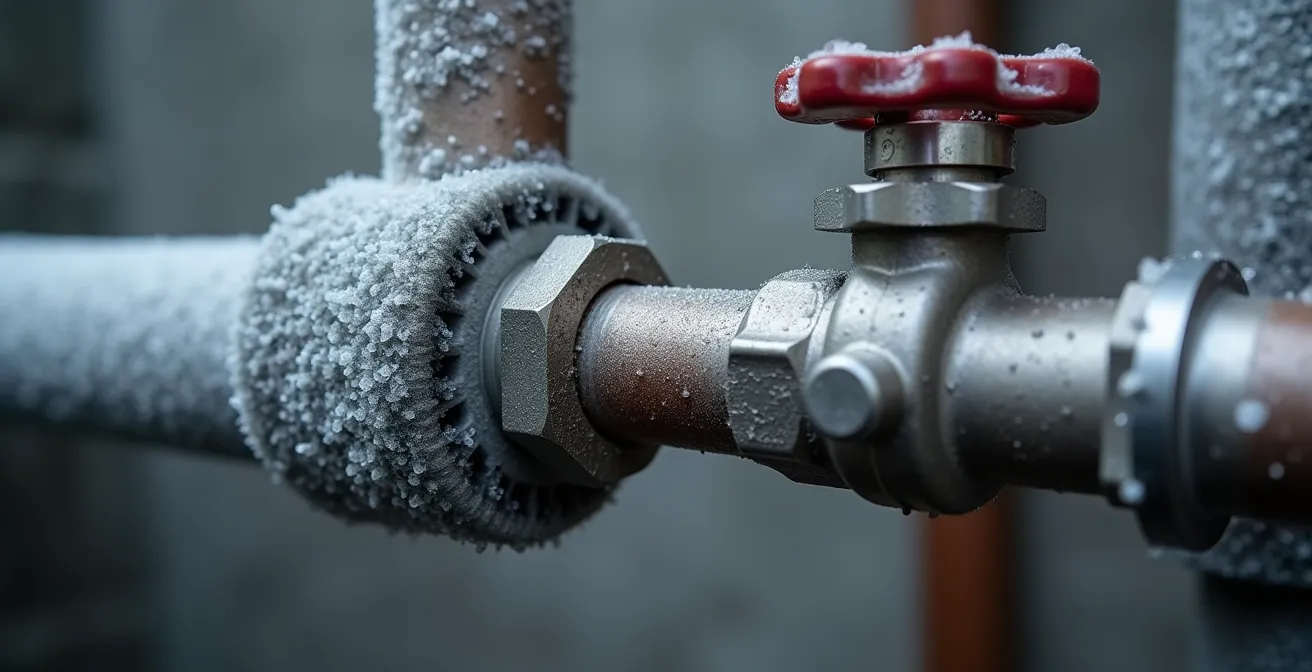
As this image illustrates, the combination of proper insulation and reliable shut-off valves is fundamental. A small investment of $50-$100 in foam sleeves and insulating tape can prevent a catastrophic failure costing over $3,000. It’s a clear demonstration of how a small, proactive expense neutralizes a huge reactive cost. This is the essence of operational predictability.
Preventive Drain Snaking: Is It Necessary if Everything Flows Fine?
For a property manager, a smoothly flowing drain is a silent asset. But assuming that “no news is good news” is a significant strategic error, especially in buildings with older infrastructure or mature trees. The question isn’t whether a blockage will happen, but when. A preventive approach treats drain health not as a reaction to a problem, but as scheduled maintenance to mitigate a high-impact risk: a sewer backup.
The financial argument is overwhelmingly in favor of prevention. Professional plumbers in Quebec have documented how a $250 preventive drain cleaning can prevent a $15,000+ emergency sewer backup. This isn’t just about the cost of the plumber; it includes water damage, sanitation services, and potential relocation of tenants. From an asset management perspective, the ROI on preventive snaking is astronomical. It’s a small, predictable operational cost that insures against a massive, unpredictable capital expense.
For older properties, particularly those common in Montreal’s established neighborhoods, the risk of root intrusion into cast-iron or clay pipes is not a possibility but an inevitability. A camera inspection is a vital diagnostic tool. It allows you to visualize the condition of your pipes, identify early-stage root growth or cracks, and make data-driven decisions about maintenance frequency. This moves you from guessing to knowing, a cornerstone of effective management. Consider scheduling an inspection if:
- The building was constructed before 1980 with its original pipes.
- There are mature trees within 10 meters of the main sewer line.
- Neighboring properties have reported issues with root intrusion.
- You need to confirm compliance with municipal backwater valve bylaws, best verified by a CMMTQ-certified plumber.
Safety Valve Testing: How to Prevent Your Water Heater from Exploding
A water heater is often forgotten until it fails, but its failure can be one of the most destructive events in a residential building. While a full-blown explosion is rare, it’s the result of a single, preventable issue: a malfunctioning Temperature and Pressure (T&P) relief valve. For a property manager, the annual testing of this small component is not just a best practice; it is a critical safety and liability-mitigation procedure.
The T&P valve is designed to release excess pressure, but mineral buildup from hard water can cause it to seize. According to Quebec plumbing industry standards, most residential water heaters last 10 to 12 years, after which the risk of component failure increases dramatically. Regular testing ensures this vital safety feature is operational, especially as the unit enters the latter half of its service life. This simple check transforms a potential liability into a managed asset.
The cost-benefit analysis is stark. An annual test is a minor operational expense, whereas the consequences of a failure are financially and structurally catastrophic. The following table breaks down the economics from a property manager’s perspective, clearly showing that prevention is not just cheaper, but the only rational financial choice.
| Scenario | Cost | Consequence |
|---|---|---|
| Annual T&P Valve Testing | $150-220 | Peace of mind, insurance compliance |
| Valve Replacement (preventive) | $180-250 | Prevents catastrophic failure |
| Water Heater Explosion | $20,000+ | Structural damage, potential liability |
| New Tank (emergency) | $1,200-2,000 | Plus water damage cleanup |
This data frames the decision not as an expense, but as an investment in risk management. A small, scheduled fee eliminates a massive, unpredictable financial and safety risk. For any portfolio, tracking the age of each water heater and scheduling T&P valve tests for all units over five years old should be standard operating procedure. It’s a non-negotiable part of proactive asset protection.
Plumbing First-Aid Kit: What to Keep on Hand While Waiting for the Pro
Even with the best preventive plan, incidents can occur. The difference between a minor issue and a major catastrophe often comes down to the first 10-15 minutes. While you wait for a professional CMMTQ-certified plumber, having a dedicated “plumbing first-aid kit” on-site can significantly minimize damage and cost. This isn’t about performing complex repairs; it’s about control and containment.
The primary goal during an active leak is to stop the flow of water. This means every on-site manager or superintendent must know the location of the main water shut-off valve and any individual fixture valves. If a pipe has burst, being able to quickly cap it can be invaluable. Tools like SharkBite push-to-connect end caps are exceptionally useful for this, as they require no special tools to install and can temporarily seal a pipe, turning a flooding event into a manageable drip.
In a condo building, a plumbing issue can quickly affect multiple units. The on-site protocol should be clear: shut off the main water supply to the affected line, contain the water with towels or a wet/dry vacuum, and if water is near electrical outlets, turn off the power at the breaker panel. Notifying building management or the condo syndicate immediately is also a crucial step for liability and coordinated response. This structured response minimizes panic and maximizes damage control.
Your Quebec Winter Plumbing First-Aid Kit Checklist
- Containment Tools: Have a bucket, multiple old towels, and a functional wet/dry vacuum readily accessible to control water spread immediately.
- Pipe Sealing: Stock SharkBite push-to-connect end caps in common pipe sizes (1/2″ and 3/4″), available at retailers like Canadian Tire, for quickly capping active leaks without soldering.
- Temporary Repairs: Keep pipe repair clamps and a roll of plumber’s tape for slowing drips on accessible pipes until professional help arrives.
- Thawing Equipment: Have a hair dryer or a dedicated heat gun for safely thawing frozen pipes. Never use an open flame, as this is a significant fire hazard and can damage the pipes.
- Emergency Contacts: Clearly tag the main shut-off valve with emergency numbers: your trusted CMMTQ-certified plumber, the municipal water utility, and Hydro-Québec.
Annual Maintenance Contract: Scam or Peace of Mind for Your HVAC?
The offer of an annual maintenance contract can feel like an upsell, but for a property manager overseeing multiple HVAC and plumbing systems, it should be evaluated as a strategic financial tool. Is it an unnecessary expense or a smart investment in operational predictability and cost control? The answer depends entirely on the structure of the contract and the needs of your properties.
A quality maintenance plan is not just an “insurance policy”; it is a service agreement that provides tangible financial benefits. These often include priority service during peak seasons (a major advantage during a January cold snap), and discounts of 10-20% on parts and labor for any repairs that are needed. For a portfolio of properties, these savings can quickly exceed the annual cost of the contract itself. Furthermore, many contracts are transferable, adding documented value to a property upon sale.
When analyzing the ROI of a contract, compare the annual fee to the cost of a single emergency call. As the table below demonstrates, the cost of one after-hours or holiday service call can often equal or exceed the price of a comprehensive annual plan that covers multiple systems.
| Contract Feature | Annual Cost | Emergency Savings |
|---|---|---|
| Basic Maintenance Plan | $150-300 | Priority service, 10-20% parts discount |
| Comprehensive Plan | $250-450 | Covers furnace + water heater + plumbing |
| Single Emergency Call | $600+ (holiday/weekend) | No discounts, long wait times |
| Transferable Contract Value | Included | Adds resale value to property |
The most effective contracts, such as those designed for Quebec’s popular bi-energy systems, bundle service for the furnace, boiler, air conditioner, and plumbing. For a property manager, this consolidates maintenance under a single, reliable vendor, simplifying scheduling and documentation. A comprehensive plan offering a discount on all repairs and a warranty on replaced parts transforms maintenance from a scattered series of costs into a managed, predictable budget item.
Photos and Invoices: How to Prove Your Maintenance in a Dispute
In property management, what isn’t documented doesn’t exist. This is especially true when it comes to maintenance. In the event of an insurance claim, a dispute with a tenant, or a due diligence process during a property sale, being able to prove that you have diligently maintained your building’s systems is invaluable. A simple collection of invoices is not enough; a robust, digital documentation system is your best defense.
Your goal is to create an unassailable record of proactive care. This system should be digital, cloud-based, and organized for easy access. For every service call, whether for routine maintenance or a repair, you should be capturing more than just the bill. Timestamped before-and-after photos provide visual proof of the work performed and the condition of the equipment. This is particularly powerful for demonstrating the resolution of an issue or the state of a component during a routine check.
The documentation should be organized logically, such as in a cloud folder structure by property address, then by year, and then by system (HVAC, Plumbing, etc.). A master spreadsheet can serve as a quick-reference index. This level of organization not only protects you in a dispute but also provides a clear history of each asset, aiding in budgeting for future replacements. Your documentation for each service event should include:
- A scanned copy of the full invoice.
- Clear notation of the plumber’s or technician’s CMMTQ certification number, which validates their professional standing.
- Dated photographs of the work area and specific components involved.
- Model and serial numbers of all major appliances like furnaces, water heaters, and sump pumps.
This disciplined approach transforms your maintenance records from a messy file folder into a powerful management and liability-protection tool. It is the definitive proof of your commitment to asset preservation and tenant safety.
Gas Furnace Lifespan: The Signs You’re in the Final Years
A gas furnace is the heart of a Quebec property in winter, and its failure is not an option. While routine annual service can extend its life, every furnace has a finite lifespan, typically 15 to 20 years. Recognizing the signs that a unit is approaching the end of its operational life is critical for a property manager. This allows you to proactively budget for a replacement, which can cost anywhere from $3,000 to $8,000, and schedule the work during the off-season, avoiding a no-heat emergency in February.
The most reliable indicator of a furnace’s decline is a loss of efficiency. A year-over-year increase of 10-15% in gas consumption on your Énergir bills, with consistent thermostat settings, is a major red flag. This means the furnace is working harder and running longer to produce the same amount of heat. This data, tracked over time, provides a clear, quantitative signal that the unit’s performance is degrading.
Beyond utility bills, physical signs and operational quirks become more apparent in the final years. Pay close attention during annual inspections and listen to tenant feedback. Key warning signs that a replacement is on the horizon include:
- Unusual Noises or Cycling: The furnace runs constantly on very cold days (below -12°C) or cycles on and off more frequently than in previous years.
- Visible Deterioration: An annual inspection reveals visible rust, corrosion, or small cracks on the heat exchanger—a critical and expensive component.
- Uneven Heating: Tenants report that some rooms are much colder than others, indicating the furnace can no longer distribute heat effectively.
- Increased Repair Frequency: You find yourself calling for repairs more than once a year, for issues beyond the standard annual maintenance tune-up.
Recognizing these signals allows you to move the furnace replacement from the “emergency” column to the “planned capital expenditure” column in your budget. This is the essence of strategic asset lifecycle management.
Key Takeaways
- The premium on emergency plumbing is a “tax on inaction”; strategic maintenance transforms this unpredictable cost into a controlled budget item.
- In Quebec, winter-proofing in the fall is the highest ROI activity, preventing catastrophic freeze-related failures.
- Documenting every service call with photos and CMMTQ numbers is not administrative work; it’s a critical liability shield.
What to Do in the First 10 Minutes of a Major Water Leak?
In a major water leak, the first ten minutes are more critical than the next ten hours. Your team’s ability to execute a clear, pre-defined emergency response plan will determine whether the event is a contained incident or a multi-unit disaster costing tens of thousands of dollars. The goal is not to fix the pipe, but to stop the damage from spreading while you wait for the professional plumber to arrive.
The absolute first step, to be executed in under two minutes, is to stop the flow of water. Every on-site staff member must be trained on the location of the main water shut-off valve for the building and for individual units, if applicable. Once the water is off, the next priority is electrical safety. If water is anywhere near the electrical panel, outlets, or major appliances, the power to the affected area must be cut at the breaker. If there is any doubt about safety, call Hydro-Québec’s emergency line immediately.
With the immediate water and electrical hazards controlled, the next steps are about mitigation and communication. A call to your trusted, CMMTQ-certified plumber should be made while another team member begins moving valuables and furniture out of the affected area. Simultaneously, you must notify your insurance provider and, in a condo, the building’s syndicate. This rapid, multi-pronged approach demonstrates control and diligence, which is crucial for both insurance claims and liability management. This is the 10-minute drill that separates professional property managers from amateurs:
- Minutes 1-2: STOP THE WATER. Locate and close the main water shut-off valve.
- Minutes 3-4: KILL THE POWER. If water is near electrical systems, turn off the corresponding breaker. Do not step in standing water.
- Minutes 5-6: MAKE THE CALL. Contact your 24/7 CMMTQ-certified plumber. Provide a clear, calm description of the situation.
- Minutes 7-8: MOVE YOUR STUFF. Relocate furniture, electronics, and important documents away from the water.
- Minutes 9-10: NOTIFY STAKEHOLDERS. Take photos of the initial damage, call your insurance broker, and alert the condo board (syndicat).
The next logical step is to move from theory to practice. Audit your current maintenance schedule against the strategies outlined here, create a documented plan for each property, and shift your budget from reactive repairs to proactive asset management.