

In summary:
- Start with a mandatory Rénoclimat energy evaluation before any work begins; this is your strategic roadmap for all grants.
- Focus on high-return upgrades like cold-climate heat pumps, which offer the best grant amount per dollar spent.
- Verify the exact AHRI reference number of your chosen heat pump system against both provincial and federal lists to avoid buying an ineligible model.
- Avoid common administrative errors, such as missing RBQ numbers on invoices, which can delay or nullify your application.
- Leverage the interest-free Canada Greener Homes Loan to finance the remaining costs after all grants have been deducted.
For any Quebec homeowner, the idea of upgrading a heating system often comes with a significant dose of sticker shock. The initial cost can feel prohibitive, even with the promise of long-term energy savings. You’ve likely heard of provincial programs like Rénoclimat and LogisVert, or even the federal Canada Greener Homes initiatives, but the landscape of grants, loans, and eligibility requirements can seem like a bureaucratic maze designed to be confusing.
Many homeowners either give up or, worse, proceed with renovations only to discover they’ve made a critical error that disqualifies them from thousands of dollars in aid. The common approach is to simply look at a list of available grants. But what if the key to making your renovation affordable wasn’t just knowing which programs exist, but mastering the *process* of applying for them?
This guide changes the perspective. It’s not another list of subsidies. It’s a procedural playbook for Quebec homeowners. We will shift the focus from what you *can* get to *how* you can get it, strategically and without falling into common administrative traps. We will break down the exact sequence of actions, from the initial evaluation to filing your final paperwork, to transform your heating upgrade from a daunting expense into a smartly subsidized investment in your home’s comfort and value.
This article will guide you through the essential steps to successfully navigate Quebec’s energy grant system. You will discover the mandatory first step, learn which renovations offer the best financial returns, and understand how to avoid the critical mistakes that jeopardize funding. The following table of contents outlines the path to maximizing your subsidies.
Summary: A Homeowner’s Guide to Quebec’s Energy Renovation Grants
- Évaluation énergétique avant travaux : pourquoi est-ce l’étape obligatoire pour être payé ?
- Quels travaux de chauffage offrent le meilleur retour en subventions par dollar investi ?
- Liste des thermopompes admissibles : comment ne pas acheter un modèle non subventionné ?
- Prêt canadien pour des maisons plus vertes : comment obtenir 40 000 $ sans intérêts ?
- Dossier incomplet : les 3 erreurs administratives qui retardent votre chèque de 6 mois
- Gainage des tuyaux d’eau chaude : combien économisez-vous en isolant les conduits au sous-sol ?
- Quand le remplacement de vos fenêtres devient-il rentable énergétiquement ?
- Is the Hydro-Québec Dual-Energy Rate Worth It for Your Home?
Évaluation énergétique avant travaux : pourquoi est-ce l’étape obligatoire pour être payé ?
Before you even request a quote for a new heat pump, there is one non-negotiable starting point for accessing the majority of Quebec’s generous grants: the pre-retrofit energy evaluation through the Rénoclimat program. Thinking of this as mere paperwork is the first strategic error. In reality, this evaluation is your roadmap to maximizing subsidies. It is a mandatory prerequisite not just for the provincial Rénoclimat grant itself, but also for unlocking access to the federal Canada Greener Homes Loan. Without a “before” snapshot of your home’s energy performance, you are ineligible.
An authorized Rénoclimat advisor will visit your home to conduct a standardized assessment, which includes a blower door test to pinpoint air leaks. The result is an EnerGuide report, which provides a rating for your home and a list of recommended upgrades. This report is not just a suggestion; it is the document that validates which renovations will be eligible for financial assistance. It’s crucial to have this evaluation done before any demolition or installation work begins. Furthermore, all work must be completed and the post-retrofit evaluation must be done before the program’s deadlines. For instance, Quebec participants in the Greener Homes initiative must complete their post-retrofit evaluation by September 30, 2025.
Viewing this step strategically means you use the advisor’s recommendations to plan a project that hits the “sweet spot”—addressing your home’s biggest energy weaknesses while targeting the most lucrative grants. This turns a bureaucratic requirement into your primary planning tool.
Your Action Plan: The Rénoclimat Grant Process
- Register with the Rénoclimat program online or by phone before starting any renovation work.
- Schedule your pre-retrofit energy evaluation with a certified advisor; this will include the crucial blower door test.
- Receive and carefully review your EnerGuide report to identify the most impactful and grant-eligible renovations.
- Hire RBQ-licensed contractors to perform the recommended work. This is mandatory for eligibility.
- Once work is complete, schedule the post-retrofit evaluation to measure the energy improvements and finalize your grant application.
Quels travaux de chauffage offrent le meilleur retour en subventions par dollar investi ?
Once your energy evaluation is complete, the next strategic question is where to invest for the best financial return. While grant programs cover a wide range of work, from insulation to windows, the most significant financial assistance is consistently tied to the installation of high-efficiency heating systems. Specifically, converting from an older, fossil-fuel-based system (like oil or propane) to a modern electric or dual-energy system offers the opportunity to “stack” multiple grants and achieve the highest subsidy levels.
The star of the show is the cold-climate heat pump. These systems are engineered to perform efficiently even at Quebec’s low winter temperatures. While they have a higher initial cost than standard models, the grants are structured to reward this choice. Programs like Hydro-Québec’s LogisVert offer substantial rebates calculated per 1,000 BTUs of heating capacity at -8°C, directly incentivizing more powerful and efficient units. When combined with other programs, this approach can dramatically lower the net cost of the project.
ROI in Action: The Cold-Climate Heat Pump Advantage
A prime example of grant stacking is upgrading an old oil furnace. This single project can make a homeowner eligible for the Chauffez Vert program for abandoning fossil fuels, as well as the LogisVert program for installing an efficient heat pump. According to an analysis from Confort Expert, Rénoclimat grants can reach from $20,000 to $40,000 for comprehensive projects, and installing a cold-climate heat pump rated for -25°C can cover over 50% of the total installation costs by leveraging these combined programs.
The table below, based on data from Thermoco, summarizes the primary grant programs available for heat pumps in Quebec, highlighting how different scenarios unlock different funding streams.
| Program | Maximum Grant | Eligibility |
|---|---|---|
| LogisVert (Hydro-Québec) | Up to $6,700 | $50 per 1,000 BTUs at -8°C |
| Dual-Energy Conversion | Up to $7,400 | Natural gas to electricity-gas hybrid |
| Chauffez Vert | Up to $1,275 | Oil/propane to electric conversion |
| Canada Greener Homes | Up to $5,000 | Closed to new applicants |
Liste des thermopompes admissibles : comment ne pas acheter un modèle non subventionné ?
One of the most devastating and entirely avoidable mistakes a homeowner can make is investing thousands of dollars in a new heat pump, only to find out it’s ineligible for grants. The government and Hydro-Québec maintain precise, regularly updated lists of eligible equipment. However, eligibility is not based on the brand, but on the specific combination of the indoor and outdoor units. A perfectly eligible outdoor unit paired with a non-listed indoor unit will result in a rejected application.
The key to protecting yourself is due diligence. You cannot simply trust a salesperson’s verbal assurance. The official eligibility of a heat pump system is determined by its AHRI reference number (Air-Conditioning, Heating, and Refrigeration Institute). This unique code corresponds to a specific pairing of an outdoor condenser and an indoor air handler (or multiple heads in a multi-zone system). Your role as an informed homeowner is to verify this number yourself against the official lists before signing any contract.
As the image suggests, the technical specifications are detailed and precise. You must request that your contractor provides the exact model numbers for all components and the corresponding AHRI number on the official quote. Then, cross-reference this information on the eligible product lists for both the LogisVert program and the broader Canada Greener Homes/Rénoclimat list. This simple verification step can be the difference between receiving a $6,000 grant and receiving nothing.
Furthermore, ensure your chosen contractor holds a valid RBQ (Régie du bâtiment du Québec) license appropriate for the work being performed. Work done by an unlicensed contractor is automatically disqualified from all provincial grant programs. Ask for the license number and verify its status on the RBQ website.
Prêt canadien pour des maisons plus vertes : comment obtenir 40 000 $ sans intérêts ?
Even after securing thousands in grants, the upfront cost of a major energy retrofit can be substantial. This is where the Canada Greener Homes Loan comes in as a powerful financing tool. This federal initiative offers an interest-free loan of up to $40,000 with a repayment term of 10 years, designed to help homeowners bridge the financial gap for eligible retrofits. In Quebec, this loan works in tandem with the provincial grant programs.
To be eligible for the loan, you must first be a participant in the Rénoclimat program and have completed your pre-retrofit energy evaluation. The work you plan to undertake must be part of the recommendations in your EnerGuide report. The loan is intended to cover the remaining costs *after* all other grants have been applied. This is a critical point of how the funding is structured, and it directly impacts the loan amount you can receive.
As the federal government outlines, the process is designed to prevent “double-dipping” and ensure the loan covers only the homeowner’s out-of-pocket expenses. Natural Resources Canada provides clear guidance on this interaction:
The federal loan amount is based on the total cost minus any provincial grants
– Natural Resources Canada, Canada Greener Homes Grant Quebec Guidelines
This means if your project costs $25,000 and you are eligible for $7,000 in provincial grants, the maximum loan you could apply for would be $18,000. Applying is a multi-step process that starts through the Canada Greener Homes portal and requires you to submit quotes for the planned work. Approval is based on the scope of the project and its estimated cost, providing you with the funds to proceed with your renovations confidently.
Dossier incomplet : les 3 erreurs administratives qui retardent votre chèque de 6 mois
After completing your energy-efficient renovations, the final hurdle is submitting a flawless application. This is where many homeowners falter, as simple administrative errors can lead to significant delays or even outright rejection. Transition énergétique Québec, the body managing Rénoclimat, processes thousands of applications and has automated systems to flag incomplete or incorrect files. Getting your cheque quickly depends on getting the paperwork right the first time.
The most common and costly mistakes are almost always related to the contractor’s invoice. This document is the primary proof of your project, and it must contain specific information to be considered valid. Based on official guidelines and reported processing issues, three major “administrative sinkholes” stand out:
- Missing or Incorrect RBQ Number: The invoice absolutely must display the contractor’s active RBQ license number. An application with a missing RBQ number often results in an instant rejection. It must be the *contractor’s* number, not a subcontractor’s.
- Vague or Non-Itemized Costs: A total amount is not enough. The invoice must provide a clear, itemized breakdown of costs, separating materials from labour. It also must clearly show the applicable GST/QST numbers.
- Date Discrepancies: All work and payment dates on the final invoice must fall chronologically *between* your pre-retrofit and post-retrofit evaluation dates. An invoice dated before your first evaluation is a major red flag that will trigger a manual review, a process that can add four to six months to your application’s processing time.
Finally, ensure the invoice is marked “Paid in Full.” The programs are designed as rebates for work that has been completed and paid for. A balance-owing invoice suggests the project is not finished and will halt your application. Double-checking these details with your contractor before they issue the final invoice can save you months of waiting and frustration.
Gainage des tuyaux d’eau chaude : combien économisez-vous en isolant les conduits au sous-sol ?
While major heating system overhauls offer the largest grants, don’t overlook smaller, high-return projects that can be done with a minimal budget. Insulating hot water pipes in your basement or crawlspace is one of the most cost-effective DIY energy-saving measures you can undertake. Uninsulated pipes, especially copper ones, continuously radiate heat into the unconditioned space of your basement, forcing your water heater to work harder to deliver hot water to your taps.
The solution is simple and inexpensive: foam pipe sleeves. These are available at any hardware store and can be easily cut to size and fitted over your accessible hot water pipes. By insulating the first six to ten feet of pipe coming from your water heater, and any long runs through the basement, you reduce standby heat loss significantly. This means the water in the pipes stays hotter for longer, so you wait less time for hot water at the faucet and your water heater cycles on less frequently.
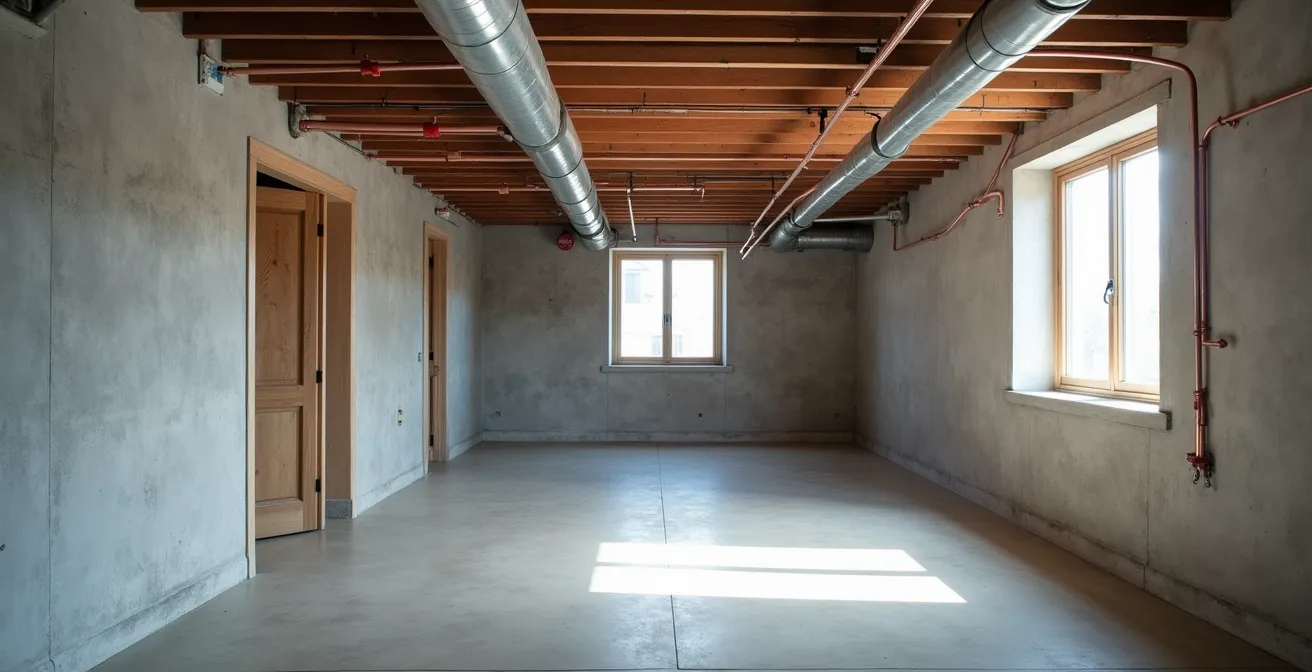
The financial return is surprisingly quick. While this specific upgrade may not have a dedicated, large-scale grant on its own, its impact is recognized as a key part of a whole-home energy efficiency strategy encouraged by Rénoclimat. The real benefit comes from the direct, year-over-year savings on your electricity bill. According to Hydro-Québec, insulating about 15 meters (50 feet) of basement pipes can save up to $75 per year on your water heating costs. Given that the materials for such a project can cost less than $50, the payback period is often under a year, making it a smart and simple addition to any larger renovation plan.
Quand le remplacement de vos fenêtres devient-il rentable énergétiquement ?
Drafty windows are a major source of heat loss and discomfort in Quebec winters, making replacement a tempting upgrade. However, from a purely financial and grant-focused perspective, full window replacement is a long-term investment with a very slow payback period. The cost of replacing all the windows in a house can easily reach $25,000 or more, while the available grants typically cover only a fraction of this expense. The resulting energy savings, while real, are often not enough to make the project “profitable” for 20-30 years.
Before committing to such a large expense, your Rénoclimat evaluation will likely highlight a much more cost-effective alternative: air sealing and weatherstripping. A significant portion of the heat loss attributed to “bad windows” actually comes from air leaks around the window frames, not through the glass itself. Sealing these gaps with caulk and adding new weatherstripping can often solve the majority of the draft problem for about 10% of the cost of full replacement. Crucially, the Rénoclimat program heavily subsidizes this type of air sealing work, sometimes covering up to 50% of the cost.
The following data, adapted from Transition énergétique Québec, clearly illustrates the financial trade-off.
| Renovation Type | Average Cost | Grant Coverage | Energy Savings | Payback Period |
|---|---|---|---|---|
| Full Window Replacement | $25,000 | Up to 20% | 15-20% | 20-30 years |
| Air Sealing & Weatherstripping | $2,500 | Up to 50% | 10-15% | 3-5 years |
If you do decide to proceed with new windows, be extremely careful about the product specifications. Most of Southern Quebec is designated as ENERGY STAR Climate Zone 2. Installing windows rated only for Zone 1 in a Zone 2 area will disqualify you from any grants, a costly error that underscores the importance of verifying every technical detail before purchase.
Key takeaways
- The Rénoclimat pre-retrofit evaluation is the mandatory first step and your strategic guide for all grant applications.
- Cold-climate heat pumps offer the best return, allowing you to “stack” grants from programs like LogisVert and Chauffez Vert.
- Always verify equipment eligibility using the AHRI number and ensure your contractor has a valid RBQ license to avoid application rejection.
Is the Hydro-Québec Dual-Energy Rate Worth It for Your Home?
For homeowners currently heating with natural gas, the dual-energy (or bi-énergie) offer from Hydro-Québec represents one of the most powerful and financially attractive paths to reducing both energy costs and carbon footprint. This system combines a new electric heat pump with your existing (or a new) gas furnace. The heat pump acts as the primary heating source during milder weather. When the outdoor temperature drops below a set point (usually -12°C or -15°C), the system automatically switches to the gas furnace. This allows you to heat with cheaper electricity most of the time, while retaining the power of gas for the coldest days.
The financial incentive is twofold. First, you gain access to Hydro-Québec’s preferential Rate DT, which offers a lower price per kilowatt-hour for electricity used outside of peak winter periods. Second, the conversion is supported by substantial grants. The grant for converting to a dual-energy system is one of the highest available for a single project, with some sources indicating it can provide up to $7,300. This is in addition to the savings you will see on your annual energy bills.
However, the process requires careful coordination. You cannot simply install the system and apply. The application for the grants and for the Rate DT are separate but linked processes that must be done in the correct order. The typical sequence is as follows:
- Complete your mandatory Rénoclimat pre-retrofit evaluation.
- Have a licensed contractor install a new, eligible dual-energy compatible heat pump system.
- Apply for the relevant heat pump grant (e.g., LogisVert) through the Hydro-Québec portal.
- Submit a separate application to Hydro-Québec to be switched to the dual-energy Rate DT.
- Schedule your post-retrofit evaluation to finalize all Rénoclimat-related grants.
This option is not for everyone—it is specifically for homes with natural gas service. But for those who qualify, it offers a strategic way to leverage a high-value grant while significantly lowering long-term heating costs.
To put these strategies into practice and begin the process, the clear next step is to register with the Rénoclimat program and schedule your initial energy evaluation.