
Identifying a lead service line is just the first step; true water safety in a pre-1970s Quebec home comes from a complete plumbing system audit.
- Lead is not removed by common water softeners, and high water pressure after a line replacement can damage your appliances.
- The real solution lies in certified filtration systems (NSF/ANSI 53 or 58) and ensuring all new fixtures are certified lead-free.
Recommendation: Start with a visual pipe inspection, but plan for a certified water filter and a full plumbing assessment for long-term peace of mind for your family.
As a homeowner in Montreal or another historic Quebec city, the news about lead in drinking water can be deeply concerning. You look at the tap, and a simple question arises: is the water my family drinks and bathes in truly safe? You may have heard the common advice: find your main water shut-off valve, scratch the pipe with a key, and if it’s a dull grey and soft, it’s likely lead. This test is a valid and necessary first step. However, focusing solely on this one pipe is like checking only one tire on your car before a long road trip.
The reality is that ensuring your family’s health requires a more holistic view. The presence of a lead service line is often a symptom of an older, potentially outdated plumbing network. Simply replacing the main line without considering the rest of the system can create new, unexpected problems. The real key to peace of mind isn’t just identifying the main problem, but understanding your home’s entire water protection system—from the pressure entering your home to the final quality of water at the faucet.
This guide goes beyond the basic scratch test. We will explore the interconnected elements of your plumbing that are crucial for water safety and performance in a Quebec context. We will examine why high water pressure can be a hidden threat, whether a water softener is a false friend in the fight against lead, and how to choose the right filtration system. By the end, you will have a comprehensive framework to not only identify lead but to build a complete system of protection for your home.
To help you navigate these crucial aspects of your home’s plumbing, this article is structured to address each key component. The following summary outlines the topics we will cover to give you a complete picture of how to ensure your water is safe and your system is sound.
Summary: A Complete Guide to Your Home’s Water Safety
- Pression d’eau trop forte : pourquoi cela endommage-t-il vos électroménagers ?
- Adoucisseur d’eau : est-ce vraiment nécessaire avec l’eau municipale de votre région ?
- Eau de puits : quels tests faire chaque année pour garantir la potabilité ?
- Tuyaux de 1/2 ou 3/4 de pouce : quel diamètre pour alimenter une douche pluie ?
- Filtre au charbon ou osmose inversée : lequel choisir pour boire l’eau du robinet sans crainte ?
- Sans plomb (Lead-Free) : comment reconnaître le marquage officiel sur un robinet ?
- Pourquoi payer 30% plus cher pour du Type L dans votre entrée d’eau résidentielle ?
- Why Is Copper Piping Still the Best Choice for Hot Water Lines?
High Water Pressure: Why It Damages Your Appliances
After replacing an old, narrow lead service line, many Quebec homeowners are surprised by a new problem: excessively high water pressure. While strong flow sounds like a benefit, pressure above the recommended level puts constant strain on your entire plumbing system. Your dishwasher, washing machine, and even your water heater are not designed to withstand this relentless force. This can lead to premature failure of seals, valves, and internal components, resulting in costly repairs and potential water damage. The constant stress is similar to over-inflating a tire—it works for a while, until it suddenly doesn’t.
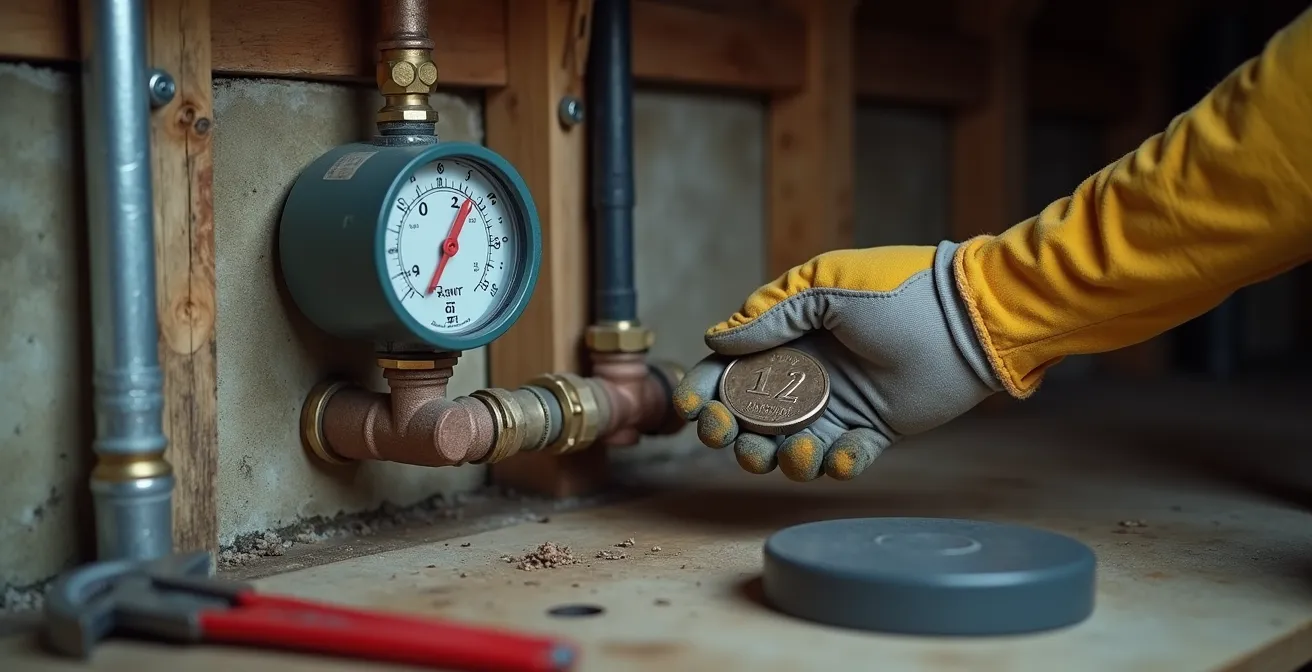
For residential properties, maintaining a balanced pressure is key. According to plumbing experts, the normal operating pressure should be between 60-65 PSI. Anything consistently above 80 PSI is considered a risk to your appliances and pipes. This is where a Pressure Reducing Valve (PRV) becomes an essential part of your home’s water protection system. This device is installed on your main water line (typically near the shut-off valve in the basement) and acts as a regulator, ensuring the pressure delivered to your fixtures and appliances remains at a safe and optimal level, extending their lifespan and preventing leaks.
Protecting your modern appliances is not just about clean water, but also about managing its force. A simple pressure check can save you from significant future expenses and is a critical step after any major plumbing work, especially the replacement of a main service line.
Water Softener: Is It Really Necessary With Your Region’s Municipal Water?
Many homeowners dealing with plumbing concerns consider installing a water softener, especially if they notice mineral buildup. However, in the context of lead contamination in Quebec, this can be a critical misunderstanding. A water softener’s job is to address water hardness by removing calcium and magnesium ions and replacing them with sodium ions. It is not designed to remove heavy metals like lead. Relying on a softener for lead removal provides a false sense of security, as the primary health threat remains completely unaddressed.
The city of Montreal’s large-scale action plan to remove lead service lines underscores this distinction. As part of its screening campaign, the city focused on replacing the physical pipes because that is the source of the contamination. The official guidance from Montreal’s lead action plan confirms that water softeners do not filter out lead. The contamination comes from lead particles leaching from the pipe itself, and these particles will pass straight through a standard ion-exchange softening system. This means that even with “soft” water, your family could still be exposed to lead if the source has not been eliminated or properly filtered.
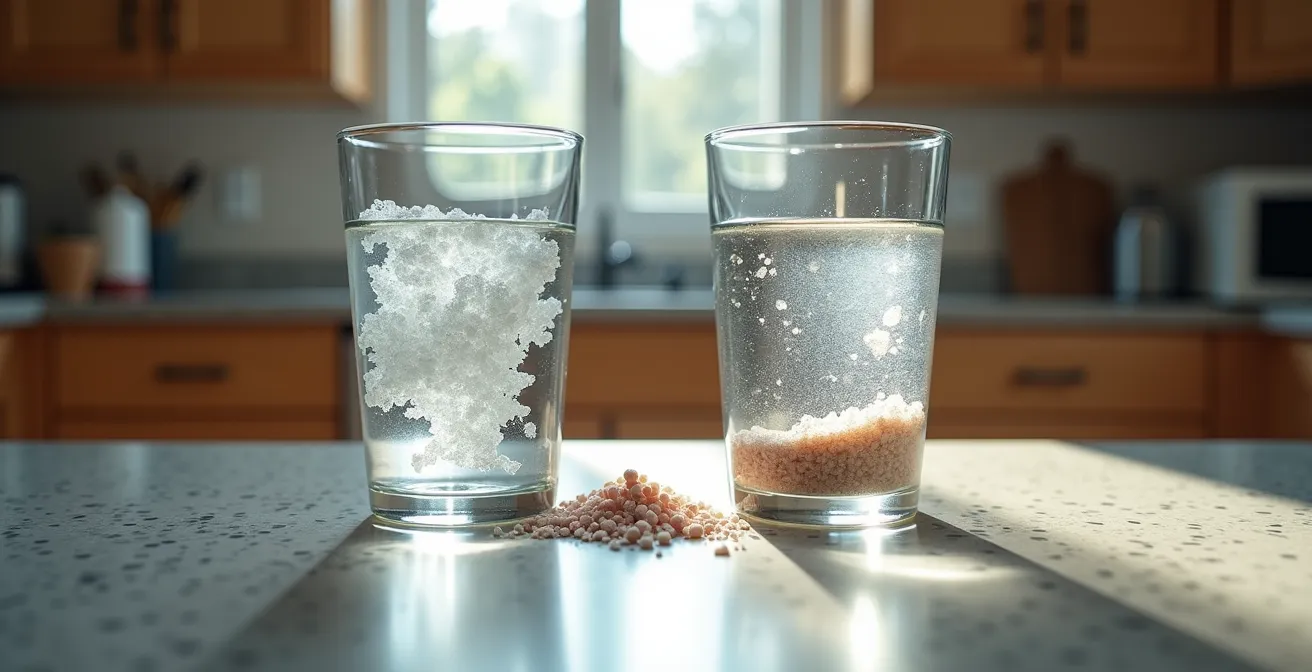
The illustration above clearly shows how a softener works on minerals but fails to capture hazardous lead particles. For a Quebec homeowner concerned about lead, investing in a water softener for this purpose is ineffective. The focus must be on source removal and, most importantly, on certified point-of-use filtration designed specifically for lead reduction.
Well Water: What Annual Tests Are Needed to Ensure Potability?
For Quebecers with a cottage or a country home relying on a private well, ensuring water potability is an annual responsibility that goes beyond municipal checks. Unlike city-treated water, well water is directly influenced by the surrounding environment and the materials in your plumbing system, making regular testing essential. The primary concerns for well owners are bacteriological contaminants (like E. coli) and physicochemical parameters, which include heavy metals like lead. The Ministère de l’Environnement (MELCC) mandates annual testing for these elements to guarantee safety.
Lead can enter well water not just from the groundwater itself, but from components within the system. Older submersible pumps with leaded-brass parts, lead solder used on copper pipes, and old brass fittings are common sources of contamination in homes built before the 1990s. The only way to know for sure is to test. In March 2019, Health Canada lowered the maximum acceptable concentration for lead in drinking water, and as an important public health measure, Quebec was the first in Canada to adopt this new, stricter standard of 5 ppb. This makes accurate testing even more critical.
Identifying potential lead components in your well system follows the same logic as for city homes. Find where the water line enters the house or look at the pipes connected to your pressure tank. Lead pipes are dull grey, soft enough to be easily scratched with a key, and a magnet will not stick to them. If you tap a lead pipe, it makes a dull thud, unlike the clearer ring of copper or galvanized steel. If you suspect lead, a water test from a certified lab is non-negotiable.
1/2-Inch or 3/4-Inch Pipes: What Diameter for a Rain Shower?
When you replace your old lead service line, you have a golden opportunity to improve your home’s entire water flow. Old lead pipes often have a narrow internal diameter, which, combined with decades of mineral buildup, can severely restrict flow. Upgrading not just the main line but also the internal distribution pipes from 1/2-inch to 3/4-inch can dramatically enhance your daily experience, especially if you plan to install modern fixtures like a rain shower head.
A rain shower requires a significantly higher volume of water to function correctly than a standard shower head. A 1/2-inch pipe may struggle to deliver that volume, resulting in a disappointing dribble instead of an immersive cascade. This is a matter of simple physics: a 3/4-inch pipe can carry more than double the volume of water of a 1/2-inch pipe. As an expert from the National Plumbing Code of Canada Implementation Guide notes:
After replacing your restrictive lead service line, upgrading internal mains from 1/2-inch to 3/4-inch is key to experiencing improved flow.
– Quebec Plumbing Code Analysis, National Plumbing Code of Canada Implementation Guide
This table illustrates how pipe diameter affects a typical Quebec home’s capacity to run multiple fixtures simultaneously. Upgrading to 3/4-inch ensures your new rain shower won’t cause the kitchen sink to lose all its pressure.
| Pipe Diameter | Fixture Units Capacity | Typical Quebec Home Type | Shower Head Support |
|---|---|---|---|
| 1/2 inch | Up to 7 units | Post-war plexes, pre-1970s bungalows | Standard shower only |
| 3/4 inch | Up to 20 units | Modern homes, renovated properties | Rain shower + multiple fixtures |
Therefore, when discussing a service line replacement with your plumber, always bring up the topic of your internal pipe diameter. It’s a strategic upgrade that ensures your plumbing system can meet the demands of a modern lifestyle.
Carbon Filter or Reverse Osmosis: Which to Choose for Safe Tap Water?
Once you’ve confirmed or suspected the presence of lead, filtration becomes the most immediate and effective line of defense. However, not all filters are created equal. For a Quebec homeowner facing this issue, the choice between a simple carbon filter and a more complex reverse osmosis (RO) system depends on your specific situation and the level of protection you need. The key is to look for certification from the National Sanitation Foundation (NSF).
To be effective against lead, a filter must be certified to a specific standard. According to public health guidelines, water filters must be NSF-compliant for lead reduction under standard NSF/ANSI 53 for carbon-based filters or NSF/ANSI 58 for RO systems. A standard carbon pitcher filter that only claims to improve taste (often certified to NSF/ANSI 42) will not protect your family from lead. Always check the packaging or manufacturer’s specifications for the correct certification before buying.
The right choice of filter is highly contextual. A tenant in a Montreal apartment might opt for a temporary solution, whereas a homeowner with a confirmed lead line needs a permanent installation. This checklist provides a clear path forward based on common scenarios in Quebec.
Your Quebec-Specific Filter Selection Plan
- For Tenants in Montreal: Choose an NSF/ANSI 53 certified pitcher or faucet-mounted filter. This is an effective, affordable, and temporary solution while you wait for the city’s lead line replacement program to reach your building.
- For Homeowners with Confirmed Lead Lines: Install an under-sink reverse osmosis (RO) system certified to NSF/ANSI 58. These systems, available at stores like Canadian Tire or Rona, offer the highest level of protection by removing over 99% of lead and other contaminants.
- For Homes Post-Replacement: After your lead service line has been replaced, a high-quality carbon block filter (NSF/ANSI 53) at the point of use is an excellent choice for removing any residual contaminants and improving taste. Remember to replace cartridges as recommended, typically every 6 months.
Ultimately, selecting a certified filter is a non-negotiable step for any household on a pre-1970 service line. It’s an immediate and reliable way to ensure the water from your tap is safe to drink.
Lead-Free: How to Recognize the Official Marking on a Faucet
Even after replacing your main service line, sources of lead can still exist *inside* your home. This is the “residual contamination” part of the water protection system. One of the most common culprits is older brass faucets and plumbing fixtures. Prior to 2014, brass alloys used in plumbing could contain a significant amount of lead. Today, regulations are much stricter to protect public health. The Safe Drinking Water Act mandates that brass fixtures used for drinking water must be “lead-free.”
This doesn’t mean zero lead. As of January 4, 2014, the standard requires that brass fixtures for drinking water contain no more than 0.25 percent lead. To ensure compliance, you must look for certification marks on the faucet or its packaging. In Canada, the most common marks are CSA (Canadian Standards Association) or cUPC (Uniform Plumbing Code). These symbols guarantee the product has been tested and meets the current lead-free standard. A faucet without these marks, especially one purchased from an online marketplace or an unverified seller, poses a significant risk.
This is not just a theoretical problem; it’s a real issue that municipalities in Quebec have encountered. As local authorities work to replace aging infrastructure, they also caution residents about the products they install inside their homes.
The installation of lead pipes was prohibited in Quebec in 1980… Today, the Quebec Government is asking for the complete replacement of these pipes. [However,] residents report finding non-compliant faucets on online marketplaces that lack CSA or cUPC certification markings.
– Hampstead, QC Public Advisory, Lead in Water Information
When renovating your kitchen or bathroom, always insist on certified fixtures from reputable suppliers. Checking for a small stamp on the faucet body is a simple action that closes a major potential loophole in your home’s water safety net.
Key Takeaways
- Identifying your main lead service line is only the first step in a comprehensive home water safety plan.
- Common water softeners do not remove lead; only filtration systems certified to NSF/ANSI 53 or 58 standards are effective.
- After a lead line replacement, you must also consider internal plumbing factors like water pressure, pipe diameter, and the certification of your faucets.
Why Pay 30% More for Type L in Your Residential Water Service Line?
When you receive quotes for replacing your lead service line with copper, you might see different “types” of copper pipe mentioned, such as Type K and Type L. The difference is wall thickness: Type K is the thickest and most durable, while Type L is thinner, and Type M is thinner still. For a residential water service line—the underground pipe that connects your home to the city’s water main—the choice is not a matter of preference. It’s a matter of code and long-term durability.
According to the National Plumbing Code of Canada, which sets the standard for plumbing practices across the country, Type K copper is the required standard for underground water service lines. Its thick walls provide the necessary resistance to corrosion, ground shifting, and the physical stresses of being buried. Type L copper, while excellent for interior hot and cold water distribution lines *inside* the house, is not robust enough for underground burial as a service line.
An unscrupulous or uninformed contractor might quote you for Type L for the underground portion to lower their price. While it may seem like a good deal, it is a major compliance and safety issue. As one Canadian Plumbing Code expert warns:
A quote with Type L for the underground portion is a major red flag – Type K copper is the Canadian standard for underground service lines.
– Canadian Plumbing Code Expert, National Plumbing Code of Canada Guidelines
Paying more for Type K copper for your service line isn’t an upsell; it’s an investment in compliance, longevity, and peace of mind. A service line installed with substandard materials is likely to fail prematurely, leading to costly and disruptive emergency repairs. Always ensure your plumbing contract explicitly specifies Type K copper for the underground service line to protect your investment and ensure your home meets Canadian safety standards.
Why Is Copper Piping Still the Best Choice for Hot Water Lines?
In the conversation about replacing lead pipes, copper consistently emerges as the gold standard for modern plumbing, especially for hot water lines. Its enduring popularity is not just a matter of tradition; it’s based on a proven track record of safety, durability, and performance. In a city like Montreal, where approximately 52,791 lead service lines were identified in 2018, upgrading to copper is seen as a definitive step toward a safer and more valuable home.
Copper’s primary advantage is its biostatic property, meaning it naturally inhibits the growth of bacteria. This is a significant benefit for your entire water system. Furthermore, it is extremely resistant to corrosion and high temperatures, making it the ideal material to handle the demands of a modern water heater and appliances without degrading or leaching harmful chemicals. Unlike some plastic alternatives, copper does not risk leaching plasticizers into the water, and it has a lifespan that can exceed 50 years, often outlasting the home itself.
This reputation for quality has a tangible impact on property value, particularly in desirable Montreal neighbourhoods. Real estate agents in areas with older housing stock know that a home with updated copper plumbing is a major selling point. It signals to potential buyers that a critical, expensive, and health-related upgrade has already been taken care of.
The city estimates that lead service lines affect 16 of Montreal’s 19 boroughs… Real estate agents confirm ‘plomberie en cuivre’ remains a premium selling feature in Le Plateau-Mont-Royal and Westmount listings.
– Montreal Real Estate Analysis, How to Recognize a Lead Water Service Line
Choosing copper is more than just a pipe replacement; it is an investment in your family’s long-term health and the financial value of your property. It completes your home’s water protection system with a material that is trusted, safe, and built to last for generations.
To truly ensure your family’s safety and the integrity of your home, the next logical step is to move from awareness to action. A comprehensive audit of your plumbing by a certified professional will provide you with a clear roadmap for any necessary upgrades, from pressure management to filtration and fixture replacement.
Frequently Asked Questions About Well Water and Lead in Quebec
What testing protocol should Quebec well owners follow?
The Ministère de l’Environnement et de la Lutte contre les changements climatiques (MELCC) requires annual bacteriological and physicochemical analyses including lead testing for private wells.
Where can lead contamination occur in well systems beyond the water source?
Lead can come from older submersible pumps with leaded-brass parts, lead solder on copper pipes, or old brass fittings commonly found in Quebec cottages and country homes built before 1980.