
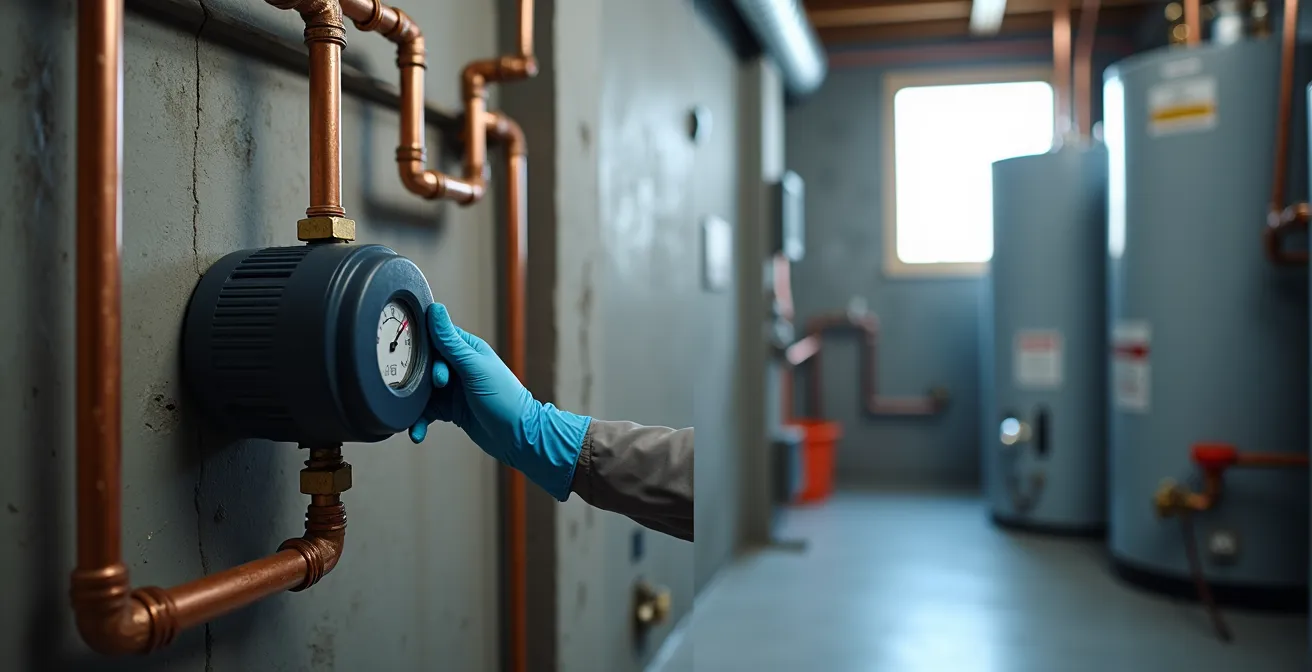
Achieving instant hot water is less about the pump itself and more about a complete, optimized system that prevents energy waste and pipe damage.
- A recirculation system must be intelligently controlled (not run 24/7) to make a real impact on your Hydro-Québec bill.
- Incorrect pump sizing is a critical failure point, leading to erosion-corrosion in copper pipes that can cause leaks within years.
Recommendation: Prioritize a system with on-demand controls and ensure the pump’s flow velocity is professionally sized by a CMMTQ-certified plumber for your home’s specific plumbing.
That daily ritual is familiar to every Quebec homeowner, especially on a frigid January morning: you turn on the shower and wait. And wait. As gallons of perfectly good, clean water run down the drain, you’re not just wasting a precious resource; you’re watching money literally disappear. The initial cold blast is the water that has been sitting in your pipes, cooling down since its last use. For an average family, this can amount to thousands of gallons wasted each year, a fact reflected in both your water and energy bills.
The common advice is often a simplistic “just install a hot water recirculation pump.” While a good starting point, this advice misses the bigger picture and can even lead to new, more expensive problems. True water and energy efficiency isn’t about adding a single gadget; it’s about understanding your home’s plumbing as a complete ecosystem. Without a proper strategy, a poorly implemented pump can run 24/7, creating constant heat loss that your water heater has to fight, inflating your Hydro-Québec bill.
But what if the real key wasn’t just circulating water, but circulating it intelligently? The secret to achieving instant hot water without the waste lies in a system-level approach. This means mastering concepts like parasitic heat loss, controlling flow velocity to prevent premature pipe failure from erosion-corrosion, and choosing the right control strategy for your lifestyle. A properly designed system delivers comfort and savings, while a poorly designed one trades one problem for another.
This guide will walk you through the real-world options and critical considerations for implementing an effective hot water strategy in your Quebec home. We’ll explore how to retrofit existing plumbing, compare advanced strategies for new builds, and reveal how to make your system work for you, not against your wallet.
To help you navigate these solutions, this article breaks down the essential strategies, from simple retrofits to comprehensive plumbing designs. Explore the topics below to find the best fit for your home and budget.
Summary: A Quebec Homeowner’s Guide to Instant Hot Water
- Recirculation loop: gravity (thermosiphon) or forced pump for your renovation?
- Recirculation without a dedicated return: how to use the cold water line to bring hot water back?
- Loop heat loss: why is insulating your pipes vital with recirculation?
- Timer or motion sensor: don’t run the pump 24/7!
- Circulation speed: why will a pump that’s too powerful puncture your pipes in 5 years?
- Recirculation loop vs. grouping: which strategy for hot water in 5 seconds?
- Octopus system: why does having a dedicated line per appliance change your life?
- How to Cut Your Hydro-Québec Bill by 20% This Winter?
Recirculation loop: gravity (thermosiphon) or forced pump for your renovation?
When planning a hot water recirculation system, especially during a renovation, you’ll encounter two fundamental types of loops: gravity-based (thermosiphon) and forced-pump. Understanding the difference is critical to choosing a solution that is effective in the context of a Quebec climate. A thermosiphon system works on a simple principle of physics: hot water is less dense than cold water, so it naturally rises. In a plumbing loop, hot water leaves the top of the water heater, cools as it travels through the pipes, and sinks back to the bottom of the heater to be reheated. This creates a slow, constant, passive circulation.
While elegant in its simplicity, the thermosiphon effect is very weak. It requires large-diameter pipes and is highly susceptible to heat loss, making it largely inefficient for the long pipe runs found in modern homes. In a cold Quebec basement, the parasitic heat loss from the pipes can easily overwhelm the gentle circulation, rendering the system ineffective and causing the water heater to work constantly to compensate. For these reasons, thermosiphon systems are considered an outdated approach for residential comfort.
The modern, effective solution is a forced-pump system. A small, low-power electric circulator pump is installed on the loop, actively pushing the water through the pipes. This provides a reliable and controllable flow that overcomes the limitations of gravity. It ensures that hot water is actively brought to the fixtures when needed, rather than relying on a weak natural current. For any renovation project aiming for tangible results in comfort and efficiency, a forced-pump system is the only practical choice, providing the power needed to deliver hot water quickly and reliably, even on the coldest days.
Recirculation without a dedicated return: how to use the cold water line to bring hot water back?
What if your home wasn’t built with a dedicated hot water return line? For most homeowners in Quebec, running a new pipe from the furthest bathroom back to the water heater is an invasive and expensive proposition. Fortunately, an innovative solution exists that uses your existing plumbing: a comfort or “bridge” valve system. This technology creates a recirculation loop by using the cold water supply line as the return path, making it an ideal retrofit solution.
The system works with two main components: a circulator pump installed at the water heater and a special thermostatic valve installed under the sink furthest from the heater. The pump pushes hot water down the hot water line. When the hot water reaches the bridge valve, its sensor detects the temperature rise and closes, stopping the flow. As the water in the loop cools, the valve opens again, allowing the pump to push the now-lukewarm water across the bridge and back to the water heater via the cold water line. This keeps the hot water line primed and ready, drastically reducing the wait time at the tap. This method is incredibly effective, with some systems proving they can save up to 11,000 gallons of water per year that would otherwise go down the drain.
The one minor drawback is that when you first turn on the cold tap, you might get a brief spurt of lukewarm water that was in the line. However, this is a small trade-off for the immense comfort and water savings. For most existing homes, this is the most practical and cost-effective path to instant hot water.
Your Action Plan: Installing a Bridge Valve System
- Install the comfort/bridge valve under the sink that is furthest from your water heater.
- Connect the valve between the hot and cold supply lines using the provided fittings.
- Mount the recirculation pump at the hot water outlet on your water heater.
- Program the system’s timer to match your household’s peak usage times and avoid running it 24/7.
- Test the system; note that it’s normal to have a 30-60 second delay for truly cold water at that specific tap, especially in winter.
Loop heat loss: why is insulating your pipes vital with recirculation?
Implementing a hot water recirculation loop without addressing pipe insulation is like trying to carry water in a leaky bucket. The entire purpose of the loop is to keep hot water ready near your taps, but if the pipes are uninsulated, you are creating a massive, continuous radiator throughout your house. This is especially true in the cold, unfinished basements common in many Quebec homes. The hot pipes are constantly shedding their heat into the cold ambient air, forcing your water heater to work overtime just to maintain the temperature in the loop.
This is known as parasitic heat loss, and it can completely negate the energy savings from reduced water consumption. The numbers are staggering; energy loss calculations show that an uninsulated ½-inch copper pipe can lose around 25 watts per meter when exposed to the 5°C air of a typical basement. Across a 30-meter loop, that’s 750 watts of continuous energy loss—the equivalent of leaving seven old-fashioned incandescent light bulbs on 24/7, all paid for on your Hydro-Québec bill.
Properly insulating all accessible hot water pipes with closed-cell foam insulation is not an optional add-on; it is a mandatory component of an efficient recirculation system. Insulation can reduce heat loss by over 80%, ensuring the water that arrives at your tap is still hot and that the circulator pump and water heater only run when necessary. It’s the single most important step to ensure your investment in comfort doesn’t turn into an energy-wasting liability.

As this image highlights, the texture of quality foam insulation is designed to trap air and prevent thermal transfer. This simple barrier is the frontline defense against a system that wastes more energy than it saves. Without it, your recirculation loop will be fighting a losing battle against the cold, and your energy bills will show it.
Timer or motion sensor: don’t run the pump 24/7!
Once your recirculation loop is installed and insulated, the single biggest factor influencing its operating cost is the control strategy. Leaving the pump to run continuously, 24 hours a day, is the most common and costly mistake. It guarantees instant hot water at all times, but it also maximizes both parasitic heat loss (even with insulation) and electricity consumption from the pump itself. This turns a solution meant for efficiency into a constant drain on your Hydro-Québec bill. The key to maximizing savings is to run the pump only when you are likely to need hot water.
The two most common control methods are timers and on-demand buttons or sensors. A simple plug-in timer allows you to schedule the pump to run during peak usage periods, such as the morning rush (6-9 AM) and the evening (5-9 PM). This simple act of running the pump for 8 hours instead of 24 can slash its electricity consumption by two-thirds. More advanced systems use on-demand activation. A button is installed in the bathroom; you press it a minute before you need hot water, the pump activates, and the water is hot when you’re ready. Motion sensors can automate this, starting the pump when someone enters the bathroom.
As this expert points out, intelligent control is about more than just energy savings; it’s about system longevity:
True on-demand hot water systems reduce wear and tear on your water heater, recirculation pump, and pipes.
– Smart Recirculation Control, Smart Recirculation Control Systems Guide
The financial argument for smart controls is undeniable. Running a pump 24/7 might only cost $30 a year in electricity, but the real cost is in the wasted heating energy. An on-demand system provides the same water-saving benefits with a negligible energy footprint.
This comparative analysis highlights the dramatic difference in operating costs on a typical Hydro-Québec bill. Clearly, running the pump continuously is an inefficient strategy.
| Control Method | Daily Runtime | Annual kWh | Annual Cost (Hydro-Québec) | Water Saved |
|---|---|---|---|---|
| 24/7 Operation | 24 hours | 350 kWh | $28-35 | Maximum |
| Timer (8hr/day) | 8 hours | 117 kWh | $9-12 | High |
| On-Demand Button | 20 minutes | 9.7 kWh | $0.80-1.20 | High |
Circulation speed: why will a pump that’s too powerful puncture your pipes in 5 years?
In plumbing, bigger is not always better, and this is especially true for recirculation pumps. A common mistake is to install an oversized pump, believing it will deliver hot water faster. In reality, a pump that is too powerful creates excessive flow velocity—the speed at which water moves through the pipes. When this velocity exceeds a safe threshold, it triggers a destructive process known as erosion-corrosion, which can physically wear away copper pipes from the inside, leading to pinhole leaks and catastrophic failure in as little as five years.
This problem is particularly pronounced in regions like Quebec with “soft” water. Soft water is naturally more aggressive and can accelerate the rate at which copper is eroded. The industry standard, as recommended by the Copper Development Association, is to keep flow velocity in residential hot water systems below 5 feet per second (fps). Many oversized pumps can easily push this to 8 or 10 fps, dramatically shortening the lifespan of your plumbing. You’ve solved the problem of waiting for hot water only to create a ticking time bomb of water damage.
Properly sizing the pump is therefore not just a matter of efficiency, but of protecting your home’s infrastructure. The calculation involves the total length of the pipe loop and its diameter to determine the required flow rate (in gallons per minute, or GPM) that keeps the velocity within safe limits. For most homes, a small fractional-horsepower pump is more than sufficient. Always consult a CMMTQ-certified plumber to perform these calculations.
Case Study: The High Cost of Oversized Pumps
In Quebec’s soft water conditions, excessive flow velocity accelerates erosion-corrosion in copper pipes. A study documented on a professional plumbing site followed 50 homes where recirculation pumps were installed. The findings were stark: homes where pumps were creating flow rates above 5 feet per second required major pipe replacement within just 5 to 7 years due to multiple pinhole leaks. The initial investment in a recirculation system was dwarfed by the thousands of dollars in water damage repairs and re-piping costs, a powerful testament to why pump sizing is a critical, non-negotiable step.
Recirculation loop vs. grouping: which strategy for hot water in 5 seconds?
When aiming for the gold standard of near-instant hot water, two primary system-level strategies emerge: the recirculation loop (which we’ve discussed for retrofits) and fixture grouping, often executed with a manifold system. The best choice depends entirely on your situation: are you retrofitting an existing home or are you doing a new build or a major gut renovation?
A recirculation loop is the champion of retrofitting. As we’ve seen, it can be installed with minimal disruption using a bridge valve and the existing cold water line. When properly controlled and insulated, it can deliver hot water to the furthest tap in just a few seconds. It’s an effective, targeted solution for solving the “long wait” problem in an established home. Its compatibility with various control methods also allows it to meet high-efficiency standards like those in Quebec’s Novoclimat program.
For new construction or a complete renovation, however, a manifold or “octopus” system represents a more fundamentally efficient design. With this approach, a central manifold distributes dedicated hot and cold PEX (cross-linked polyethylene) pipes to each individual fixture. Instead of one large trunk line serving multiple taps, each faucet has its own smaller-diameter home run. This drastically reduces the volume of water sitting in any given pipe, meaning the hot water from the heater arrives in 3-5 seconds with no pump required. This design also eliminates pressure and temperature fluctuations—the dreaded “shower scald” when someone flushes a toilet.
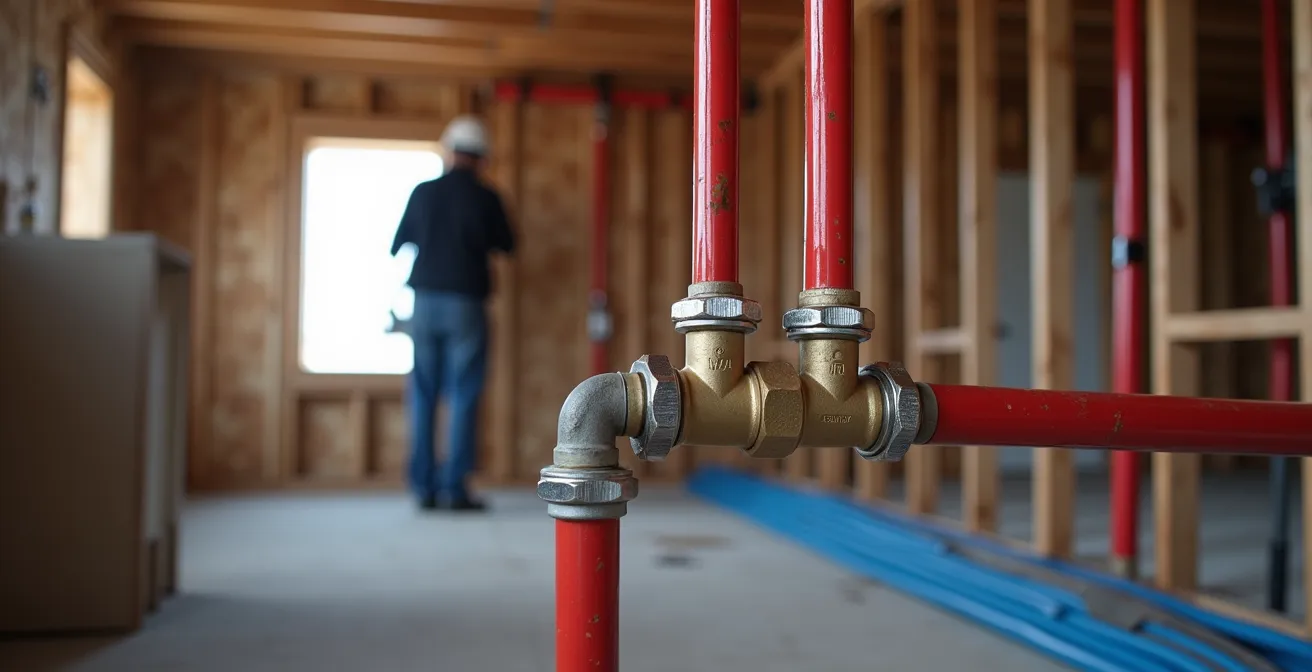
The choice comes down to installation context and budget, as a manifold system is significantly more expensive upfront but offers superior performance and inherent efficiency. A recirculation loop offers 80% of the benefit for 20% of the cost in a retrofit scenario.
| Strategy | Best For | Installation Cost | Hot Water Delay | Novoclimat Compatible |
|---|---|---|---|---|
| Recirculation Loop | Existing homes, retrofits | $800-$1,500 | 0-3 seconds | Yes, with timer controls |
| Manifold/Grouping | New construction, gut renovations | $2,500-$4,000 | 3-5 seconds | Excellent – minimizes pipe volume |
Octopus system: why does having a dedicated line per appliance change your life?
A manifold plumbing system, often called a “home-run” or “octopus” (pieuvre) system, fundamentally re-architects how water is delivered in your home. Instead of a large trunk-and-branch system where pipes split off to serve different fixtures, a manifold acts as a central switchboard. From this hub, individual, smaller-diameter PEX lines run directly to each sink, shower, and appliance. This design offers two life-changing benefits: stable water pressure and dramatically reduced wait times for hot water.
The biggest improvement is the elimination of temperature and pressure shock. In a traditional system, when someone flushes a toilet, it draws a large volume of cold water, “stealing” it from the shower and causing a sudden drop in cold pressure and a spike in hot temperature. With a manifold, the toilet and shower are on separate, dedicated lines, so they operate independently. One fixture’s use has no impact on another’s. This benefit alone is a major upgrade in comfort and safety, especially for families with children or elderly members. As one Montreal homeowner noted after a retrofit:
After retrofitting our 1960s Montreal triplex with a PEX manifold system, the temperature shock problem completely disappeared. No more scalding when someone flushes the toilet upstairs. The $3,200 investment was worth every penny for the comfort and safety it provides our tenants.
– Homeowner, Montreal
The second major benefit is speed. Because the individual PEX lines are smaller (typically ⅜” or ½”) and run directly to the fixture, the volume of water they hold is minimal. When you turn on a tap, the hot water only has to push out a small amount of cooled water before it arrives, often in under five seconds. While a manifold system is more expensive to install, with typical installation costs ranging from $2,500 to $4,000 for a standard home, the gains in daily comfort, safety, and long-term water savings make it the superior choice for any new build or major renovation project.
Key Takeaways
- A recirculation pump is only effective with proper insulation and smart controls to avoid high Hydro-Québec bills.
- Oversizing a pump is dangerous; flow velocity above 5 ft/s can cause pipe erosion and leaks, especially in Quebec’s soft water.
- For new builds, a PEX manifold (“octopus”) system offers superior comfort by eliminating pressure drops and reducing wait times.
How to Cut Your Hydro-Québec Bill by 20% This Winter?
While the primary motivation for installing a hot water recirculation system is often comfort, a properly designed and holistically managed system can lead to significant savings on your Hydro-Québec bill. Cutting your energy costs by up to 20% is not about a single magic bullet, but about combining several key efficiency measures. The foundation of these savings comes from drastically reducing water waste. Research shows a typical household can waste over 10,000 gallons of water per year just waiting for it to get hot. Since approximately 20-25% of your energy bill is from water heating, saving that water directly saves energy.
The first step is implementing an on-demand recirculation system. As we’ve seen, running a pump 24/7 is counter-productive. Using a push-button or timer-based control ensures you get comfort without the constant energy drain of a continuously running pump and the associated heat loss. Next, couple this with other proven efficiency measures. Lowering your water heater’s setpoint to 60°C (140°F) is a critical step; this temperature is high enough to prevent the growth of Legionella bacteria while reducing standby heat loss. Insulating not just the hot water pipes but also the water heater tank itself with an R-12 blanket can further cut these standby losses by 25-45%.
Finally, reduce the amount of water used at the tap by installing low-flow faucet aerators (1.5 GPM or less). This reduces the volume of hot water needed, further lowering heating demand. When combined, these strategies create a powerful synergy. A case study of a Quebec family of four who implemented a smart on-demand pump, insulated their tank and pipes, and lowered their heater temperature saw a total reduction of 18% on their annual Hydro-Québec bill, saving approximately $240. This demonstrates that a thoughtful, system-wide approach to hot water is a direct path to lower winter energy costs.
Stop letting comfort and savings run down the drain. The next logical step is to consult with a CMMTQ-certified plumber to assess which of these high-efficiency hot water solutions is the right fit for your home and start cutting your Hydro-Québec bill this winter.