
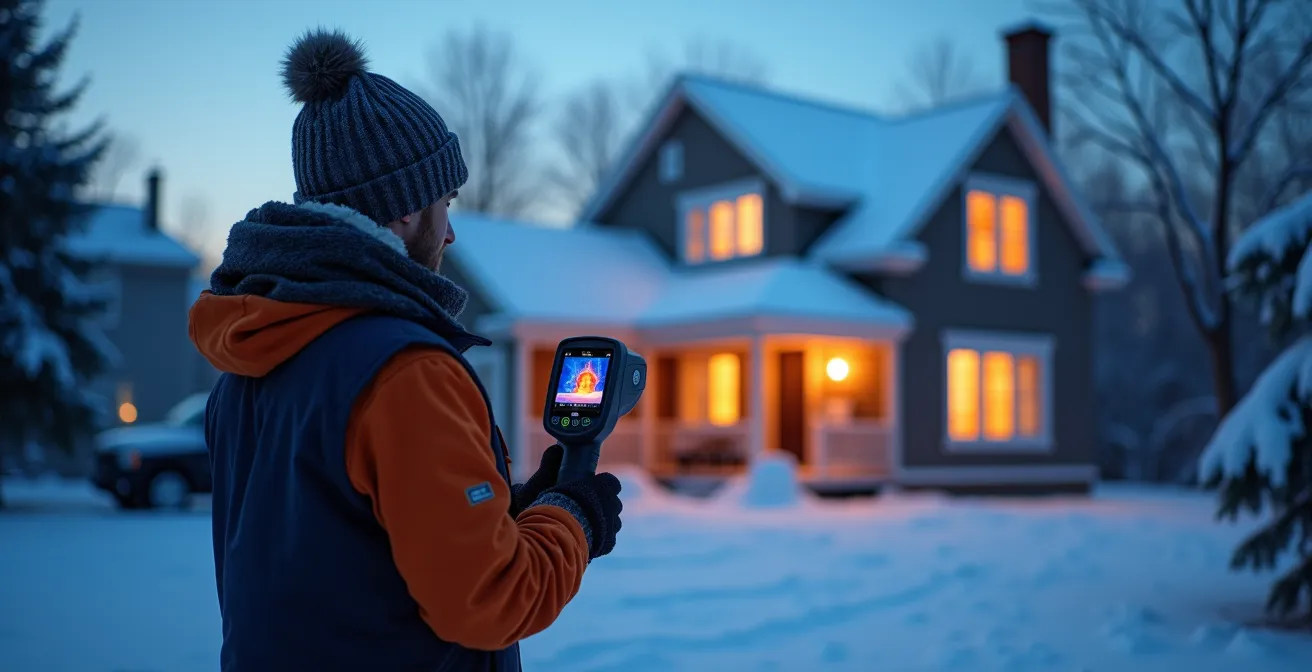
The biggest energy savings in your Quebec home often don’t come from a new furnace, but from controlling invisible airflows within the building envelope.
- Uncontrolled air leakage can be responsible for over a third of your home’s total heat loss, representing a massive source of energy waste.
- A certified energy evaluation is the mandatory first step for accessing major provincial subsidies like the Rénoclimat program.
Recommendation: Start with a diagnostic approach to identify and seal air leaks before considering any expensive equipment upgrades for the highest return on investment.
Living in Quebec means embracing the cold, but it shouldn’t mean accepting sky-high heating bills as an inevitability. Many homeowners instinctively look towards big-ticket items like a new high-efficiency furnace or replacing all their windows to combat energy loss. While these can be part of a solution, they often overlook the most significant and cost-effective area for improvement: the integrity of the building envelope itself. The real culprit behind a cold, drafty house is frequently a series of small, invisible air leaks that, when combined, act like an open window all winter long.
Thinking of your house as a single, interconnected system is the key to a successful energy audit. The performance of your furnace, the comfort in your living room, and even the air quality in your basement are all linked to how well your home’s shell controls the flow of air and heat. This holistic approach moves beyond simply patching problems and focuses on understanding the root causes of energy waste. It’s about diagnosing before you prescribe a solution. An energy auditor doesn’t just see a drafty window; they see a pressure imbalance that could be affecting the entire structure.
This guide will walk you through the mindset and methods of a professional energy auditor, tailored for the unique challenges of Quebec’s climate and housing stock. We’ll explore how to use technology to see the invisible, why sealing cracks can offer a better return than a multi-thousand-dollar furnace, and how to leverage provincial programs to help pay for it all. By treating your home as a complete system, you can make smarter, more impactful upgrades that enhance comfort, reduce costs, and improve your home’s overall health.
text
This article will guide you through the essential steps and considerations for a comprehensive home energy audit. Discover the tools, techniques, and financial incentives available to Quebec homeowners.
Summary: A Complete Guide to Finding and Fixing Heat Loss in Your Home
- Caméra thermique : comment interpréter les zones bleues sur vos murs en hiver ?
- Infiltrations d’air : pourquoi calfeutrer vos fenêtres rapporte plus que changer votre fournaise ?
- Fenêtres à triple vitrage : l’investissement est-il rentable pour le climat de Montréal ?
- Chauffage passif : comment orienter vos rideaux pour chauffer gratuitement le jour ?
- Gainage des tuyaux d’eau chaude : combien économisez-vous en isolant les conduits au sous-sol ?
- Comment savoir si votre maison est en pression négative et aspire le radon ?
- Évaluation énergétique avant travaux : pourquoi est-ce l’étape obligatoire pour être payé ?
- Which Insulation Type Is Best for Preventing Frozen Pipes in Crawl Spaces?
Caméra thermique : comment interpréter les zones bleues sur vos murs en hiver ?
The first step in any serious energy audit is making the invisible visible. A thermal imaging camera is an auditor’s most powerful diagnostic tool, translating heat signatures into a color-coded map. In winter, warm areas appear in yellow, orange, or red, while cold spots show up as purple or deep blue. These blue zones are the tell-tale signs of heat loss, indicating either missing insulation or, more commonly, cold air infiltrating your home’s thermal envelope.
Interpreting these images requires understanding how buildings in Quebec are constructed. For instance, a vertical blue streak on a party wall in a Montreal plex likely points to a gap in insulation between you and your neighbour. A distinct blue patch where a concrete balcony meets the exterior wall reveals a “thermal bridge”—a pathway for cold to conduct directly into your home’s structure. These are critical points of energy loss that are impossible to spot with the naked eye.
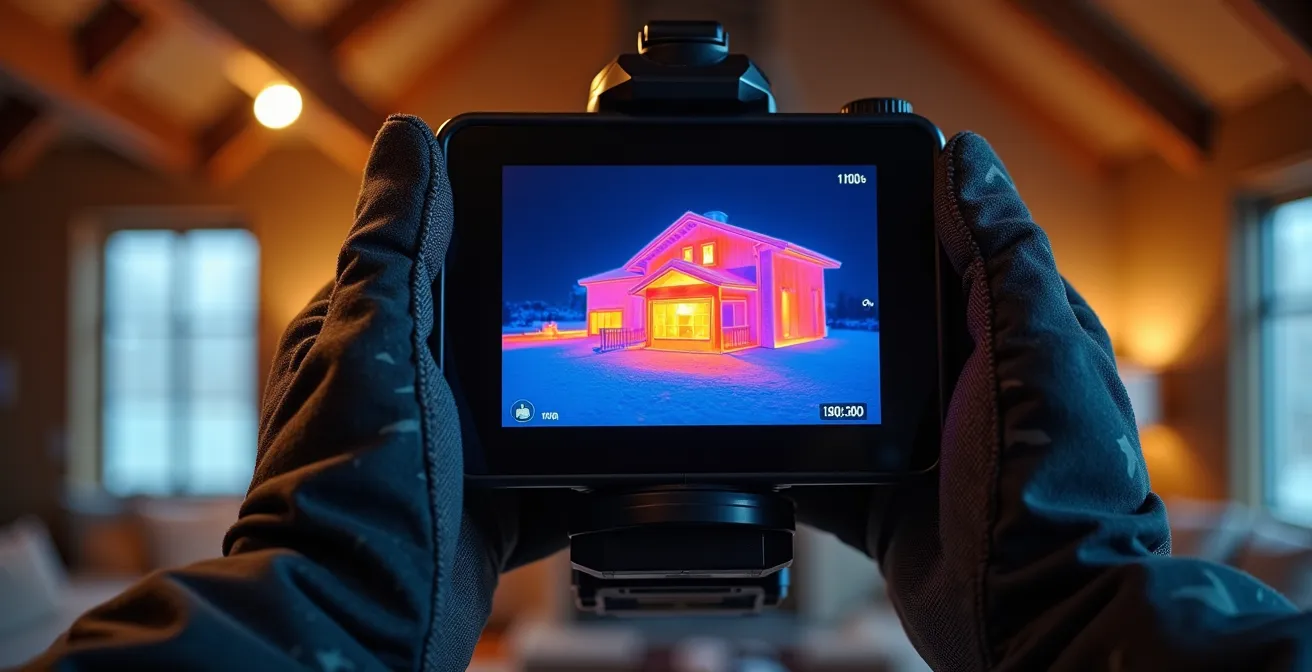
As the image shows, the corners where walls meet ceilings are especially prone to becoming cold zones. Beyond just energy loss, these areas create a risk for condensation to form, which can lead to mold growth and compromise indoor air quality. A thermal camera doesn’t just find where you’re losing money; it finds potential health hazards. Mastering its use is fundamental to creating an effective upgrade plan.
Your Action Plan: Interpreting Thermal Camera Images in a Quebec Home
- Ensure a minimum 15°C temperature difference between inside and outside for accurate readings.
- Turn on all exhaust fans (kitchen, bathroom) for 20 minutes before scanning to depressurize the home and amplify air leaks.
- Scan party walls in Montreal plexes; look for vertical blue streaks indicating missing insulation between units.
- Check concrete balcony connections, where blue thermal bridges often appear at the junction with exterior walls.
- Focus on where the foundation meets the wood structure; cold blue zones here indicate critical air infiltration points.
Infiltrations d’air : pourquoi calfeutrer vos fenêtres rapporte plus que changer votre fournaise ?
After diagnosing heat loss, the next step is prioritizing fixes based on return on investment (ROI). Homeowners often assume the furnace is the biggest factor in their heating bill, leading them to consider a costly replacement. However, from a systemic perspective, this is often the wrong first move. If your home’s envelope is leaky, a new high-efficiency furnace will simply heat air that is quickly escaping outside. It’s like pouring water into a bucket full of holes.
The real powerhouse of energy savings is air sealing. Addressing drafts and uncontrolled air infiltration provides a much faster and higher ROI. According to energy auditors, air leakage can account for 25-30% of energy waste in a typical home, representing a huge opportunity for savings. Sealing these gaps with caulk, weatherstripping, and spray foam is a low-cost, high-impact strategy. This approach reduces the load on your *existing* heating system, making it run less often and more efficiently.
By focusing on thermal envelope integrity first, you right-size the problem. Once your home is properly sealed, you may find your current furnace is perfectly adequate. If a replacement is still needed, a tighter home might allow you to install a smaller, less expensive unit. This is the essence of a holistic audit: fixing the structure before upgrading the machinery.
The following table breaks down the typical costs and benefits, clearly showing why air sealing is the champion of energy retrofit ROI in Quebec.
| Solution | Average Cost (CAD) | Annual Savings | Payback Period | Energy Reduction |
|---|---|---|---|---|
| Professional Air Sealing | $500-$1,500 | $200-$400 | 2-4 years | Up to 33% |
| DIY Caulking & Weatherstripping | $75-$200 | $100-$250 | Under 1 year | 10-20% |
| New High-Efficiency Furnace | $4,000-$7,000 | $150-$300 | 15-25 years | 10-15% |
Fenêtres à triple vitrage : l’investissement est-il rentable pour le climat de Montréal ?
Windows are a significant component of the building envelope and a common source of heat loss. The question for many Quebec homeowners is whether the substantial investment in triple-pane windows is justified. The answer depends heavily on our specific climate. An energy auditor looks at a metric called Heating Degree Days (HDD), which measures how cold a location is and for how long. The higher the HDD number, the greater the heating demand.
This is where the Quebec context is critical. Climate data from Natural Resources Canada shows Montreal has around 4,500 HDD, compared to about 3,500 in Toronto. This 28% higher heating demand means that high-performance windows deliver significantly more savings and a faster payback period in Montreal than in less severe climates. While a double-pane, low-E, argon-filled window is a good baseline, triple-pane becomes a financially viable and often recommended upgrade in the coldest parts of the province.
However, no decision should be made in isolation. The true value is revealed through a certified energy evaluation, such as one conducted under the Rénoclimat program. The evaluator’s report will model the potential energy gains from new windows based on your specific house—its orientation, window-to-wall ratio, and existing air tightness. This data-driven recommendation ensures you are investing wisely, not just spending money. For many older “shoebox” style homes with large, original windows, the upgrade can be transformative, but only an audit can confirm the exact ROI.
Chauffage passif : comment orienter vos rideaux pour chauffer gratuitement le jour ?
A truly holistic energy strategy isn’t just about preventing heat loss; it’s also about maximizing “free” heat gain. This is the principle of passive solar heating, and your windows and curtains are the primary tools to control it. During a cold but sunny Quebec winter day, the low-angle sun provides a significant amount of thermal energy. By strategically managing your window coverings, you can capture this warmth and reduce the workload on your furnace.
The strategy is simple but effective. On south-facing elevations, where sun exposure is greatest, curtains should be opened wide in the morning to let the sunlight stream in and warm up the floors and interior mass of your home. As the sun moves across the sky, you follow its path, opening east-facing curtains in the morning and west-facing ones in the afternoon. The key is to act just before dusk: close all curtains tightly to trap the accumulated heat inside for the night. This turns your curtains into an extra layer of insulation.
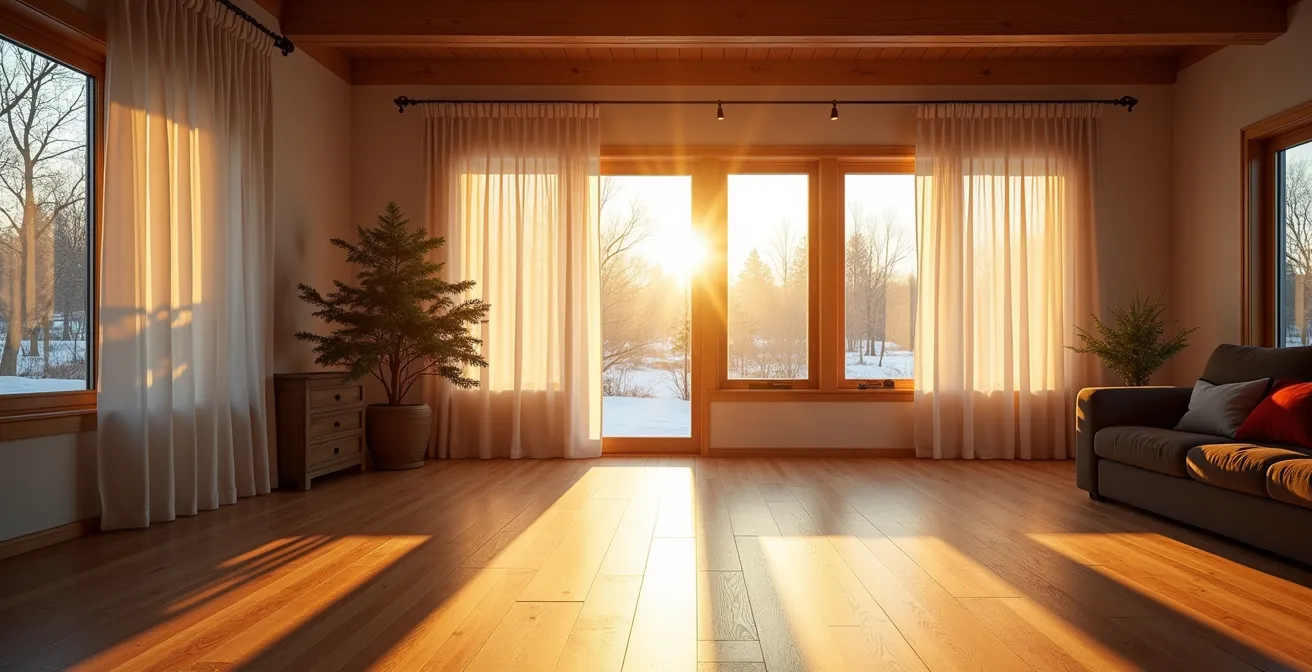
The effectiveness of this technique is amplified by using the right type of curtains. Heavy, thermal-lined drapes are particularly effective, especially on north-facing windows that receive little to no direct sun and are a source of constant heat loss. By implementing a daily and seasonal curtain strategy, you are performing a type of manual energy management, making small adjustments that yield cumulative savings over the winter.
- Morning (9 AM): Open all south-facing curtains to capture maximum solar heat gain.
- Peak Sun (10 AM – 3 PM): Keep south-facing curtains fully open. On north-facing windows, keep thermal curtains closed to prevent heat loss.
- Late Afternoon (from 3 PM): Begin closing east-facing curtains as the sun’s angle decreases.
- Dusk (4-5 PM in winter): Close all curtains tightly to trap the day’s accumulated heat inside the house.
- Night: Ensure all windows, especially on the north and west sides, are covered with well-sealed thermal curtains.
Gainage des tuyaux d’eau chaude : combien économisez-vous en isolant les conduits au sous-sol ?
In a comprehensive energy audit, no detail is too small. While we often focus on space heating, water heating is typically the second-largest energy expense in a Quebec home. A significant amount of this energy is lost as the hot water travels from your water heater to the tap. In an unfinished, cold basement, uninsulated copper pipes act like radiators, constantly bleeding heat into a space where it isn’t needed.
Insulating hot water pipes is one of the easiest and most cost-effective DIY energy-saving projects. Simple foam pipe sleeves can be purchased inexpensively at any hardware store and are easy to install. By sleeving at least the first six feet of pipe coming from the water heater (both hot and cold lines) and any long, accessible runs throughout the basement, you can significantly reduce standby heat loss. This means the water arrives at the faucet hotter, so you may use less hot water overall. It also means your water heater will cycle on less frequently to maintain the temperature in the tank.
While the savings from this single action may seem modest, it’s a crucial part of the “building as a system” philosophy. A series of small, targeted improvements add up to substantial overall savings. In fact, Save on Energy research indicates that targeted improvements can lead to an up to 30% reduction in total home energy use. Insulating pipes is a prime example of such an improvement—a small investment of time and money that pays dividends for years. This is especially true in homes with long pipe runs or where the water heater is located far from the main points of use, like the kitchen and bathrooms.
Comment savoir si votre maison est en pression négative et aspire le radon ?
As we make our homes more airtight to save energy, we must also manage indoor air quality and pressure. An overly tight home can create a situation of negative pressure, where powerful exhaust fans (like a kitchen range hood or a clothes dryer) pull more air out of the house than is coming in. When this happens, the house will desperately try to draw “makeup” air from the path of least resistance. This often means pulling air up from the ground through tiny cracks in the foundation.
This is where energy efficiency intersects with health and safety. The soil beneath our homes can contain radon, a naturally occurring radioactive gas that is the leading cause of lung cancer for non-smokers. If your home is under negative pressure, it can actively suck this dangerous gas into your basement and living spaces. This is a particular concern in Quebec, with regions like the Montérégie and Gaspésie known to have higher radon concentrations.
You can perform a simple DIY test to see if your home is susceptible to negative pressure. This is not a radon test, but a test of your home’s pressure dynamics. If the test indicates a problem, the solution is often a Heat Recovery Ventilator (HRV) or Energy Recovery Ventilator (ERV) that is properly balanced to supply fresh air as it exhausts stale air, keeping the pressure neutral. Here is a simple diagnostic to perform:
- Turn off all HVAC systems and close all exterior windows and doors.
- Turn on your most powerful exhaust fans (e.g., kitchen range hood on high).
- Light an incense stick and hold it near the bottom of closed exterior doors and windows.
- Observe the smoke. If it is actively pulled inward, your home is under negative pressure.
- If negative pressure is confirmed, it is highly recommended to schedule a professional long-term radon test.
Évaluation énergétique avant travaux : pourquoi est-ce l’étape obligatoire pour être payé ?
Identifying potential energy-saving retrofits is one thing; paying for them is another. Fortunately, the Quebec government offers substantial financial assistance to encourage homeowners to improve their property’s energy efficiency. However, accessing these funds, particularly through the flagship Rénoclimat program, requires a specific, non-negotiable first step: a pre-work energy evaluation by a certified advisor.
This initial evaluation is not a formality; it’s the foundation of the entire process. The advisor performs a full diagnostic of your home, including a blower door test to quantify air leakage, and provides you with a detailed report. As the official documentation explains, this report provides an energy diagnosis and recommends improvements, some of which will be eligible for financial aid. It assigns your home an EnerGuide rating and becomes the official baseline against which your improvements will be measured. You cannot receive Rénoclimat grants for work done *before* this initial audit.
The cost of this evaluation is itself subsidized. For example, QuebecSpec energy evaluation data shows a cost of $150+tx for the first visit, a minor investment to unlock thousands of dollars in potential grants. After you complete eligible work (like adding insulation or sealing air leaks), a post-work evaluation is performed to measure the improvement. The financial assistance you receive is based on the verified energy savings. This two-step audit process ensures that public funds are tied to actual, measurable results, and it provides homeowners with an expert-guided path to a more efficient home.
Key Takeaways
- A home is a system; treating it as such means prioritizing air sealing over expensive equipment replacement for the best ROI.
- A thermal camera is a powerful tool for diagnosing invisible heat loss through air leaks and thermal bridging.
- The Rénoclimat program in Quebec requires a certified pre-work energy evaluation to be eligible for financial assistance.
Which Insulation Type Is Best for Preventing Frozen Pipes in Crawl Spaces?
Crawl spaces are notoriously problematic areas in cold climates. Often unheated and poorly sealed from the outside, they expose plumbing to sub-zero temperatures, creating a high risk of frozen pipes. Choosing the right insulation is critical not just for energy efficiency, but for preventing catastrophic water damage. The best choice depends on the specific conditions of your crawl space, particularly its moisture level.
For damp or humid crawl spaces, closed-cell spray foam is the superior choice. It has a high R-value per inch (R-6 to R-7) and, crucially, acts as its own vapor barrier. It creates a monolithic seal, blocking both air leaks and moisture from entering the space, making it an all-in-one solution. Mineral wool is another excellent choice for moist environments; it does not absorb water and is naturally fire-resistant, adding a layer of safety.
In a dry crawl space, the options are broader. Rigid foam panels (XPS) offer good R-value and are DIY-friendly, but all joints must be meticulously sealed with tape or foam to prevent air leakage. Standard fiberglass batts are the most affordable option but should only be used in perfectly dry conditions. If fiberglass gets wet, it compresses and loses its insulating properties, rendering it useless and potentially promoting mold growth. The following table compares the most common options for Quebec’s climate.
| Insulation Type | R-Value/inch | Moisture Resistance | Cost/sq ft | Best Use Case |
|---|---|---|---|---|
| Closed-Cell Spray Foam | R-6 to R-7 | Excellent (vapor barrier) | $3-5 | Damp crawl spaces, seals air leaks |
| Mineral Wool Batts | R-3.5 to R-4 | Very Good (won’t absorb water) | $1-2 | Fire resistance priority areas |
| Rigid Foam Panels (XPS) | R-5 | Good | $1.50-2.50 | DIY projects, needs sealed joints |
| Fiberglass Batts | R-3 to R-3.5 | Poor (loses R-value when wet) | $0.50-1 | Dry crawl spaces only |
Now that you understand the principles of a holistic energy audit, the next logical step is to move from theory to action. For a detailed, personalized analysis of your home’s performance and to begin the process for accessing Rénoclimat grants, scheduling a certified energy evaluation is your starting point.