
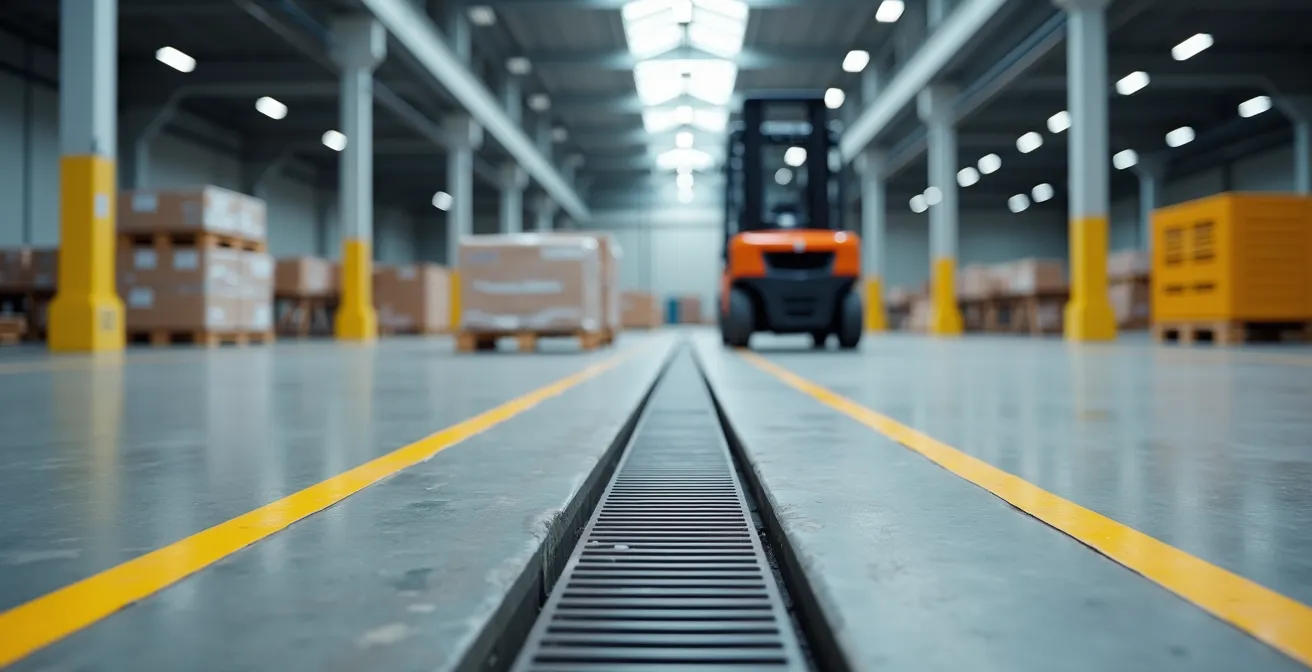
Choosing a trench drain in Quebec is not about picking the strongest part; it’s about engineering a complete system to survive the unique pressures of dynamic loads, extreme thermal shock, and local regulations.
- Forklift braking and turning can triple the static load on a drain grate, making a higher load class (like Class E) a non-negotiable safety factor, not an upgrade.
- The material must withstand both -40°C winters and +100°C steam cleaning, expanding and contracting at the same rate as the surrounding concrete to prevent cracking.
Recommendation: Prioritize a 316L stainless steel system with a rounded channel bottom and ensure installation includes proper isolation joints to prevent systemic floor failure and guarantee long-term compliance with CNESST and MAPAQ standards.
A puddle on the warehouse floor. It seems minor, but for a Quebec facility manager, it’s a warning sign. The wrong trench drain isn’t just an inconvenience; it’s the starting point of a systemic failure. Most guides talk about load classes and materials, treating drain selection like picking an item off a shelf. They advise choosing a strong grate and a durable channel, but they miss the real story. In a high-traffic warehouse, especially one subject to Quebec’s brutal freeze-thaw cycles and stringent safety regulations, a drain is an integrated part of your floor slab’s structural integrity.
The common approach is to match the drain’s static load capacity to the forklift’s weight. This is the first, and most dangerous, platitude. It completely ignores the immense forces of a turning, braking, 10-tonne machine. But the true threat is a combination of forces. The same drain must endure the thermal shock of steam cleaning one day and sub-zero temperatures the next, all while complying with a complex regulatory ecosystem from MAPAQ to the CNESST. A failure in any one of these areas doesn’t just mean a clogged drain; it means a cracked floor, a safety hazard, and costly operational downtime.
But what if the key wasn’t just selecting a drain, but engineering a complete drainage system designed for resilience? This guide moves beyond generic advice. We will dissect the critical factors—from the dynamic load multiplier on grates to the thermal expansion coefficient of materials—that determine whether your drain protects your investment or actively destroys it. We will focus on the specific challenges of the Quebec operating environment to build a system that is not just functional, but fundamentally robust and safe for the long haul.
For those who prefer a visual overview, the following video demonstrates the fundamental principles of a properly installed water drainage system, which complements the technical details we will explore in this article.
This article breaks down the essential decisions you need to make to build a bulletproof drainage system. We’ll cover everything from load capacity and material science to installation errors and long-term maintenance, all tailored to the specific demands of a Quebec industrial facility.
Summary: A Warehouse Manager’s Guide to Industrial Trench Drains in Quebec
- Load Class C vs. E: What’s Required for a 10-Tonne Forklift?
- Rounded vs. Square-Bottom Channel: Which Best Prevents Bacterial Growth?
- Polymer Concrete vs. Stainless Steel: Resisting Thermal Shock from Steam Cleaning?
- The Installation Sealing Error That Cracks the Floor Around the Drain
- Sediment Baskets and Traps: How to Prevent Clogging the Main Network?
- Industrial Grease Separators: Sizing for Backflow Prevention
- Applying the “Indestructible” Philosophy to Your Drainage System
- Post-Drain Piping: Why Drain Material Dictates Your Pipe Choice
Load Class C vs. E: What’s Required for a 10-Tonne Forklift?
The first mistake in drain specification is looking at the static weight of your forklift. A 10-tonne (approx. 22,000 lbs) forklift might seem compatible with a Class C grate, which is rated for loads up to 28,100 lbs. However, this static rating is dangerously misleading in a dynamic warehouse environment. When that forklift brakes hard, turns sharply, or drops a heavy pallet, it creates a dynamic load multiplier effect. These forces can easily increase the effective weight on the grate by two to three times, pushing it far beyond its static capacity and leading to catastrophic failure.
This is why for any facility with heavy forklift traffic, especially those with solid tires, Class D or E is the professional standard. In fact, many Quebec logistics hubs now mandate Class E as a baseline. While Class D supports pneumatic tire forklifts, Class E is specifically engineered for the extreme point loads of solid tire forklifts. These grates are built to handle the real-world abuse of a busy warehouse. For example, specialized Class E trench drain grates are engineered to withstand up to 79,200 lbs per square foot, providing a critical safety margin.
Choosing a lower class to save on initial costs introduces a significant, and often uninsurable, risk of grate collapse, equipment damage, and serious operator injury. It’s a gamble that simply isn’t worth taking when worker safety and operational uptime are on the line. The CNESST’s focus on workplace safety implicitly supports specifying for worst-case dynamic loads, not just static weight.
This table from AASHTO standards, contextualized for Quebec, clarifies the appropriate applications for each class.
| Load Class | Weight Capacity | Typical Application | Quebec Requirements |
|---|---|---|---|
| Class C | Up to 28,100 lbs | Medium commercial traffic | Light forklifts only |
| Class D | Up to 89,920 lbs | Pneumatic forklifts | Standard warehouse |
| Class E | Up to 134,800 lbs | Solid tire forklifts | CNESST recommended for 10-tonne equipment |
Rounded vs. Square-Bottom Channel: Which Best Prevents Bacterial Growth?
For any facility where hygiene is a concern—from food processing plants to mechanic garages dealing with oils and chemicals—the shape of the drain channel is as important as its material. A square-bottom channel is a breeding ground for problems. The 90-degree corners are dead zones where water stagnates, debris accumulates, and bacteria thrive. These corners are incredibly difficult to clean effectively, trapping contaminants and creating persistent odour and hygiene risks that can jeopardize MAPAQ or other regulatory compliance.
The solution is a channel with a rounded, U-shaped profile. This design is engineered for self-cleaning. The smooth, continuous curve eliminates corners, ensuring that water flows freely. When combined with a minimum 2% built-in slope, it creates a powerful “hydraulic scour” effect, where the force of the draining water naturally pushes sediment and debris towards the outlet. This significantly reduces the manual cleaning effort and the amount of water and chemicals required for sanitation. Studies have shown this can lead to a cleaning time reduction of up to 40%.
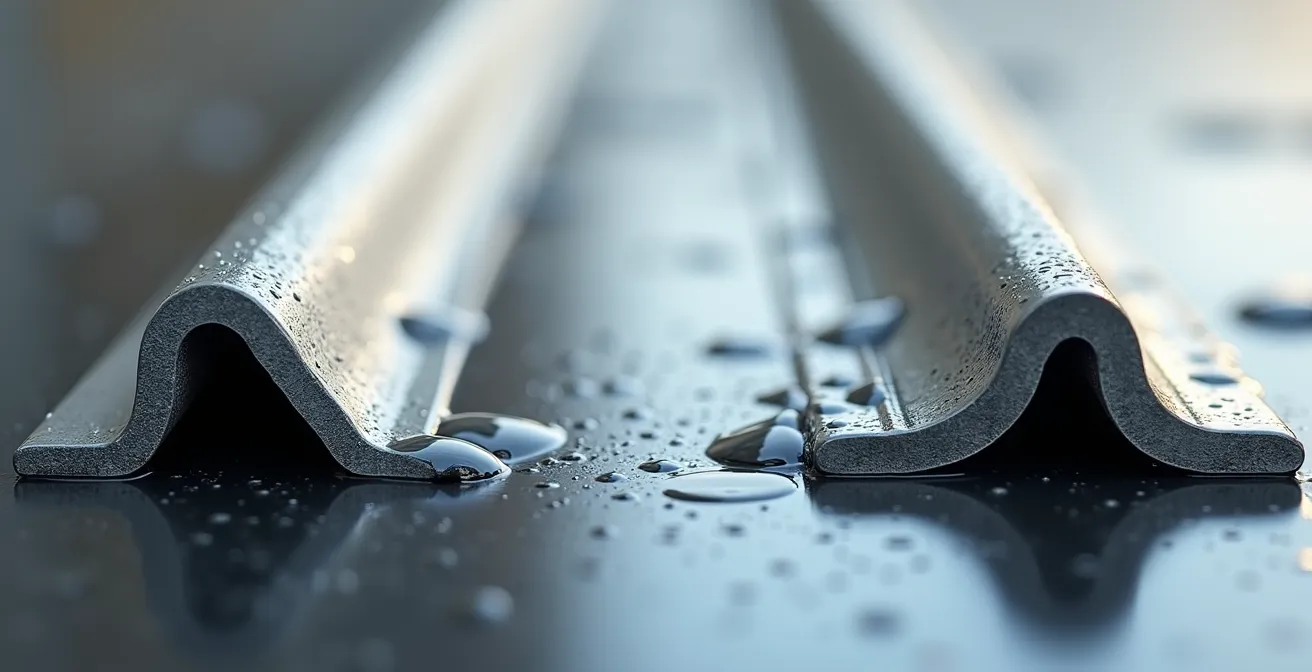
As the visual comparison shows, the rounded profile promotes complete drainage, while the square profile inherently traps fluids and particles. For facilities subject to HACCP (Hazard Analysis and Critical Control Points) plans, a rounded-bottom, seamless channel is not just a preference; it’s a fundamental component of a compliant and sanitary design. This design feature is crucial for preventing biofilm buildup and ensuring your facility can pass the most rigorous hygiene inspections.
Your Checklist for a HACCP-Compliant Channel
- Verify a rounded U-shaped profile with a minimum 2% slope to achieve self-cleaning hydraulic scour.
- Confirm the interior surfaces are smooth and non-porous, meeting MAPAQ hygiene standards with no pits.
- Check for radius corners that eliminate the 90-degree angles where debris and bacteria accumulate.
- Ensure the system is fully compatible with the 100°C steam cleaning protocols required in many Quebec facilities.
- Document the potential cleaning time reduction (typically 40% less than square channels) for your operational budget.
Polymer Concrete vs. Stainless Steel: Resisting Thermal Shock from Steam Cleaning?
In Quebec, a trench drain lives a life of extremes. It must perform flawlessly when the floor is -30°C in winter and not crack when hit with 100°C steam or boiling water during a sanitary washdown. This rapid temperature change, known as thermal shock, is a primary cause of drain system failure. The key is not just the material’s temperature resistance, but its coefficient of thermal expansion relative to the surrounding concrete. If the drain material expands and contracts at a different rate than the concrete encasing it, it will inevitably lead to cracking, delamination, and water ingress, destroying the floor from within.
Polymer concrete offers good chemical resistance and a lower initial cost. However, its thermal expansion rate can differ significantly from that of standard concrete. While some plastic drains are rated for Quebec’s ambient temperatures, which can range from -40°C to +45°C in warehouses, they may not handle the acute shock of high-temperature cleaning. This discrepancy puts immense stress on the sealant and the concrete haunch.
As the experts at Dura Trench note, this is a critical design consideration:
During these events materials can expand and contract very rapidly due to these drastic changes. The trench channels in these applications need to be able to handle the temperatures, but also need to expand and contract at relatively the same rate as the concrete.
– Eric’sons Dura Trench Technical Team, Food Processing Drain Installation Guidelines
This is where 316L stainless steel excels. Its thermal expansion coefficient is much closer to that of concrete, minimizing stress during temperature swings. It is also non-porous and can easily handle extreme temperatures, making it the superior choice for any application involving thermal shock. While the initial investment is higher, the long-term benefit is clear. A 15-year total cost of ownership analysis for a Quebec agri-food plant found that 316L stainless steel provided a 60% lower TCO compared to polymer concrete, precisely because it eliminates the need for costly repairs caused by thermal stress failure.
The Installation Sealing Error That Cracks the Floor Around the Drain
Even the best trench drain system will fail if installed improperly. The most common and destructive mistake is failing to isolate the drain body from the surrounding concrete slab. Concrete and the drain material (whether steel or polymer) expand and contract at different rates due to temperature changes and moisture. Without a buffer, these opposing forces create immense stress, which concentrates at the edge of the drain channel. Over time, this stress leads to hairline cracks that widen, allowing water and corrosive chemicals to seep under the slab, leading to widespread spalling and eventual floor failure.
The solution is mandated by best practices and the Quebec Construction Code: the use of isolation joints. This involves creating a small gap (typically 10-15mm) between the drain’s frame and the concrete floor. This gap is then filled with a flexible, high-performance sealant (like polyurethane or silicone) that can absorb the movement of both materials. This simple joint acts as a crucial shock absorber, decoupling the drain from the slab and preventing stress transfer. It’s a small detail that makes the difference between a 2-year and a 25-year lifespan for your floor.
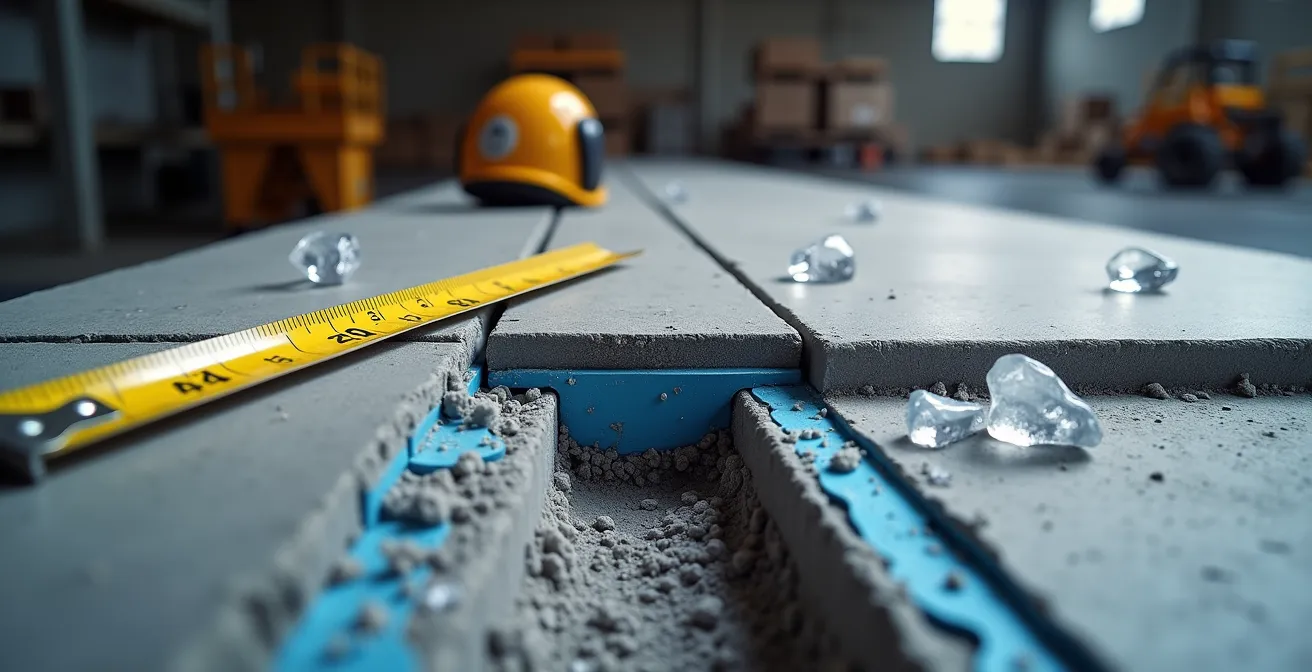
Another critical element is the concrete haunch, a reinforced concrete support structure poured around the channel. According to guidelines from sources like a detailed guide to channel drain installation, this haunch should extend at least 300mm beyond the drain body to properly distribute the load from the grate into the subfloor. Omitting or undersizing this haunch concentrates all the weight directly onto the channel walls, guaranteeing premature failure. For Quebec’s freeze-thaw conditions, it’s also vital to include expansion joints perpendicular to the channel run at 25-30m intervals to accommodate the slab’s seasonal movement.
Sediment Baskets and Traps: How to Prevent Clogging the Main Network?
An industrial trench drain is designed to handle large volumes of liquid, but it’s not a garbage disposal. Debris, solids, and sediment—from gravel in a mechanic’s bay to vegetable matter in a food plant—are the primary cause of clogs in the main plumbing network. A single blockage downstream can shut down your entire operation. The first line of defense is a system of sediment baskets and catch basins strategically placed along the drain run. These simple but essential components are designed to intercept solids before they enter the pipes.
For optimal performance, catch basins with removable sediment baskets should be installed at regular intervals. A common professional recommendation is to place them every 50-75 feet and at any change in direction of the drain line. This ensures that debris is captured close to its source and prevents it from travelling far enough to consolidate and create a major blockage. The baskets themselves must be robust, made from stainless steel or heavy-duty polymer, and designed for easy removal and cleaning. Their design must also meet ergonomic standards.
Beyond simple baskets, the system must include properly sized P-traps to prevent sewer gases from entering the facility. The National Plumbing Code of Canada specifies minimum trap sizes for industrial applications, typically 4 inches or larger, with adequate venting to prevent siphoning that could compromise the trap’s water seal. In municipalities like Montreal, there are often specific wastewater discharge requirements mandating that sediment traps must be capable of removing particles larger than a certain size (e.g., 5mm) and that maintenance logs must be kept for inspection. This makes the sediment management system a key part of your environmental and regulatory compliance strategy.
Industrial Grease Separators: Sizing for Backflow Prevention
For any facility discharging fats, oils, and grease (FOG)—such as commercial kitchens, food processing plants, or vehicle wash bays—a grease separator (or interceptor) is a legal and environmental necessity. Its job is to capture FOG before it enters the municipal sewer system, where it can solidify, cause massive blockages (“fatbergs”), and lead to sanitary sewer overflows. Sizing this interceptor correctly is critical; an undersized unit will be overwhelmed, leading to FOG bypassing the trap and, even worse, causing foul wastewater to back up into your facility.
Sizing is not based on the size of your trench drain, but on the peak flow rate of wastewater discharged into it. You must calculate the worst-case scenario, accounting for all sources simultaneously: process equipment discharge, multiple high-pressure hose washdowns, and even rainfall if the drains are partially outdoors. For example, an Eastern Townships cheese plant processing 5,000 litres of wastewater per day required an interceptor with three times the standard capacity due to the high milk fat content and Quebec’s strict environmental discharge limit of 100 mg/L of FOG.
The chosen interceptor’s capacity, measured in litres or gallons, must provide sufficient “retention time”—the duration wastewater spends in the tank—for the lighter FOG to naturally separate and float to the surface. Faster flow rates require larger tanks to achieve the same level of separation. Neglecting this calculation is a recipe for non-compliance and messy, hazardous backflows.
This table provides a general guideline for sizing based on flow rate, keeping in mind that specific contaminants like heavy fats may require oversizing.
| Trench Drain Flow (GPM) | Min Interceptor Size (L) | Quebec FOG Limit | Cleaning Frequency |
|---|---|---|---|
| 0-50 | 500 | 100 mg/L | Weekly |
| 51-150 | 1,500 | 100 mg/L | Bi-weekly |
| 151-300 | 3,000 | 100 mg/L | Monthly |
Key Takeaways
- Systemic Failure: A trench drain is not a standalone component; it’s an integral part of your floor slab. A poor choice in material or installation will lead to systemic floor failure.
- Dynamic Loads > Static Weight: Always specify drain grates (Class D or E) based on the dynamic loads of braking and turning forklifts, not just their static weight.
- Material Science is Key: In Quebec’s climate, the drain material (ideally 316L stainless steel) must have a thermal expansion rate similar to concrete to survive thermal shock from weather and cleaning.
Applying the “Indestructible” Philosophy to Your Drainage System
The concept of “indestructible” equipment is often associated with high-abuse fixtures like institutional toilets. However, this philosophy of specifying for maximum durability and worst-case scenarios is even more critical when applied to a warehouse drainage system. An “indestructible” drain system is one that is engineered to resist not just the expected daily use, but also the unexpected abuse that is inevitable in a heavy-traffic industrial environment. It’s a shift from “what’s the minimum I need?” to “what’s the maximum this system can handle?”.
This starts with the frame. As engineering experts point out, the grate’s frame is what transfers the immense point loads from a forklift’s solid tires to the surrounding concrete haunch. A weak frame or one with insufficient bearing surface will cause the load to be transferred to the drain channel body itself, causing it to deform or crack.
Industrial applications need a heavy duty frame to transfer the loading from the grate to the surrounding concrete. Be cautious of using a trench drain where the frame has little bearing surface in the concrete to transfer this load. If the loads are transferred to the channel drain body they may prematurely fail.
– Dura Trench Engineering, Industrial Manufacturing Drain Specifications
Adopting an indestructible philosophy means writing performance-based specifications that demand resilience. Instead of just asking for a material type, demand proof of performance. Your spec sheet for a truly robust system should include requirements such as:
- A minimum 25-year service life under continuous forklift traffic, compliant with CSA B335-15 standards.
- Grate locking mechanisms that are not only secure but also meet CNESST safety requirements to prevent accidental dislodging.
- Defined impact resistance for tracked vehicles like skid-steers, often specified at 5x the static load rating.
- Mandatory load transfer testing data showing minimal deflection under the maximum rated load.
This approach moves the burden of proof to the manufacturer and ensures the product you install is genuinely built to last, saving you from the cycle of premature replacement and repair.
Post-Drain Piping: Why Drain Material Dictates Your Pipe Choice
The most robust trench drain in the world is useless if it’s connected to a failing pipe network. The final, and often overlooked, piece of the drainage puzzle is ensuring the outlet piping is compatible with both the drain system and the substances it will carry. A mismatch in materials can lead to chemical corrosion, joint failure, and costly excavation to repair a leak that should have been prevented from the start. Your choice of drain material should directly inform your choice of post-drain piping.
If you’ve invested in a 316L stainless steel trench drain system to handle corrosive chemicals or high temperatures, connecting it to standard PVC or ABS piping is a critical error. These plastics can degrade when exposed to certain solvents or fail under the same thermal shock that the stainless drain is designed to handle. The logical and safest choice is to continue the run with a compatible material, such as stainless steel or high-density polyethylene (HDPE) piping, which offers similar resistance to chemicals and temperature extremes.
The upfront cost of upgrading your piping material is minuscule compared to the cost of failure. A facility analysis in Quebec revealed that a single failed pipe connection costs an average of $45,000 in excavation, concrete repair, and 3-day operational downtime. The initial investment to upgrade to a fully compatible stainless steel or HDPE piping system for that same connection would have been around $3,000. This is a staggering 15-to-1 return on investment in preventative engineering. Thinking of the drain and the subsequent piping as a single, unified system is essential for long-term reliability.
The integrity of your floor and the safety of your operations depend on this holistic view. To avoid the catastrophic costs of a systemic failure, the next logical step is to have your current or planned system evaluated by a specialist who understands the unique demands of Quebec’s industrial environment. Ensure your specification is built for the real world, not just a catalogue.
Frequently Asked Questions on Industrial Trench Drains
What are Montreal’s wastewater discharge requirements for warehouse sediment traps?
Facilities must install sediment baskets capable of removing particles larger than 5mm and maintain monthly cleaning logs for municipal inspection.
How does the National Plumbing Code of Canada affect trap sizing?
The code requires P-traps sized at minimum 4 inches for industrial applications with proper venting to prevent siphoning.
What CNESST ergonomic requirements apply to sediment basket design?
Baskets must weigh less than 23kg when full, have handles positioned for two-person lifting, and be accessible without confined space entry.