

The key to financial stability for your Quebec property is not simply saving for repairs, but transforming your plumbing system into a set of predictable, manageable assets.
- Most plumbing failures are not random; they are the predictable end of an asset’s lifecycle.
- Quebec’s specific insurance rules, climate, and building codes dictate non-negotiable replacement timelines that must be budgeted for.
Recommendation: Shift from a reactive, emergency-based mindset to a proactive, 10-year capital expenditure (CapEx) plan to eliminate financial surprises and protect your property’s long-term value.
As a Quebec homeowner, you understand that your property is one of your most significant financial assets. You diligently pay your mortgage, manage taxes, and perhaps even set aside a “rainy day” fund for unexpected repairs. But what if the most financially damaging events, like a burst water heater or a failed foundation drain, aren’t truly unexpected? The common approach is to react, calling for an emergency plumber when disaster strikes, often during a January cold snap, and facing an inflated, unplanned bill.
This reactive cycle is a constant source of financial stress. We are told to perform basic maintenance and hope for the best. But this perspective overlooks a fundamental truth: plumbing components are not permanent. They are assets with a predictable lifecycle. The true key to mastering your home’s finances isn’t just about saving; it’s about financial foresight. It’s about shifting your perspective from that of a mere occupant to that of a strategic asset manager.
Instead of waiting for failure, what if you could map out the inevitable and turn costly surprises into scheduled, budgeted investments? This guide provides a framework for doing exactly that. We will move beyond generic advice and build a 10-year capital expenditure plan tailored specifically to Quebec’s unique regulatory, insurance, and environmental landscape. We will analyze the real lifecycles of your home’s most critical systems, transforming unpredictable expenses into a manageable financial strategy that secures your peace of mind and your property’s value.
This article provides a detailed roadmap for this strategic financial shift. By examining each critical plumbing component through the lens of proactive asset management, you will learn how to build a robust, forward-looking budget that puts you in control.
Summary: A Proactive 10-Year Plumbing Budget for Quebec Homeowners
- Water Heater 10 vs. 15 years: when do insurance companies force you to change it?
- Lifespan of a gas furnace: the signs you’re in the final years
- Ceramic cartridges: when does it become impossible to find replacement parts?
- French drain: how to know if it’s approaching its useful life end (25-30 years)?
- Circulation pumps: why replace them preventively before they seize?
- When to replace cast iron or copper stacks in a 40-year-old building?
- Maintenance schedule: the 4 fall actions to avoid disaster in January
- What Are the Unique Quebec Plumbing Code Rules for Basement Apartments?
Water Heater 10 vs. 15 years: when do insurance companies force you to change it?
The hot water tank is arguably the most significant liability in your home’s plumbing portfolio. Its failure is not a matter of ‘if’ but ‘when,’ and the consequences are severe. In Quebec, this isn’t just a maintenance issue; it’s a critical insurance and financial planning matter. Given that water damage represents a staggering 50% of homeowners insurance claims, insurers have become extremely strict about water heater age. Forgetting this single line item in your capital expense plan is a gamble you cannot afford to take.
For most Quebec property owners, the 10-year mark is a hard deadline imposed not by the manufacturer, but by your insurance provider. As a result of the steep financial consequences of ruptured tanks, especially in condominiums, most insurers will not cover water damage from a tank older than 10 years. Some may offer conditional coverage up to 12 years, but often with a drastically increased deductible, potentially reaching $5,000 for a claim. This transforms a potential repair into a guaranteed out-of-pocket catastrophe.
Therefore, your 10-year budget must treat a water heater replacement as a non-negotiable, scheduled expense. Waiting for it to leak is not a strategy; it’s a financial liability. Proactively replacing the unit around its ninth year protects you from both water damage and the risk of a denied insurance claim. The cost of a new, professionally installed tank is a predictable, manageable figure, whereas the cost of a basement flood is an unpredictable and financially devastating event.
Lifespan of a gas furnace: the signs you’re in the final years
While a gas furnace failure may not cause the dramatic damage of a burst water tank, a breakdown in the middle of a harsh Quebec winter constitutes a genuine emergency. A furnace has a typical lifespan of 15 to 20 years, but its final years are often marked by clear warning signs. Recognizing these signs is crucial for your predictive budgeting, allowing you to plan for a replacement on your own terms, not as a desperate measure during a cold spell.
As a furnace ages, its efficiency plummets, leading to a noticeable increase in your heating bills. You might also hear unusual noises—banging, squealing, or rumbling—which indicate mechanical fatigue. Another critical signal is the frequency of repairs. If you find yourself calling a technician more than once a year, the cumulative repair costs may soon approach the price of a new unit. Visually, signs of rust or corrosion on the components, especially around the heat exchanger, are a clear indication that the system’s integrity is compromised. This is more than just a performance issue; a cracked heat exchanger can leak carbon monoxide, posing a serious health risk.
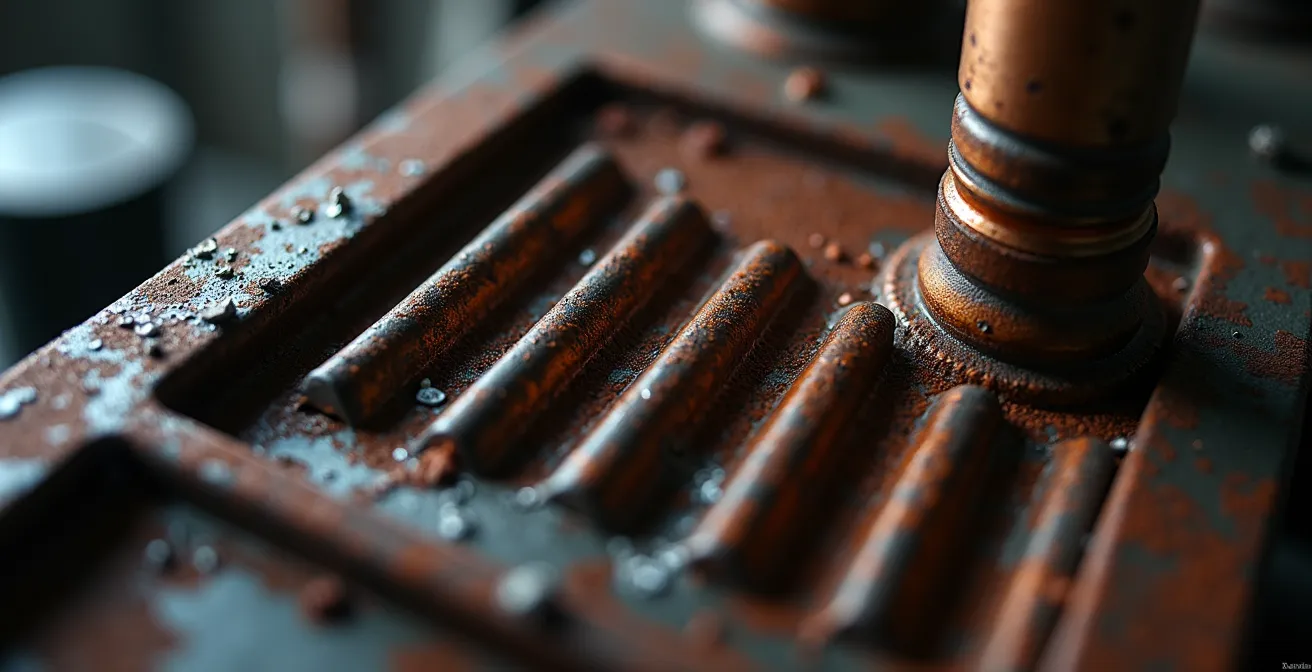
The image below highlights the kind of textural wear and tear—oxidation and material degradation—that a professional looks for during an inspection. These are the subtle but certain signs of an aging system approaching the end of its asset lifecycle.
Including a furnace replacement in your 10-year plan, especially as it passes the 15-year mark, is a prudent financial move. It allows you to research energy-efficient models, take advantage of potential government grants for upgrades, and schedule the installation during the off-season, avoiding the premium pricing and long waits of a winter emergency.
Ceramic cartridges: when does it become impossible to find replacement parts?
It seems minor compared to a furnace or water heater, but a single dripping faucet can be a significant drain on both your water bill and your budget. Modern faucets rely on ceramic disc cartridges for drip-free operation. While durable, these cartridges eventually wear out. The strategic question for a property owner is not just whether to fix it, but at what point a search for a replacement part becomes a poor financial decision.
The challenge lies in the sheer variety of faucet models and brands, many of which are discontinued after a few years. For a faucet that is over 10 years old, finding the exact replacement cartridge can become a time-consuming and often fruitless quest. This is where you must think like a financial planner. A plumber’s time is a direct cost. In Quebec, a licensed plumber’s rate can range from $91 to $156 per hour. If a plumber spends two hours searching for an obscure part online or driving between suppliers, you have already incurred a significant cost before the repair has even begun.
The cost-benefit analysis becomes clear: paying for several hours of a specialist’s time to locate a $30 part for an aging faucet is poor asset management. It is often far more economical to allocate a budget for a complete faucet replacement. For example, while data varies by location, a full faucet repair and installation can be significant. When the cost of the search plus the repair approaches or exceeds the cost of a new, more efficient fixture, proactive replacement is the logical financial choice. This should be a recurring line item in your 10-year plan, allocating funds for the systematic upgrade of older fixtures before they become a costly and frustrating scavenger hunt.
French drain: how to know if it’s approaching its useful life end (25-30 years)?
The French drain, or foundation drain, is your home’s silent protector against water infiltration. Buried and out of sight, it’s an easy system to forget until it fails, leading to a wet basement, foundation damage, and costly remediation. With a typical lifespan of 25 to 30 years, any Quebec home built in the 1990s or earlier should have its drainage system on a high-priority watch list within your capital expenditure plan. Waiting for visible signs of failure, like dampness on basement walls, means the problem has already become critical.
Proactive assessment is key. The only way to truly understand the condition of your French drain is through a professional camera inspection. This allows a technician to identify blockages, collapsed sections, or root intrusion without costly excavation. In many parts of Quebec, a major concern is the presence of ochre deposits (fer ocreux), a gelatinous sludge caused by iron-eating bacteria that can completely clog a drainage system long before its expected end-of-life. An inspection can identify this specific problem, which requires a specialized management strategy.
Building a budget for a potential French drain replacement is one of the most significant capital expenses a homeowner will face. Getting a camera inspection report serves as the foundational document for this budget item, providing the evidence needed to plan for a multi-thousand-dollar project over a 5-to-10-year horizon, rather than being faced with an unexpected emergency excavation.
Your Action Plan: French Drain Health Check
- Schedule a Camera Inspection: If your home is over 20 years old, book a professional camera inspection to assess the drain’s condition, specifically looking for collapses or root intrusion common in Quebec’s heavy clay soil.
- Check for Ochre Deposits: Ask the professional to specifically identify signs of “fer ocreux,” a prevalent issue in many Quebec regions that can lead to premature drain failure.
- Document Basement Conditions: Keep a log of any foundation moisture, damp smells, or visible efflorescence on concrete walls, especially after heavy rain or the spring thaw.
- Establish a Budgetary Quote: Use the inspection report to request a preliminary quote for replacement. This figure becomes a core component of your long-term capital expense plan.
As experts from RenoQuotes note in their guide, planning is essential because inspections can reveal hidden issues. They state, “Unexpected findings, such as damaged or obsolete pipelines can call for additional repairs or upgrades to ensure the system’s reliability.” This uncertainty is precisely why a proactive inspection and budget are not just advisable, but essential for sound financial management.
Circulation pumps: why replace them preventively before they seize?
In many Quebec multi-unit buildings (‘plexes’) and homes with hydronic (hot water) heating systems, the circulation pump is the heart of the heating system. It works tirelessly all winter to move hot water to your radiators. When it fails, the heat stops. A pump failure on a -20°C January night is not an inconvenience; it’s a crisis that can lead to frozen pipes and extensive water damage, multiplying the repair cost exponentially.
Circulation pumps have a lifespan of 10-15 years. As they age, their bearings wear out, and they can seize without warning. The cost of a planned, preventive replacement is a predictable and manageable expense. The cost of an emergency replacement is a different story entirely. An emergency call will incur premium rates, as after-hours service can cost 1.5 to 2 times the standard rate. Furthermore, the delay in restoring heat increases the risk of pipes freezing and bursting, turning a simple mechanical replacement into a major plumbing and restoration project.
Cost Analysis: Preventative vs. Emergency Pump Replacement in a Montreal Triplex
Consider the financial difference. A planned replacement of a circulation pump during the off-season might cost between $500 and $800, including the part and labour. In contrast, an emergency replacement during a winter storm can easily exceed $2,000. This includes the emergency plumber fees at double the rate, plus the potential secondary costs of repairing frozen or burst pipes that occurred while the heat was off. This clear financial delta makes preventative replacement a cornerstone of prudent risk mitigation for any property with a hydronic heating system.
In your 10-year capital plan, circulation pumps should be flagged for replacement as they approach the 12-year mark. This preventative action is a perfect example of asset lifecycle management. You are not just fixing a part; you are investing a smaller, predictable amount to avert a much larger, unpredictable financial risk. It’s one of the smartest, highest-return investments you can make in your property’s operational budget.
When to replace cast iron or copper stacks in a 40-year-old building?
For owners of older Quebec buildings, particularly the classic ‘plexes’ built before 1980, the main vertical drain stacks (or “columns”) represent a massive, hidden financial liability. These large-diameter pipes, typically made of cast iron or copper, are the backbone of the entire plumbing system. While incredibly durable, they are not eternal. A failure in a main stack can affect multiple units simultaneously, leading to widespread damage and complex, expensive repairs.
The good news is that these systems were built to last. Well-maintained brass, cast iron or steel stacks can last 70 to 100 years. However, ‘well-maintained’ is the operative phrase. Decades of corrosion, blockages, and stress can take their toll. For a building hitting the 40- or 50-year mark, a proactive assessment is a fiduciary duty. Signs of trouble include recurring drain backups across multiple floors, visible rust or flaking on exposed sections of pipe in the basement, and unpleasant odours that suggest a cracked vent stack.
Replacing a main stack is a major capital project, involving opening walls and coordinating work across multiple units. The cost can be substantial, and planning for this expense is a long-term strategic necessity. For condominium syndicates, this should be a primary focus of the contingency fund study (`étude du fonds de prévoyance`). For individual owners, understanding this potential liability is crucial before purchasing or renovating an older property.
Fortunately, modern techniques can sometimes avoid a full tear-out. Cured-in-place pipe (CIPP) lining, for instance, involves inserting a resin-coated liner into the old pipe, creating a new, seamless pipe within the old one. This is a less invasive and often more cost-effective option perfect for dense urban settings like Montreal. The following table provides a high-level budget overview for stack replacement, a critical tool for your long-range financial plan.
| Material | Lifespan | Replacement Cost | Notes |
|---|---|---|---|
| Cast Iron/Steel | 70-100 years | $1,952-$5,206 | Depends on accessibility and length |
| PVC | 30-40 years | $1,952-$5,206 | Easier to work with but shorter lifespan |
| CIPP Lining | 50+ years | Varies | Less invasive alternative for Montreal condos |
Key Takeaways
- Proactive replacement based on asset lifecycle is always cheaper than emergency repair.
- Quebec-specific insurance and building codes create non-negotiable deadlines for your budget.
- Your 10-year plan should transform unpredictable risks into scheduled, manageable capital expenditures.
Maintenance schedule: the 4 fall actions to avoid disaster in January
A 10-year capital expenditure plan is about looking ahead at major replacements. However, this long-term vision must be supported by a disciplined, short-term risk mitigation schedule. For a Quebec property, autumn is the most critical season for preventative maintenance. The actions you take between October and December directly determine your risk of facing a plumbing catastrophe in the depths of winter. Integrating these four actions into your annual calendar is a non-negotiable part of sound property management.
This is not just a generic checklist; it is a calendar tailored to the specific climate challenges of Quebec, where an early frost or a sudden deep freeze can wreak havoc on unprepared plumbing. Each action is designed to prevent a specific, common, and costly winter failure.
- October – Exterior Water Shut-off: Before the first hard frost (typically mid-October in southern Quebec), disconnect all garden hoses. More importantly, locate and shut off the interior valve that supplies each outdoor spigot, then open the outdoor spigot to drain any remaining water. A few drops of trapped water are all it takes to freeze, expand, and burst the pipe inside your wall. Installing insulated foam covers on outdoor faucets provides an extra layer of protection.
- November – Furnace & Boiler Service: Schedule your annual furnace or boiler maintenance before the winter rush. In November, HVAC technicians are in high demand. A professional service will clean components, check for safety issues like carbon monoxide leaks, and ensure the system is running at peak efficiency before it comes under the heavy load of winter.
- Before First Snowfall – Gutter and Drain Clearing: Clear all leaves and debris from your gutters, downspouts, and any ground-level drains, particularly basement window wells. If gutters are blocked, water can back up, freeze, and create ice dams. These dams force melting snow underneath your shingles, leading to serious roof and attic leaks during the first major thaw.
- Early December – Sump Pump Test: Your sump pump sits idle for months. Before the ground freezes solid, test its operation by pouring a bucket of water into the sump pit. You need to ensure the float switch activates and the pump engages. Discovering a seized pump during the major spring thaw in March or April is a recipe for a flooded basement.
What Are the Unique Quebec Plumbing Code Rules for Basement Apartments?
Finishing a basement or creating a basement apartment is a popular way to increase a property’s value in Quebec. However, it’s an area where cutting corners on plumbing can lead to legal non-compliance, denied insurance claims, and catastrophic failures. The *Code de construction du Québec, Chapitre III, Plomberie* sets out specific rules that are often stricter than in other provinces. These rules are not suggestions; they are legal requirements that must be factored into the budget and scope of any basement renovation project from day one.
Firstly, any significant plumbing work must be performed by a licensed professional who is a member of the Corporation des maîtres mécaniciens en tuyauterie du Québec (CMMTQ). This is not just a best practice; it is the law. Using an unlicensed plumber can void your home insurance and leave you liable for any resulting damages. The CMMTQ certification ensures the work is done to code and reported correctly to the relevant authorities.
Secondly, one of the most critical requirements for basement apartments in many Quebec municipalities is the mandatory installation of a backwater valve (clapet anti-retour). This device is installed on the main sewer line and automatically closes to prevent municipal sewer backups from flooding your basement. Given the increasing frequency of heavy rainfall events, a backwater valve is an essential, non-negotiable budget item that protects your investment from one of the most destructive types of floods.
Finally, the Quebec code has specific prohibitions and requirements regarding fittings and venting. For example, “S” traps are generally prohibited, and there are strict rules governing the use and placement of air admittance valves (AAVs), which differ from other jurisdictions. A licensed Quebec plumber will navigate these specific requirements, ensuring your new living space is not only comfortable but also safe, legal, and insurable. Ignoring these rules to save a few dollars upfront is a profound financial miscalculation.
Frequently Asked Questions on Quebec Plumbing Budgets
Why must I hire a licensed plumber for basement apartment work in Quebec?
Quebec law requires that plumbing work be performed by members of the CMMTQ (Corporation des maîtres mécaniciens en tuyauterie du Québec) to ensure code compliance and maintain insurance validity. Work done by an unlicensed individual can lead to denied claims and legal liability.
What is a backwater valve and why is it mandatory?
A backwater valve (clapet anti-retour) is a protective device that prevents municipal sewer backups from flowing back into your basement. Due to the high risk of sewer-related flooding, most Quebec municipalities legally require their installation for any new or renovated basement living space.
What plumbing fittings are prohibited in Quebec?
The Quebec Plumbing Code prohibits certain types of fittings that are common elsewhere, such as ‘S’ traps under sinks. It also has very specific and often restrictive rules about venting, including the use of air admittance valves (AAVs), which must be followed to ensure the system is legal and functions safely.