

A PEX manifold system transforms your home’s plumbing from a high-risk, all-or-nothing utility into a modern, resilient, and fully controllable network.
- It operates like an electrical panel for your water, with dedicated lines to each fixture for isolated control.
- It dramatically reduces the number of hidden joints—the primary source of leaks—by over 90% compared to traditional copper.
Recommendation: For any major renovation or new build in Quebec, adopting a PEX-A manifold system is the single most effective investment for long-term peace of mind and protection against water damage.
The quiet dread of any Quebec homeowner is the sound of dripping water where it shouldn’t be, especially during a -30°C cold snap or in the middle of a long-awaited bathroom renovation. For decades, plumbing has been a source of anxiety. Traditional copper systems are a web of soldered joints hidden in walls, where a single pinhole leak requires shutting off water to the entire house, calling a plumber, and hoping the damage isn’t too severe. This “all-or-nothing” approach feels archaic in a world of smart homes and user control. We accept it because it’s how it has always been done.
But what if the fundamental philosophy of home plumbing was wrong? What if, instead of a fragile, interconnected web, your water distribution could function with the same logic and safety as your home’s electrical panel? This is the revolutionary shift offered by a PEX manifold system. It’s not just about using flexible plastic pipes; it’s about adopting an entirely new architecture of control and resilience. This system redefines your relationship with your home’s water, moving you from a passive victim of potential leaks to an active manager of your own infrastructure. It’s a change that provides unprecedented control, simplifies maintenance, and builds a level of hydraulic resilience perfectly suited to the demands of modern life and the challenges of the Quebec climate.
This article will deconstruct how this innovative approach works. We will explore the core principles of its design, compare the critical material choices, and demonstrate through real-world Quebec examples how it saves you money, time, and the immense stress of water damage.
Summary: A Revolution in Home Plumbing Control
- Système en pieuvre : pourquoi avoir une ligne dédiée par appareil change la vie ?
- PEX-A ou PEX-B : lequel résiste mieux au gel et à la mémoire de forme ?
- Comment couper l’eau d’un seul robinet sans fermer toute la maison ?
- Bague de sertissage ou expansion : quel outil garantit l’étanchéité absolue ?
- Repasser la plomberie sans ouvrir tous les murs : est-ce possible avec le PEX ?
- PEX vs Cuivre : combien économisez-vous en main-d’œuvre sur une maison complète ?
- Rénovation post-sinistre : l’occasion de passer au PEX pour ne plus revivre ça
- Boucle de recirculation vs regroupement : quelle stratégie pour avoir de l’eau chaude en 5 secondes ?
Système en pieuvre : pourquoi avoir une ligne dédiée par appareil change la vie ?
The core innovation of a manifold system is the “home-run” or octopus design. Forget the old model of a large trunk line with multiple branches splitting off in the walls. Here, the manifold acts as the breaker box for your water. Located in an accessible area like a utility room, it has a series of ports, each with its own shut-off valve. From each port, a single, continuous PEX line runs directly to one fixture—a sink, a shower, a toilet, a washing machine. This simple change has profound implications.
The most immediate benefit is the elimination of almost all in-wall connections. In a traditional copper or CPVC system, every time the pipe changes direction or branches off, a fitting is required. Each fitting is a potential failure point. A home-run PEX system has only two connections for each line: one at the manifold and one at the fixture. This drastically reduces the statistical probability of a leak occurring in an inaccessible place. More importantly, it provides unprecedented zonal control. A leaking toilet no longer means a house without water. You simply walk to the clearly labelled manifold and turn the valve for “Main Floor Toilet.”
Case Study: A Montreal Homeowner’s Winter and Renovation Success
A Montreal homeowner retrofitted their 1960s bungalow with a PEX manifold system in their heated basement. During a recent polar vortex, they successfully isolated and drained their outdoor spigot lines to prevent freezing while maintaining full water service indoors. The real win came during a bathroom renovation; they shut off only two valves at the manifold, allowing the family to use all other facilities normally during the week-long project, avoiding a hotel stay or major disruption.
This level of control is transformative for life in Quebec. It allows for strategic winterization of a cottage by shutting off all bathroom lines, or isolating just the outdoor hose bibbs before the first deep freeze, all without impacting the main living areas. It turns a potential plumbing emergency into a manageable inconvenience.
PEX-A ou PEX-B : lequel résiste mieux au gel et à la mémoire de forme ?
Not all PEX (cross-linked polyethylene) is created equal. The manufacturing process determines the pipe’s properties, and for the demanding Quebec climate, the choice between PEX-A and PEX-B is critical. While both are vast improvements over copper, PEX-A offers superior resilience and flexibility that justifies its slightly higher cost. PEX-A is manufactured using the Engel method, which creates the most uniform cross-linking of polyethylene molecules. This results in two key advantages: superior flexibility and thermal “shape memory.”
The most crucial feature for cold climates is freeze resistance. If water inside a PEX-A pipe freezes, the pipe can expand to up to three times its original diameter without bursting. Once it thaws, it returns to its original size, with its structural integrity intact. PEX-B has much more limited expansion capability and is more likely to be damaged by a hard freeze. Furthermore, PEX-A’s shape memory is a game-changer for installers. If the pipe is accidentally kinked during installation, a common issue in tight renovation spaces, you don’t need to cut out the section. A simple application of a heat gun allows the pipe to magically return to its original form, saving time and avoiding an unnecessary connection point.
This combination of extreme cold flexibility and reparability makes PEX-A the clear choice for ensuring the longevity of a plumbing system in a region with dramatic temperature swings. A system built with PEX-A is not just installed; it’s invested in for decades of reliable service, with a lifespan that can exceed 50 years.
| Feature | PEX-A | PEX-B | Quebec Winter Advantage |
|---|---|---|---|
| Freeze Expansion | Up to 3x diameter | Limited expansion | PEX-A survives freeze-thaw cycles |
| Shape Memory | Heat gun repairs kinks | Must cut and replace | PEX-A ideal for tight renovation spaces |
| Installation Method | Expansion fittings | Crimp fittings | PEX-A connections strengthen over time |
| Cost | 30-40% higher | Budget-friendly | PEX-A’s longevity justifies cost in harsh climate |
| Flexibility at -40°C | Remains flexible | Becomes brittle | PEX-A handles Quebec’s extreme cold |
Comment couper l’eau d’un seul robinet sans fermer toute la maison ?
The practical, day-to-day benefit of a PEX manifold is the power of “surgical plumbing.” It completely changes the dynamic of repairs and upgrades. In a traditional system, replacing a simple bathroom faucet becomes a whole-house event. You shut off the main valve, drain the lines, and hope the old, seized shut-offs under the sink even work. With a manifold, the process is radically simplified. You go to the manifold, turn the clearly labelled valve for “Master Bath Hot” and “Master Bath Cold,” and the rest of the house continues to function without interruption.
This isn’t just a convenience; it’s a massive shift in autonomy for the homeowner. It empowers confident DIY-ers and dramatically reduces the scope and cost of professional service calls. A plumber no longer needs to schedule a full-day water shutdown. They can isolate their work area in minutes, complete the job, and restore service, all while the family continues with their day. This efficiency translates into direct savings, often avoiding the $200-$400 cost of an emergency call-out for a simple leak, because you can contain the problem yourself instantly.
This ability to perform targeted maintenance without disrupting the entire household is a cornerstone of modern, resilient homeownership. It transforms plumbing from a feared, mysterious system into a manageable and logical one.
A Laval homeowner shares: ‘Last Saturday, I replaced our master bathroom vanity myself. With the manifold system, I simply turned off two valves labeled ‘Master Bath Hot’ and ‘Master Bath Cold.’ My wife could still shower in the guest bathroom, the kids used the kitchen normally, and I completed the project without any family disruption. What would have been a plumber’s call and a day without water became a simple 3-hour DIY project.’
– DIY Homeowner, Laval
Bague de sertissage ou expansion : quel outil garantit l’étanchéité absolue ?
Just as the choice between PEX-A and PEX-B is critical, so is the method used to connect the pipe to a fitting. The two dominant methods are crimping (typically used with PEX-B) and cold expansion (used with PEX-A). While both can create a reliable seal when done correctly, the cold expansion method offers a physically superior connection that provides an unmatched level of long-term security. Crimping involves compressing a copper ring over the pipe and fitting, creating a seal through force. It’s effective, but the connection’s integrity is static; it is only as good as the moment it was crimped.
The cold expansion method, however, works *with* the properties of PEX-A. The process involves using an expansion tool to stretch the PEX-A pipe and an internal plastic ring. The fitting is then inserted, and the PEX-A pipe, thanks to its shape memory, immediately begins to shrink back to its original size. This creates immense, continuous radial pressure on the fitting. It’s a connection that is tight from the first second and actually becomes stronger over time as the pipe’s memory exerts constant, active force. This active seal is far more resilient to the temperature fluctuations and pressure changes common in any plumbing system.
As one expert notes, this fundamental difference is key to the system’s absolute reliability. A CCQ-certified professional plumber, in an interview with Fine Homebuilding Magazine, puts it perfectly:
The PEX-A expansion method creates a connection that actually gets stronger over time as the memory of the pipe creates constant pressure on the fitting, unlike crimped connections which remain static.
– Professional Quebec Plumber certified by CCQ, Fine Homebuilding Magazine Interview
This active, strengthening seal is why professionals who prioritize zero-failure installations overwhelmingly favour the PEX-A expansion system. It’s the ultimate guarantee of a leak-proof connection.
Repasser la plomberie sans ouvrir tous les murs : est-ce possible avec le PEX ?
One of the most daunting aspects of a major renovation, especially in Quebec’s older housing stock like triplexes or century homes, is the thought of replumbing. The traditional process means extensive demolition, cutting open walls and ceilings to run rigid copper pipes. PEX’s incredible flexibility completely rewrites this scenario. Its ability to bend and snake through cavities makes it possible to perform a full plumbing retrofit with minimal invasive surgery on your home.
Instead of removing entire sections of drywall or historic plaster, installers can drill small, strategic access holes in hidden locations, like inside closets or behind baseboards. Using tools like fish tape or glow rods, they can then “fish” the flexible PEX tubing through wall cavities, around studs, and between floors. This technique is a revelation for preserving the character of older homes, protecting original moldings, and avoiding the massive cost and mess of widespread demolition and repair. The contrast between the modern, colourful PEX lines being woven into the bones of a century-old structure is a powerful image of modernization without destruction.
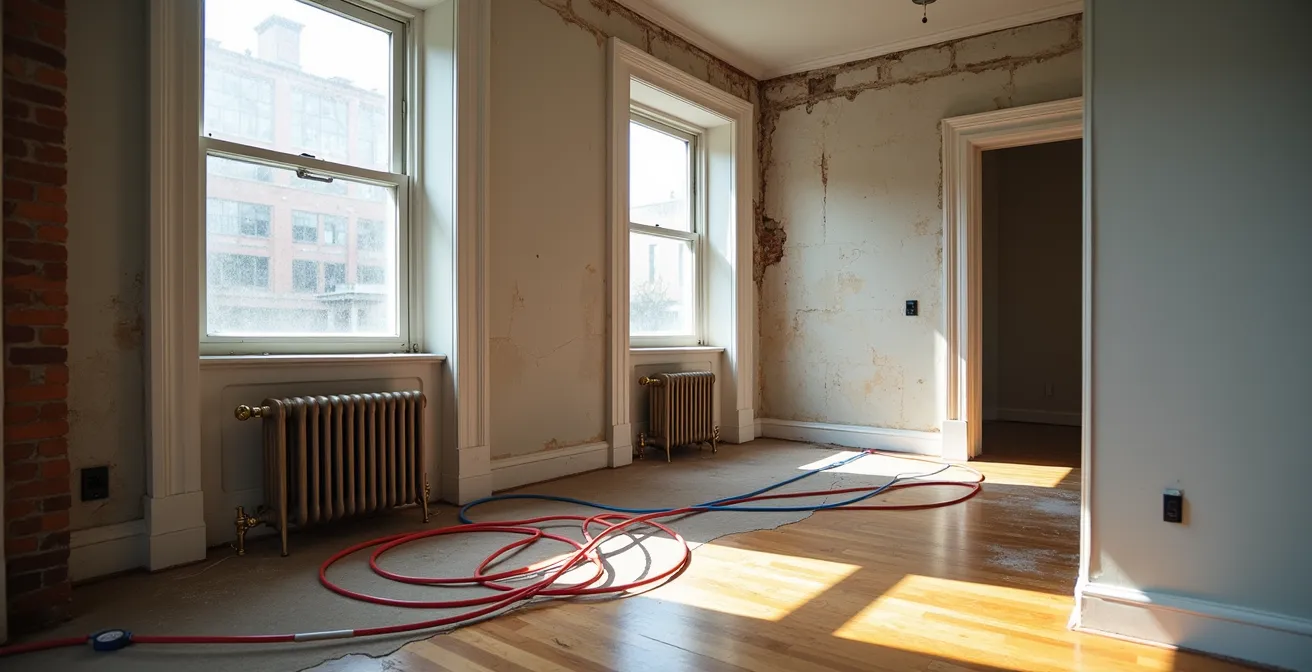
This minimally invasive approach is not just cleaner and faster; it’s often significantly cheaper, as it drastically reduces the labour hours associated with demolition, patching, and painting. It makes the once-unthinkable project of a full-house repipe a feasible and intelligent upgrade for homeowners looking to secure their property for the next 50 years.
Your Action Plan: Minimally Invasive PEX Retrofit
- Map the route: Use a stud finder and an inexpensive endoscope camera to plan the path for the pipes, avoiding electrical wiring and other obstructions without opening the wall.
- Drill strategic access holes: Create small (3/4-inch) holes at the top and bottom plates of walls, ensuring they will be hidden by baseboards or are inside closets.
- Use fish tape or glow rods: Attach the PEX tubing to the end of a fish tape and guide the flexible pipe through the wall cavities, using its ability to bend around gentle obstacles.
- Protect the PEX: Wherever a PEX line must pass through a wooden stud, install steel nail plates to prevent accidental punctures from future drywall screws or nails.
- Minimize patching: Small access holes can often be covered with simple, decorative plumbing escutcheons rather than requiring complex drywall and paint repairs.
PEX vs Cuivre : combien économisez-vous en main-d’œuvre sur une maison complète ?
While the resilience and control of a PEX manifold system are its primary technical advantages, the financial argument is equally compelling. For any auto-constructor or major renovator, the cost savings compared to a traditional copper installation are substantial, primarily driven by a massive reduction in labour. Installing copper is a slow, methodical craft requiring skill in measuring, cutting, cleaning, and soldering every single joint. It’s labour-intensive and requires costly safety equipment, like fire extinguishers and heat shields, for soldering near wooden structures.
PEX installation, by contrast, is dramatically faster. Running a continuous flexible line from a manifold to a fixture can be done in a fraction of the time it takes to build a rigid copper branch. There’s no open flame, fewer complex fittings, and less material waste. This efficiency translates directly into a lower final invoice. As a detailed cost breakdown shows, the savings on a typical Quebec home are not trivial. On top of the upfront installation savings, some Quebec insurers recognize the reduced risk of PEX manifold systems. Homeowners may be eligible for a reduction of 15-20% in water damage deductibles, providing an ongoing financial benefit and acknowledging the superior safety of the system.
The following table illustrates the stark difference in cost for plumbing a standard 1,500 sq.ft. bungalow in Quebec, based on recent material costs and CCQ labour rates.
| Cost Component | PEX System | Copper System | Savings |
|---|---|---|---|
| Materials | $2,500 CAD | $4,800 CAD | $2,300 |
| Labour (40hrs @ CCQ rates) | $3,200 CAD | $6,400 CAD | $3,200 |
| Fittings & Supplies | $400 CAD | $1,200 CAD | $800 |
| Fire Safety Equipment | Not required | $150 CAD | $150 |
| Total Installation | $6,100 CAD | $12,550 CAD | $6,450 |
| 10-Year Maintenance Est. | $500 CAD | $2,000 CAD | $1,500 |
This data, based on a recent comparative analysis, clearly shows that a PEX system can cut the total installation cost by more than half, while also reducing long-term maintenance expenses.
Rénovation post-sinistre : l’occasion de passer au PEX pour ne plus revivre ça
No one wants to experience a major water leak, or *dégât d’eau*. But in the unfortunate event that it happens, the subsequent renovation presents a golden opportunity to upgrade your home’s infrastructure and ensure it never happens again. After a pipe burst, walls and floors are often already opened up for drying and repair, eliminating the biggest barrier to a full repipe. This is the perfect moment to transition from a failure-prone old system to a resilient PEX manifold.
This isn’t just a smart choice; it can also be a financially astute one. Many insurance policies in Quebec contain “betterment” provisions. An astute insurance adjuster may recognize that upgrading to a PEX system is a form of loss mitigation. By investing in a demonstrably safer system, the risk of a future claim is significantly reduced. In such cases, the insurance company may cover the cost of replacing the old system on a like-for-like basis, leaving the homeowner to pay only the marginal difference for the superior PEX manifold system—a small price for immense peace of mind.
This proactive approach turns a disaster into an investment in your home’s future value and safety. It’s about breaking the cycle of repair and replacement and building true hydraulic resilience into the very fabric of your home.
Case Study: A Gatineau Family’s Post-Flood Resilience Upgrade
Following a January pipe burst that caused $45,000 in damage, a Gatineau family worked with their Desjardins insurance adjuster to upgrade their entire plumbing system to PEX with manifold control. According to a report on their experience, the insurance covered the base replacement cost, and the homeowners paid only the $3,000 difference for the superior system. The manifold now allows them to shut off water to vulnerable crawlspace zones during cold snaps, and their insurer even granted a 10% premium reduction in recognition of this proactive measure.
Key Takeaways
- A PEX manifold acts like an electrical panel for water, providing individual control over each fixture.
- PEX-A is the superior choice for the Quebec climate due to its exceptional freeze resistance and shape memory.
- The system dramatically reduces labour costs by over 50% compared to copper and enables minimally invasive retrofits.
Boucle de recirculation vs regroupement : quelle stratégie pour avoir de l’eau chaude en 5 secondes ?
A common side effect of a home-run PEX system can be a slightly longer wait for hot water, as the water from the heater has to travel through a dedicated line to the fixture. For homeowners who value instant comfort, there are two primary strategies to solve this: intelligent design (fixture grouping) and technology (recirculation pumps). For new constructions, the most energy-efficient solution is smart architectural design. By grouping fixtures that need hot water (like a master bathroom and laundry room) close to the water heater, the length of the PEX lines is minimized, resulting in a hot water wait time of only 5-10 seconds with zero additional energy cost.
For existing homes or larger layouts where grouping isn’t possible, a hot water recirculation system is the answer. This involves adding a small, dedicated return line from the furthest fixture back to the water heater and a pump that periodically circulates hot water through the lines. This provides nearly instant hot water, but it comes at an energy cost. A continuously running pump can be wasteful, but modern “smart” pumps with timers or on-demand buttons offer a great compromise. They can be programmed to run only during peak usage times, like mornings and evenings. According to a typical Hydro-Quebec billing impact analysis, a continuous pump can add $120-$180 to your annual electricity bill, while a smart, on-demand system can cut that cost in half while still providing excellent comfort.
| Strategy | Wait Time | Energy Cost | Installation Complexity | Best For |
|---|---|---|---|---|
| Fixture Grouping | 5-10 seconds | No increase | Design phase only | New construction |
| Smart Recirculation | Instant | $60-90/year | Moderate retrofit | Luxury comfort |
| Dedicated Return Line | 2-5 seconds | $120-180/year | Complex retrofit | Large homes |
| Standard Manifold | 15-30 seconds | No increase | Simple | Budget conscious |
Ultimately, the choice depends on balancing the desire for instant comfort with installation complexity and long-term energy costs. For most renovations, a smart recirculation system added to a PEX manifold offers the best of both worlds.
By shifting your perspective and seeing your plumbing not as a set of pipes but as a controllable network, you unlock a new level of confidence in your home. A PEX manifold system is more than a leak-reduction strategy; it’s a fundamental upgrade to your home’s resilience, serviceability, and long-term value. For any renovator or builder in Quebec, embracing this technology is the clear and logical next step in creating modern, intelligent, and worry-free homes.