
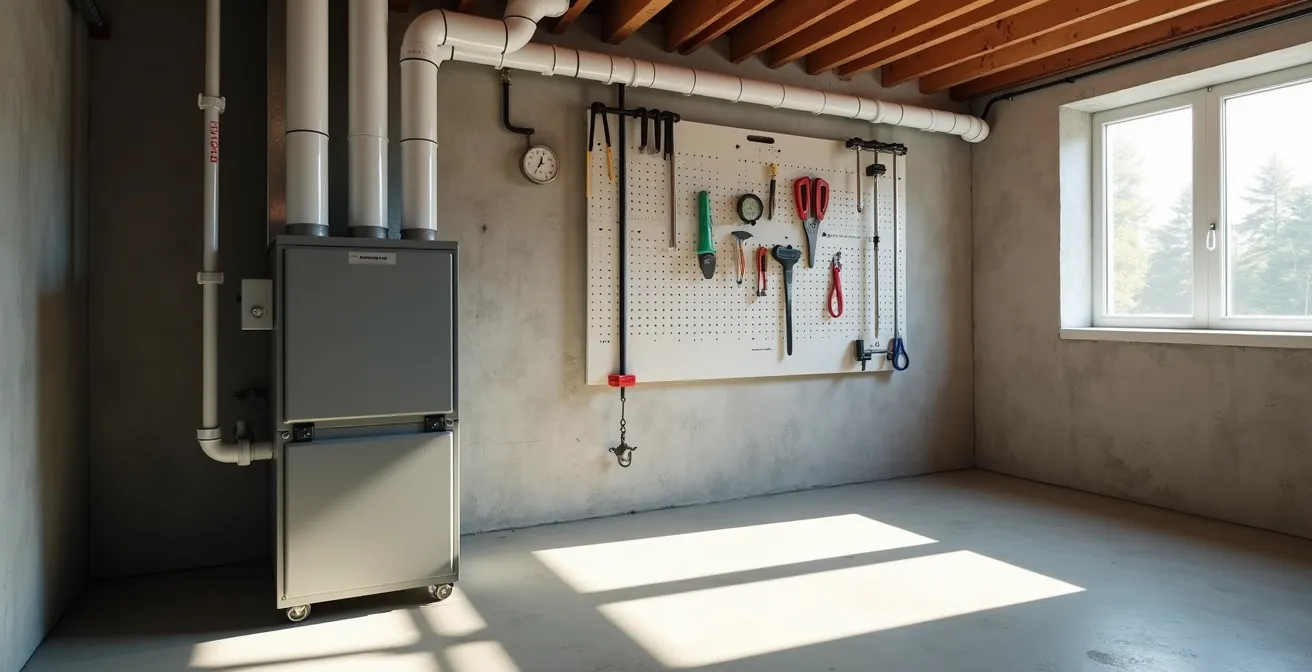
The optimal heating system for a 1980s Quebec bungalow is not the one with the highest efficiency rating, but the one that is correctly sized and integrated into the home’s complete thermal envelope, maximizing long-term return on investment (ROI).
- A 95% AFUE furnace offers a significantly better payback period (4-7 years) than standard models, making it a sound financial choice in Quebec’s climate.
- System sizing is more critical than peak efficiency; an oversized unit will short-cycle, leading to premature wear and reduced comfort.
Recommendation: Prioritize a professional heat loss calculation (Manual J) before selecting any equipment to ensure your investment is engineered for performance, not just specifications.
As the owner of a 1980s bungalow in Quebec, you’re likely facing the dual challenge of aging infrastructure and rising energy costs. Your original furnace, a relic of an era with different energy standards, is probably costing you more than just money; it’s costing you comfort and contributing to a larger carbon footprint. The common advice is to switch to a high-efficiency system, often a modern heat pump or a furnace with a stellar AFUE rating. This advice, while well-intentioned, is dangerously incomplete.
The marketplace is filled with simplistic solutions: “get a heat pump,” “choose the highest efficiency rating,” or “just replace what you have with a modern equivalent.” These approaches ignore a fundamental engineering principle: a home is an integrated system. Your heating equipment does not operate in a vacuum. Its performance is intrinsically linked to your home’s insulation, window quality, and air tightness—what we call the thermal envelope integrity. Simply installing a powerful new system without considering the envelope is like putting a race car engine in a wooden cart; the power is wasted, and the structure is compromised.
But what if the key wasn’t simply chasing the highest AFUE percentage, but rather calculating the optimal systemic ROI? This engineering-first perspective moves beyond the sticker price and the spec sheet. It involves a holistic analysis of your home to select a system that is not just efficient on paper, but perfectly sized and integrated to deliver maximum comfort and the fastest possible payback period in the unique context of Quebec’s demanding climate. This guide is built on that principle.
This article will deconstruct the critical decisions you face, moving from the financial viability of high-efficiency furnaces to the practicalities of converting from oil. We will analyze the nuances of comfort, the costly pitfalls of improper sizing, and the strategies for maximizing the financial assistance available to you as a Quebec resident. Prepare to look at your heating system not as an appliance, but as a calculated investment in your home’s future.
Summary: A Strategic Guide to Upgrading Your 1980s Bungalow’s Heating System
- Why a system rated AFUE 95% is more profitable despite its purchase price
- How to switch from oil to electric without ruining your landscaping
- Forced air or hot water: what comfort to choose for a family that feels the cold
- The oversizing error that wears out your furnace twice as fast
- Cold room problem: how to balance your system without replacing everything
- Oil furnace dismantling: the steps and hidden costs of conversion
- Triple-pane windows: is the investment profitable for the Montreal climate?
- How to Maximize Your Grants from LogisVert and MaPrimeRénov in Quebec?
Why a system rated AFUE 95% is more profitable despite its purchase price
From an engineering perspective, the decision to invest in a high-efficiency furnace is a straightforward ROI calculation. The Annual Fuel Utilization Efficiency (AFUE) rating is a direct measure of how much of your fuel dollar is converted into usable heat. An 80% AFUE furnace, common in older homes, wastes 20 cents of every dollar. A 95% AFUE model wastes only 5 cents. While the initial cost of a 95% unit is higher, the long-term savings in a cold climate like Quebec’s create a compelling business case.
The key is the payback period. Consider a typical 1980s bungalow with an annual heating bill of $1,500 using an 80% AFUE furnace. Upgrading to a 95% model can yield significant annual savings. For instance, in comparable cold climates, data shows that upgrading to 95% AFUE can save homeowners $237 annually. This saving directly counteracts the higher initial investment. The upfront cost difference between a standard and high-efficiency furnace typically ranges from $1,500 to $3,000. By dividing this extra cost by your annual savings, you can calculate your payback period, which is often surprisingly short.
This comparative analysis demonstrates the clear financial advantage of higher efficiency models in a high-demand heating environment like Quebec. The shorter payback period for a 95% AFUE unit makes it the superior long-term investment.
| AFUE Rating | Annual Fuel Cost ($1,500 baseline) | Annual Savings vs 80% | Payback Period |
|---|---|---|---|
| 80% (Standard) | $1,500 | – | – |
| 90% (High Efficiency) | $1,333 | $167 | 9-12 years |
| 95% (Premium) | $1,263 | $237 | 4-7 years |
| 98% (Ultra Premium) | $1,224 | $276 | 7-10 years |
The data clearly shows that the 95% AFUE furnace hits the sweet spot for ROI. While a 98% unit offers slightly more savings, its higher initial cost often extends the payback period, making the 95% model the most financially prudent choice for most homeowners. This calculation doesn’t even factor in provincial and federal grants, which can further shorten this timeline, cementing the profitability of the upgrade.
How to switch from oil to electric without ruining your landscaping
The transition from an oil furnace to an electric system, such as a heat pump, involves more than just swapping indoor equipment. A major consideration, often overlooked until it’s too late, is the placement of the outdoor unit and its impact on your property’s aesthetics and usability. For a 1980s bungalow with established gardens and landscaping, a poorly planned installation can cause significant damage and require costly restoration. The key is strategic placement and selecting a contractor who prioritizes landscape preservation.
Modern heat pumps offer flexibility in placement. They can be mounted on brackets attached to the foundation, placed on a pre-cast concrete pad, or even located at a distance from the house with insulated lines running underground. An experienced HVAC engineer will conduct a site assessment to identify a location that is not only technically optimal for performance (ensuring proper airflow and service access) but also minimally disruptive. This might mean placing the unit on a less visible side of the house or integrating it behind existing shrubbery. The goal is to make the unit a discreet part of the home’s exterior, not a focal point.
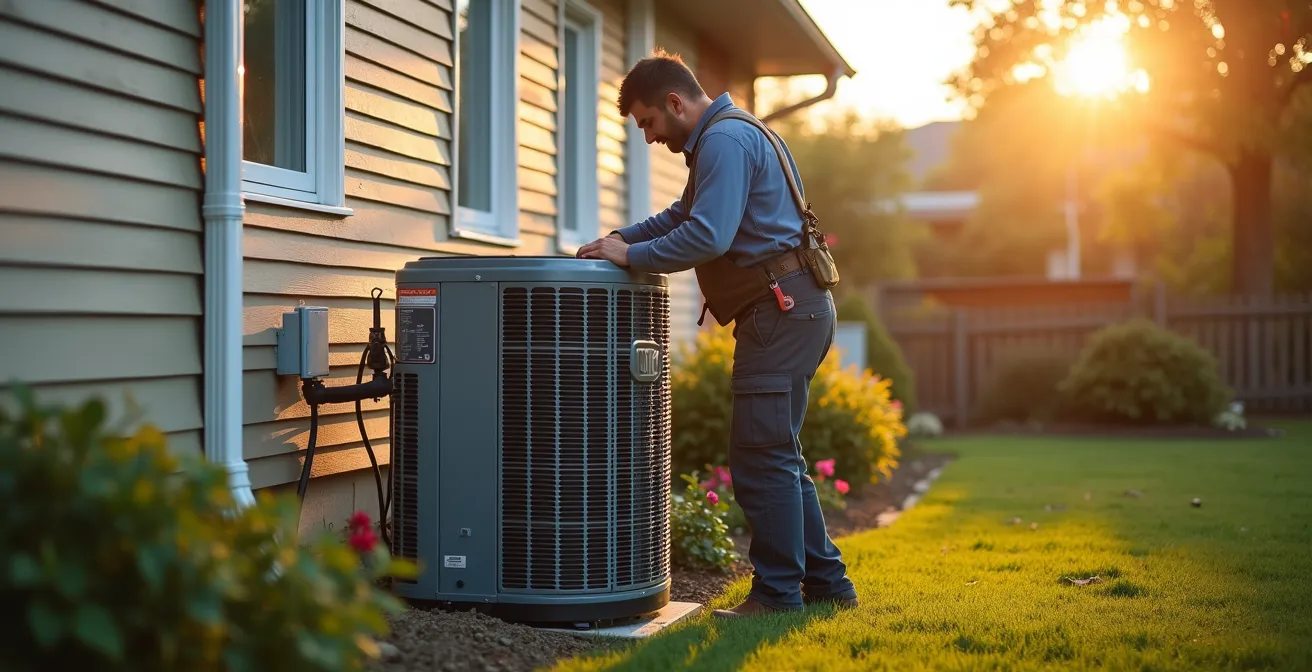
As the image demonstrates, careful planning allows the outdoor unit to be installed with zero impact on mature flower beds and landscaping. This requires precise coordination, from choosing the unit’s location to planning the route for refrigerant lines and electrical wiring. Discussing your landscaping concerns with your contractor upfront is crucial. Specify that preservation is a priority and ensure the installation plan reflects this. A reputable installer will see this as a standard part of delivering a professional, high-quality service, not an additional burden.
Forced air or hot water: what comfort to choose for a family that feels the cold
Choosing between a forced-air (air pulsé) and a hydronic (eau chaude) system is one of the most significant decisions for a family sensitive to cold, as it directly impacts the quality of thermal comfort. With data showing that heating costs in Quebec represent nearly 60% of the total energy bill, this choice has major financial and comfort implications. The two systems deliver heat in fundamentally different ways, each with distinct advantages for a 1980s bungalow.
Forced-air systems, typically using a furnace or a central heat pump, distribute heat quickly throughout the house via ductwork. This allows for rapid temperature adjustments and provides the integrated benefit of air filtration, humidification, and central air conditioning through the same ducts. However, it can create drafts and temperature stratification (cooler air near the floor, warmer air near the ceiling), which can be uncomfortable for those who are particularly sensitive to cold. The air can also feel dry if not properly humidified.
Hydronic systems, which circulate hot water through radiators or in-floor radiant tubing, provide what many consider a superior form of comfort. The heat is primarily radiant, warming objects and people directly, much like the sun. This creates a gentle, even warmth with no drafts or noise from blowing air. As Natural Resources Canada points out, it’s a particularly good match for modern technology:
Air-water heat pumps operate more efficiently when heating the water to lower temperatures, i.e., below 45 to 50°C, and as such are a better match for radiant floors or fan coil systems
– Natural Resources Canada, Heating and Cooling With a Heat Pump Guide
This synergy makes hydronic heating an excellent, highly efficient choice. A detailed comparison from a trusted source like CAA-Quebec can help clarify the trade-offs in your decision-making process.
| System Type | Comfort Level | Installation Cost | Best For |
|---|---|---|---|
| Forced Air | Even heat distribution, integrated A/C possible | Lower for existing ducts | Whole-home comfort with filtration needs |
| Hydronic (Hot Water) | Superior radiant comfort, no drafts | Higher retrofit cost | Cold-sensitive families, basement heating |
| Electric Baseboard | Uneven heat, takes wall space | Lowest upfront | Budget-conscious, room-by-room control |
For a family that feels the cold, the consistent, draft-free radiant warmth of a hydronic system is often the winning choice, despite its higher installation cost in a retrofit scenario. It provides a more stable and deeply felt comfort that forced-air systems struggle to replicate.
The oversizing error that wears out your furnace twice as fast
One of the most common and costly mistakes in HVAC replacement is system oversizing. It stems from an outdated “rule of thumb” approach where contractors estimate a home’s heating needs based on square footage alone, often padding the number to be “safe.” This is a critical error. In an engineering context, an oversized furnace or heat pump is just as bad as an undersized one. It leads to a phenomenon called short-cycling, where the system turns on, quickly heats the space, and shuts off, repeating this cycle frequently. This constant starting and stopping inflicts massive wear and tear on components like the blower motor and ignition system, drastically reducing the unit’s lifespan and efficiency.
The correct approach is a detailed heat loss calculation, known as a Manual J calculation. This analysis considers all the specific factors of your 1980s bungalow: the quality of its insulation, the type and age of its windows, the rate of air leakage, its orientation to the sun, and the specific climate data for your part of Quebec. As an Ontario HVAC analysis relevant to Quebec’s climate found, systems sized for extreme -30°C “worst-case” days without a proper Manual J calculation operate inefficiently for the vast majority of the winter. A properly sized system is designed to run for longer, more consistent cycles, providing even temperatures and operating at its peak efficiency.
As a homeowner, you are the first line of defense against this costly error. Being able to spot the warning signs that a contractor is not performing their due diligence is crucial. An engineer’s approach demands data, not guesswork. If your contractor cannot provide a detailed heat loss calculation report, it’s a major red flag.
Your Checklist: Spotting the Red Flags of an Oversized System
- Quotation Process: The contractor relies solely on “rules of thumb” like BTUs per square foot and doesn’t perform a detailed home evaluation.
- System Operation: The new system cycles on and off very frequently (less than 10-minute cycles) even on moderately cold days.
- Comfort Level: You notice significant temperature swings of 3°C or more between heating cycles, with the house getting too hot then too cold.
- Noise and Wear: The system is excessively loud due to the frequent starts and stops.
- Summer Performance (for Heat Pumps/AC): The system runs for such short periods that it fails to properly dehumidify the air, leaving it feeling cool but clammy.
Insisting on a Manual J calculation is not an unnecessary expense; it’s the most important investment you can make to protect your new, expensive equipment and ensure you actually get the comfort and efficiency you’re paying for.
Cold room problem: how to balance your system without replacing everything
Even with a new, perfectly sized heating system, many owners of 1980s bungalows still struggle with a common issue: uneven heating, with some rooms being too warm while others remain stubbornly cold. This is rarely a fault of the furnace or heat pump itself. Instead, it’s almost always a problem of air distribution—an unbalanced forced-air system. Before considering expensive solutions like supplemental heaters or duct modifications, you can often solve the problem yourself with some basic adjustments.
The ductwork in your basement is the highway for your home’s heated air, and it’s equipped with traffic controls: dampers. These are small levers on the round ducts leading to different rooms, designed to regulate airflow. By strategically adjusting these dampers, you can redirect air from rooms that are too warm to the rooms that are too cold, effectively balancing the entire system. The process is methodical but simple: start with all dampers fully open, then slightly close the dampers on the ducts leading to the warmest rooms. This increases the static pressure in the system, forcing more air to the under-served, colder areas of your home.
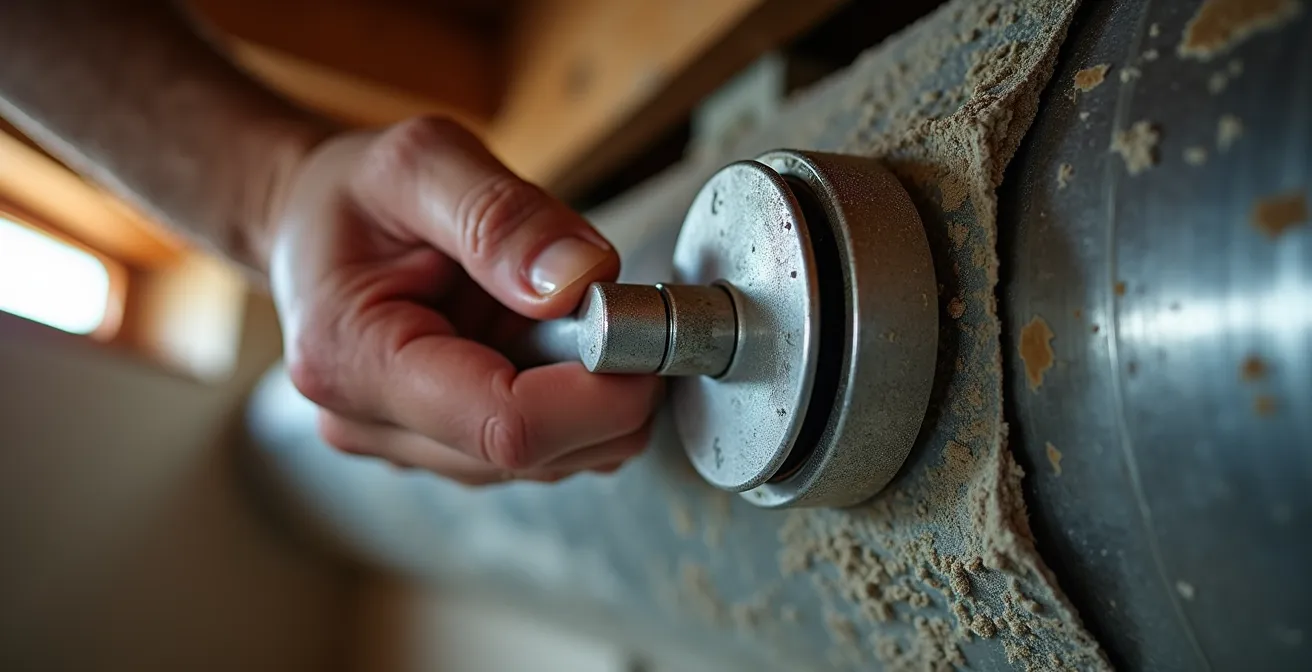
This hands-on adjustment is the most effective first step. As highlighted by Hydro-Québec, there are several simple, no-cost actions you can take to improve system balance and overall efficiency:
- Ensure all vents and registers are clean and not blocked by furniture or rugs.
- Start by locating and adjusting the ductwork dampers in your basement.
- Use the “Constant Fan” setting on your thermostat to circulate air continuously, which helps mix the air and even out temperatures.
- Check and clean your furnace filter monthly during the heating season, as a clogged filter severely restricts airflow.
These simple maintenance and adjustment steps can resolve most common temperature imbalance issues. Only after these have been exhausted should you consider more complex solutions. A balanced system not only improves comfort but also ensures your furnace operates more efficiently, saving you money in the long run.
Oil furnace dismantling: the steps and hidden costs of conversion
Converting from oil to an electric system is a major step towards reducing your carbon footprint, but the process is far more complex than a simple equipment swap. The “conversion pathway” involves a series of mandatory steps and potential hidden costs, particularly related to the decommissioning of your old oil tank. Understanding this sequence is critical for a smooth and legally compliant project in Quebec.
The first major task is the safe removal and disposal of the oil tank. This is not a DIY job. In Quebec, this work must be handled by contractors certified by the MELCC (Ministère de l’Environnement et de la Lutte contre les changements climatiques). If you have an underground tank, the process is even more involved, requiring excavation and mandatory soil testing to check for contamination. If a leak is found, you are responsible for the soil remediation costs, which can quickly run into thousands of dollars. This is the single biggest “hidden cost” of an oil-to-electric conversion.
The second critical step is often a main electrical panel upgrade. A 1980s bungalow may have a 100A or 125A panel, which is often insufficient to handle the load of a modern all-electric heat pump, especially with electric backup heat. Upgrading to a 200A service is a common requirement, an expense that can cost between $2,000 and $4,000. This must be factored into your total project budget from the start. A complete conversion timeline typically takes 8-12 weeks, from the initial Rénoclimat audit to the final installation, and requires careful coordination between your HVAC contractor, the tank removal specialists, and an electrician. While programs exist to offset these costs, such as how Hydro-Quebec offers up to $22,000 in assistance for specific technologies like Electric Thermal Storage (ETS), a clear understanding of the total cost is vital.
Triple-pane windows: is the investment profitable for the Montreal climate?
When planning a major energy efficiency upgrade, homeowners often face a critical choice: should I invest my budget in a new heating system or in new windows? This brings us back to the concept of the thermal envelope integrity. From an ROI perspective in a cold climate like Montreal’s, the answer is usually clear: prioritize the HVAC system first. While high-performance windows are an essential part of a truly efficient home, their payback period is significantly longer than that of a heating system upgrade.
Triple-pane windows offer superior comfort by eliminating drafts and reducing condensation. They create a much more pleasant living space near the window area during cold winter days. However, their direct impact on annual energy savings is often modest compared to their high upfront cost. A full window replacement on a 1980s bungalow can easily cost $15,000 to $25,000 or more. The resulting energy savings might only be a few hundred dollars per year.
Let’s analyze the systemic ROI of a hypothetical $15,000 investment. As the following data shows, putting that money toward a high-efficiency heating system yields a much faster financial return.
| $15,000 Investment | Annual Energy Savings | Comfort Benefits | Payback Period |
|---|---|---|---|
| Triple-Pane Windows | $200-300 | Eliminates drafts, reduces condensation | 50-75 years |
| 95% AFUE Furnace + Heat Pump | $400-600 | Consistent temps, A/C included | 25-37 years |
| Cold-Climate Heat Pump Only | $300-500 | Heating & cooling, quiet operation | 30-50 years |
The numbers demonstrate that an investment in a modern, dual-fuel system (a high-efficiency gas furnace paired with a cold-climate heat pump) delivers roughly double the annual energy savings, effectively halving the payback period compared to windows. The optimal strategy, therefore, is to upgrade the HVAC system first. The improved efficiency of new windows is still valuable, as better windows directly impact the required size (and cost) of a new heating system. Better windows allow for a smaller, less expensive, and more efficient furnace or heat pump. The ideal long-term plan is to do both, but from a purely financial standpoint, the heating system should be the priority.
Key Takeaways
- The ROI of a 95% AFUE furnace in Quebec is superior to other models, with a payback period of just 4-7 years.
- System oversizing is a critical error; a proper Manual J heat loss calculation is non-negotiable to ensure equipment longevity and efficiency.
- The oil-to-electric conversion pathway is a multi-step project involving certified tank removal, potential soil remediation, and likely a costly electrical panel upgrade.
How to Maximize Your Grants from LogisVert and MaPrimeRénov in Quebec?
Navigating the landscape of financial incentives is a critical step in reducing the upfront cost of your heating system upgrade. While the LogisVert program is a cornerstone of Quebec’s financial aid, it’s crucial to note that MaPrimeRénov is a program exclusive to France and is not available in Quebec. This section will therefore focus on the effective strategies for maximizing the actual grants available to Quebec homeowners. Success depends on understanding the sequence of applications and how to “stack” different programs.
The strategy is not simply to apply for grants, but to follow a specific, mandatory order. For most major programs, the process must begin with a pre-retrofit evaluation from a Rénoclimat advisor. This audit, which has a nominal fee, is the gateway to accessing many other grants. Attempting to install your system first and apply for grants later will almost certainly result in ineligibility. After the installation by a certified contractor using eligible equipment (found on the NEEP list), you can submit your applications.
The real power comes from stacking multiple grants from different levels of government and utility providers. For example, a single heat pump installation could be eligible for funding from several sources simultaneously. The primary provincial grant is LogisVert from Hydro-Québec, where Hydro-Quebec’s LogisVert program provides up to $6,700 for eligible heat pumps. This can be combined with federal programs like the interest-free Canada Greener Homes Loan. Furthermore, if you are converting from oil and meet certain income criteria, you may be eligible for the federal Oil to Heat Pump Affordability Program. The key is to meticulously check the eligibility criteria for each program. A strategic approach to grants can reduce the net cost of your project by 50% or more.
The Grant Stacking Pathway for Quebec Homeowners:
- Start with a Rénoclimat Audit: This pre-work evaluation is the mandatory first step for most programs.
- Apply for LogisVert: Submit your application to Hydro-Québec within 9 months of your heat pump installation.
- Check Federal Programs: Look into the Canada Greener Homes Loan (interest-free financing) and the Oil to Heat Pump Affordability Program (if applicable).
- Explore Dual-Energy Grants: If you are installing a dual-energy system with natural gas, check for conversion grants from Energir.
- Verify Contractor and Equipment: Ensure your contractor holds a valid RBQ license and all equipment is on an official eligibility list (e.g., NEEP) before signing any contract.
This methodical process transforms grant applications from a confusing chore into a powerful financial strategy, maximizing the return on your high-efficiency investment.
Ultimately, upgrading the heating system in your 1980s bungalow is an engineering project with significant financial implications. By adopting a data-driven approach that prioritizes a professional heat loss calculation, a proper ROI analysis, and a strategic plan for grant applications, you move from being a consumer to being an informed investor in your own property. The next logical step is to commission a professional heat loss calculation to ensure your investment is precisely tailored to your home’s unique thermal signature and not based on guesswork.