
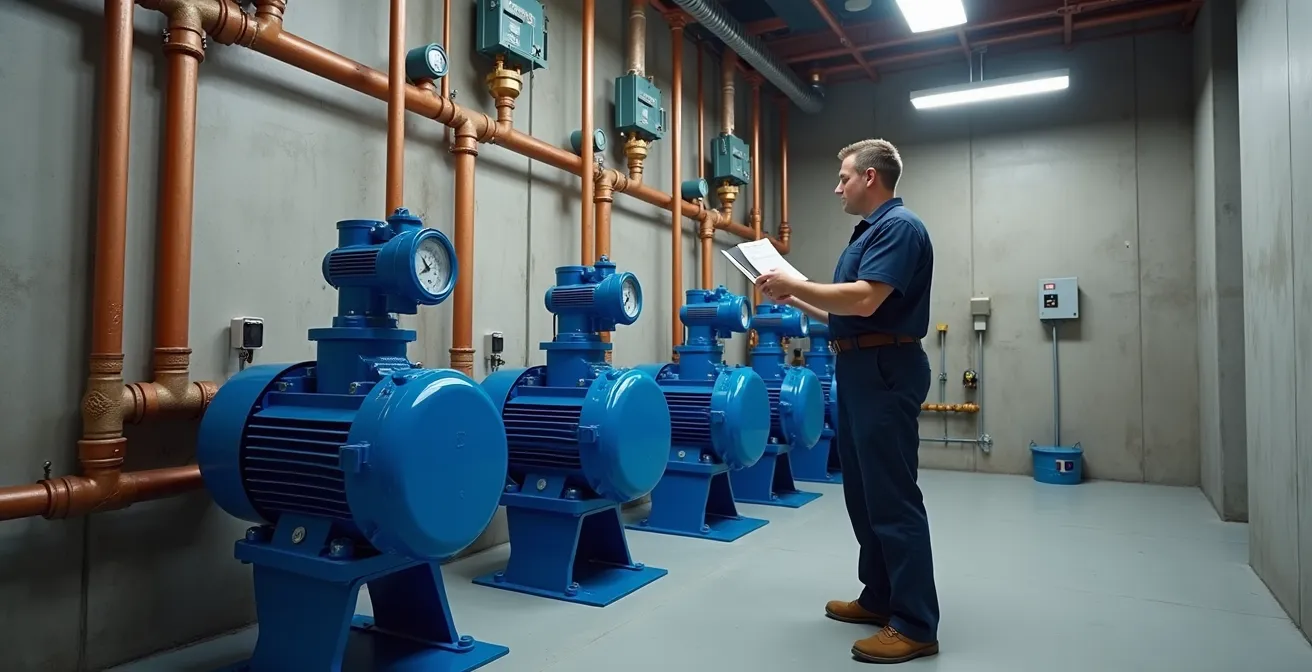
The key to solving chronic water pressure complaints in a multi-story building is to stop treating symptoms and implement a systemic, building-wide asset management plan.
- Most “fixes” address individual units, ignoring the interdependent nature of a high-rise’s vertical plumbing ecosystem.
- Component choices, like full-port versus standard valves, have a direct and significant impact on both water pressure and long-term operational costs.
- Proactive auditing and strategic budgeting, guided by Quebec’s Bill 16, are non-negotiable for preventing catastrophic failures and financial liability.
Recommendation: Shift immediately from a reactive repair model to a proactive one by commissioning a complete engineering assessment of your plumbing risers and an official contingency fund study (‘étude du fonds de prévoyance’).
As a property manager for a Montreal condo building, you’re likely caught in a frustrating cycle. Residents on the top floors complain about weak showers, while those on the lower floors report strange noises or even damaged washing machine hoses. The typical response involves a series of one-off plumbing calls, patching leaks, and adjusting individual fixtures. You might be told to “check the aerators” or that a specific leak is “just due to old pipes.” These are symptoms, not solutions.
This approach is not only inefficient; it’s financially hazardous. Each isolated repair fails to address the core physics of a ten-story vertical plumbing system. The pressure required to serve the penthouse is fundamentally different from the pressure delivered to the lobby. Ignoring this systemic reality leads to recurring problems, escalating emergency repair costs, and dissatisfied co-owners. The constant firefighting distracts from the real, underlying issue: the building’s plumbing is a single, complex asset that is deteriorating as a whole.
But what if the answer wasn’t in chasing the next leak, but in proactively managing the entire vertical ecosystem? The true solution lies in adopting an engineer’s mindset. It requires understanding that your building’s plumbing is an interdependent system governed by the laws of physics and, in Quebec, the strict financial planning requirements of Bill 16. This is not about fixing pipes; it’s about managing a critical piece of infrastructure to ensure its reliability and protect its financial value.
This guide provides a strategic framework for condominium syndicates and property managers. We will dissect the most common and costly high-rise plumbing failures, explore the engineering principles behind them, and lay out a clear, actionable path for long-term budgeting and maintenance. By the end, you will have a new lens through which to view your building’s plumbing—not as a source of problems, but as a manageable asset.
Summary: An Engineer’s Guide to High-Rise Water Pressure Management
- Why Does a Riser Leak Cost 10 Times More Than a Normal Leak?
- Water Noise in Walls: How to Acoustically Insulate Drain Stacks?
- When to Replace Cast Iron or Copper Risers in a 40-Year-Old Building?
- Floor-by-Floor Shut-Off Valves: The Investment That Avoids Cutting Water to 100 Families
- How to Detect a Micro-Leak in a Technical Shaft Before It Breaks Through the Ceiling?
- Excessive Water Pressure: Why Does It Damage Your Appliances?
- Full Port Valves: Why Are They Crucial for Maintaining Water Pressure?
- How to Budget for Plumbing Replacements Over the Next 10 Years?
Why Does a Riser Leak Cost 10 Times More Than a Normal Leak?
A leak under a kitchen sink is an inconvenience. A leak in a vertical riser—the main water supply or drainage pipe that runs through the height of the building—is a financial catastrophe. The cost isn’t in the pipe repair itself, but in the extensive, multi-floor collateral damage. Water from a failed riser on the 8th floor doesn’t just damage that unit; it travels down through walls, ceilings, and floors, affecting every unit in its path all the way to the ground floor. This creates a cascade of restoration projects, from drywall and flooring replacement to electrical system inspections and mould remediation across multiple properties.
The financial stakes are immense. Consider that in a major Canadian city like Toronto, the Toronto Regional Real Estate Board reports the average condo price can be substantial, representing a significant asset at risk from water damage. The cost differential is amplified by insurance realities. A single major riser failure will almost certainly trigger the syndicate’s master insurance policy, which in Quebec, often comes with a hefty price tag. In fact, it’s common for condo building insurance deductibles to exceed $25,000. This cost is then borne by all co-owners, on top of the disruption and potential for special assessments.
Furthermore, emergency repairs are exponentially more expensive than planned work. They demand premium rates from plumbers and restoration crews, often requiring work outside of normal hours. The complexity of accessing pipes within concrete shafts adds significant labour costs. Unlike a simple leak, a riser failure is a multi-unit, multi-trade, and high-stakes emergency that can easily cost hundreds of thousands of dollars, making proactive replacement an exercise in sound financial management.
Water Noise in Walls: How to Acoustically Insulate Drain Stacks?
Constant gurgling, rushing, or dripping sounds from within the walls are a common complaint in multi-story buildings, severely impacting residents’ quality of life. This noise isn’t a sign of a leak but of normal water flow through the main vertical drain stacks. In older Montreal buildings constructed with cast iron pipes, this sound transmission is particularly pronounced. The problem lies not with the pipes themselves, but with the lack of acoustic insulation and decoupling from the building structure.
Effective acoustic insulation is a two-part process. The first is wrapping the pipes directly with a dense, sound-absorbing material. The gold standard is high-density mineral wool or specialized acoustic pipe lagging. This material absorbs the airborne noise generated by turbulent water flow inside the pipe. Simply using standard thermal insulation is ineffective, as it lacks the necessary mass to block sound waves. The key is density and complete coverage, ensuring no gaps are left at joints or bends.
The second, and equally crucial, step is structural decoupling. This involves using resilient isolation clips to mount the pipes, preventing vibrations from transferring directly from the pipe to the studs and drywall. Without this, the pipe itself acts like a tuning fork, turning the entire wall assembly into a speaker. As an example from a case study involving a 1912 Montreal building, engineers found that combining pressure balancing with proper acoustic insulation solved both noise and water flow issues endemic to the city’s older high-rises. This shows that noise is a systemic issue, not just an annoyance.

As the image demonstrates, the meticulous application of thick, fibrous insulation directly onto the pipe is fundamental. This process, combined with isolating the pipe from the building’s frame, is the only way to truly silence water noise in walls, transforming a noisy unit into a peaceful one and protecting property values.
When to Replace Cast Iron or Copper Risers in a 40-Year-Old Building?
For a condominium built in the 1970s or 80s, the question isn’t *if* the main plumbing risers will fail, but *when*. At 40+ years, both cast iron and copper systems are well into the second half of their expected service life and are operating on borrowed time. Procrastination is a gamble against physics. As one beleaguered board president noted in a RAND Engineering study, “We put this off as long as we could, because it was the most disruptive and the most expensive.” That delay ultimately leads to a far more disruptive and expensive emergency.
We put this off as long as we could, because it was the most disruptive and the most expensive.
– Board President Bischoff, RAND Engineering Study on Riser Replacement
The timeline from the first signs of trouble—like reduced flow or discoloured water—to a catastrophic failure can be deceptively long, lulling a syndicate into a false sense of security. However, data from one Montreal co-op documented that this period can be as short as 12 years from the initial warning signs to a full-blown crisis. Waiting for visible leaks is a failed strategy; by then, the internal corrosion has likely rendered the pipe walls paper-thin and a major breach is imminent. A proactive camera inspection of all risers is the only way to accurately assess their true internal condition.
Different materials present different risks at this age, but none are immune. The following table, based on industry data, provides a clear framework for decision-making in a typical 40-year-old Montreal high-rise.
| Pipe Material | Expected Lifespan | Common Issues in 40-Year Buildings | Replacement Urgency |
|---|---|---|---|
| Cast Iron (Fonte) | 50-75 years | Internal corrosion, paper-thin walls, rust buildup | High – Immediate assessment needed |
| Copper (Cuivre) | 50-70 years | Pinhole leaks, joint failures, green patina | Medium – Monitor closely |
| Galvanized Steel | 40-50 years | Severe corrosion, reduced flow, rust in water | Critical – Replace immediately |
As this comparative analysis shows, galvanized steel is a critical immediate replacement, while cast iron requires urgent assessment. Delaying replacement is not saving money; it’s merely deferring a much larger, inevitable, and uncontrolled expense.
Floor-by-Floor Shut-Off Valves: The Investment That Avoids Cutting Water to 100 Families
Imagine a leak on the 7th floor of a 10-story, 100-unit building. Without floor isolation valves, the only way to stop the water is to shut off the main supply in the basement. This immediately cuts off water to all 100 families, turning a single-unit problem into a building-wide crisis. Residents can’t shower, flush toilets, or cook. This scenario is not just inconvenient; it creates immense frustration and can last for hours or even days, depending on the repair complexity. This is the reality in many older Montreal condo towers that lack a modern, segmented plumbing design.
Installing shut-off valves on the main risers for each floor is one of the single most impactful infrastructure investments a syndicate can make. This strategic upgrade transforms emergency response. With floor isolation valves, that same leak on the 7th floor requires only shutting off the water to that specific floor (or even a single vertical stack of units). The other 90+ units in the building are completely unaffected. The repair can be conducted in a controlled manner, minimizing disruption and resident complaints.
The return on investment (ROI) for this project is not measured in years, but in avoided disasters. The cost of retrofitting these valves is a planned, predictable capital expense. The cost of not having them is an unplanned, catastrophic emergency expense. When you factor in the potential for a single avoided insurance claim—with its $25,000+ deductible common in Quebec—the project often pays for itself after preventing just one major incident. This investment shifts the building from a state of high risk to one of manageable, segmented control, which is the cornerstone of modern high-rise plumbing management.
How to Detect a Micro-Leak in a Technical Shaft Before It Breaks Through the Ceiling?
The most destructive leaks are the ones you don’t see. A slow, silent micro-leak from a pinhole in a copper pipe or a failing joint inside a concrete technical shaft can go undetected for months. By the time a water stain appears on a resident’s ceiling, significant structural damage, corrosion, and mould growth have already occurred behind the walls. Relying on visual signs from residents is a purely reactive strategy that guarantees extensive and costly repairs. The key is proactive detection using modern technology.
Two primary technologies have revolutionized early leak detection in high-rises. The first is thermal imaging inspection. Certified technicians use infrared cameras to scan walls and ceilings along the path of the plumbing risers. A hidden leak, even a small one, creates a subtle temperature anomaly as the moisture cools the surrounding material through evaporation. This allows an expert to pinpoint the exact location of a developing problem long before any water becomes visible, turning a potential disaster into a minor, targeted repair.

The second, and even more powerful, approach is the implementation of IoT-based smart water monitoring systems. As one Montreal-based property management firm demonstrated, these systems provide 24/7 protection. Small sensors installed on the main water lines continuously monitor flow patterns. They can detect minute changes in flow that indicate a micro-leak and can even automatically shut off the water to a specific zone if an anomaly persists. This proactive stance, combining periodic thermal inspections with constant electronic monitoring, has saved thousands in repair costs by transforming leak detection from a guessing game into a precise science.
Excessive Water Pressure: Why Does It Damage Your Appliances?
While low pressure is a common complaint, excessively high water pressure is a silent killer of plumbing systems and appliances. In a high-rise, a powerful booster pump system is necessary to get water to the top floors. However, if not properly regulated, this can deliver dangerously high pressure to the lower floors. Most residential appliances, like dishwashers, washing machines, and the internal components of modern refrigerators (ice makers, water dispensers), are designed to operate within a specific pressure range, typically between 40 and 80 PSI. When pressure consistently exceeds this limit, it puts constant, undue stress on every seal, gasket, and hose.
This sustained high pressure acts like a slow-motion-but-unstoppable force. It causes flexible supply hoses on washing machines to bulge and burst, leading to major floods. It forces water past the solenoid valve seals in dishwashers, causing them to overfill or leak. It can damage the delicate internal workings of an ice maker and even lead to “water hammer”—a loud banging noise in the pipes when a valve shuts off quickly, which sends a damaging shockwave through the system. For a property manager, this translates into a constant stream of service calls that seem unrelated but all stem from one root cause: unregulated building-wide pressure.
Crucially, this is not just a maintenance issue; it’s a liability issue. Manufacturers’ warranties for most major appliances are voided if the appliance is operated in an environment where water pressure exceeds their specified maximum (usually 80 PSI). Therefore, when an appliance fails prematurely due to high pressure, the co-owner may find their warranty claim denied, leading to disputes with the syndicate. It is the syndicate’s responsibility to provide water within a safe operating pressure. Failure to install and maintain pressure-reducing valves (PRVs) on the lower floors exposes the co-ownership to financial liability for damaged resident property.
Full Port Valves: Why Are They Crucial for Maintaining Water Pressure?
Not all valves are created equal, and choosing the wrong type can inadvertently choke your building’s entire water supply. The critical distinction lies between a standard port valve and a full port (or full bore) valve. The difference is simple but has massive implications for water flow and pressure. A full port valve has an opening (the “bore”) that is the same diameter as the pipe it’s connected to. A 1-inch full port valve has a 1-inch hole. It creates virtually no restriction.
A standard port valve, however, has an opening that is one size smaller than the pipe. A 1-inch standard port valve forces all of the water through a 3/4-inch hole. As one Montreal Master Plumber aptly described it, this is like “forcing the flow of the Lachine Rapids through a garden hose.” This restriction creates significant friction loss, which directly translates to a drop in water pressure on the other side of thevalve. When these restrictive valves are used on main risers or floor isolation lines, their impact is cumulative, causing significant pressure loss by the time water reaches the upper floors.
A standard port valve on a 1-inch pipe forces all your water through a 3/4-inch opening. It’s like forcing the flow of the Lachine Rapids through a garden hose.
– Montreal Master Plumber, Professional Plumbing Standards Guide
While standard port valves may be slightly cheaper upfront, they represent a classic case of false economy. The flow restriction forces the building’s booster pumps to work harder to overcome the resistance, leading to higher energy consumption and increased wear and tear on the pumps. For property managers, the long-term consequences are higher utility bills and more frequent, costly pump repairs or replacements.
| Valve Type | Flow Restriction | Pressure Loss | Long-term Cost Impact | Best Application |
|---|---|---|---|---|
| Full Port Ball Valve | No restriction | Minimal (< 1 PSI) | Lower energy costs, longer lifespan | Main lines, floor isolation valves |
| Standard Port Valve | 25-30% restriction | Significant (3-5 PSI) | Higher pumping costs, pressure complaints | Branch lines only |
As the data clearly shows, specifying full port ball valves for all critical points in the main water distribution system is a non-negotiable aspect of sound engineering. It is a fundamental choice that directly impacts system efficiency, resident satisfaction, and the building’s long-term operating budget.
Key Takeaways
- A building’s plumbing is a single, interdependent ecosystem, not a collection of separate parts. Problems are systemic, not isolated.
- Proactive auditing and planned replacement based on engineering assessments are financially superior to reactive emergency repairs.
- Every component choice, from pipe material to valve type, has a direct and measurable impact on long-term operating costs and property value.
How to Budget for Plumbing Replacements Over the Next 10 Years?
Shifting from a reactive to a proactive plumbing management strategy requires a robust, long-term financial plan. For a Quebec condominium syndicate, this isn’t just good practice—it’s a legal obligation under Bill 16, which mandates the commissioning of a comprehensive contingency fund study (‘étude du fonds de prévoyance’). This study, performed by qualified professionals like engineers, forms the bedrock of your 10-year (and longer) budget. It moves the conversation from “if” a replacement is needed to “when” and “how much” to allocate for it.
The budgeting process must be data-driven. It begins with a complete inventory and condition assessment of the entire plumbing asset, including camera inspections of all risers. This provides a clear picture of what needs to be replaced and on what timeline. Costs must then be projected, factoring in materials, labour from CMMTQ-certified plumbers (whose rates can vary), permits, and a crucial 15-20% contingency for unforeseen issues discovered during renovation. A large-scale project, like the successful multi-year booster pump upgrade at a DoubleTree hotel, highlights that success hinges on meticulous planning and clear communication.
This long-term financial plan is not a static document. It must be a living budget, reviewed annually and presented transparently to the assembly of co-owners (‘assemblée des copropriétaires’). By showing a clear, phased replacement schedule, the syndicate can justify the necessary annual contributions to the contingency fund, ensuring the money is there when needed. This approach prevents the shock of massive special assessments and protects the co-ownership from the financial and logistical chaos of catastrophic system failure.
Your 10-Year Plumbing Budget Action Plan for Quebec Syndicates
- Commission a professional contingency fund study (‘étude du fonds de prévoyance’) as required by Quebec’s Bill 16.
- Obtain a full engineering assessment of all riser pipes and common plumbing elements from a qualified firm.
- Conduct a comprehensive camera inspection of all drain stacks and supply risers to determine their real internal condition.
- Create a detailed inventory of all common-element plumbing, noting materials, ages, and condition ratings.
- Develop a phased replacement schedule that prioritizes the highest-risk sections of the building first.
- Calculate projected material and labour costs, comparing options like PEX-A vs. Copper for your specific building’s needs.
- Incorporate a 15-20% contingency fund into the total project cost to cover unforeseen structural or access issues.
- Research and present financing options for large-scale projects from institutions like Desjardins or the National Bank of Canada.
- Present a comprehensive 25-year capital expenditure projection to the assemblée des copropriétaires for full transparency.
- Establish and approve the required annual contributions to the contingency fund to finance the plan without resorting to emergency measures.
To secure your building’s future and move from a state of constant crisis to one of control, the next logical step is to engage a qualified engineering firm to begin the process outlined in this plan. Commissioning your contingency fund study is not an expense; it is the most critical investment you can make in your property’s long-term stability and value.
Frequently Asked Questions About High-Rise Plumbing
What water pressure range is typical for high-rise buildings?
Water pressure in high-rise buildings typically ranges from 40 to 80 PSI. However, this can vary significantly based on the building’s height, the type and configuration of its pump systems, and the specific floor level being measured. Lower floors require pressure-reducing valves to stay within this safe range.
How often should condo plumbing systems be inspected?
Annual inspections by a qualified professional are highly recommended as a baseline to prevent major issues. For buildings older than 25 years, more frequent or more detailed inspections, such as periodic camera inspections of drain stacks, should be considered as part of a proactive maintenance program.
Can high water pressure void appliance warranties?
Yes, absolutely. Most appliance manufacturers specify a maximum operating water pressure, typically 80 PSI. Sustained pressure above this level can be considered improper operating conditions, which can not only cause premature failure of dishwashers, washing machines, and ice makers but can also give the manufacturer grounds to void the warranty.